Fluid Mechanics
Engineering Academy
Learn Without Limits: Free Engineering Courses
Pre-recorded video course. Watch anytime at your own pace.
FREE
1 already enrolled!
Advanced course for professionals
Anytime Learning
Learn from Industry Expert
Career Option Guideline
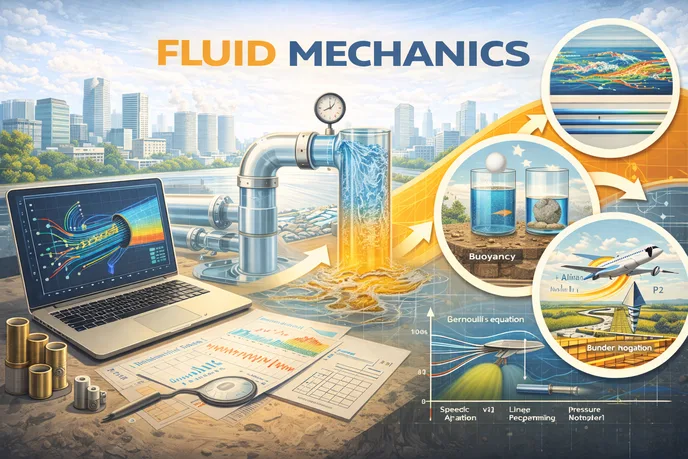
Fluid Mechanics
Why enroll
Fluid Mechanics is a core subject for civil engineering students and professionals, as it underpins advanced topics such as hydraulics, irrigation engineering, environmental engineering, and river engineering. A strong understanding of this subject enables engineers to design safe and efficient pipelines, channels, pumps, and hydraulic structures. It is also essential for competitive exams, higher studies, and technical interviews.
Course content
The course is readily available, allowing learners to start and complete it at their own pace.
Fluid Mechanics
37 Lectures
2074 min
Lec 1: Basic Concepts of Fluid
Preview
67 min
Lec 2: Properties of Fluid
72 min
Lec 3: Fluid Flow Analysis
65 min
Lec 4: Concepts of Hydrostatic
60 min
Lec 5: Measurement of Pressure and Hydrostatic forces
47 min
Lec 6: Buoyancy, Metacentre, Stability and Rigid body motion
63 min
Lec 7: Reynolds Transport Theorem
68 min
Lec 8: Conservation of Mass
62 min
Lec 9: Conservation of Momentum
59 min
Lec 10: Conservation of Momentum Applications
61 min
Lec 11: Bernoulli’s Equation
55 min
Lec 12: Applications of Bernoulli’s Equation
58 min
Lec 13: Fluid Statics Applications: Example Problems
49 min
Lec 14: Conservation of Momentum: Example problems
47 min
Lec 15: Bernoulli’s Equation : Problems Solving on Black Board
53 min
Lec 16: Lagrangian and Eulerian Descriptions
59 min
Lec 17: Motion and deformation of fluid elements
46 min
Lec 18: Problems Solving on Black Board
57 min
Lec 19: Dimensional Homogeneity
46 min
Lec 20: Dimensional Analysis and Similarity
45 min
Lec 21: Laminar and Turbulent Flows
56 min
Lec 22: Losses in Pipe Fittings
57 min
Lec 23: Flow in Noncircular Conduits and Multiple Path Pipeflow
55 min
Lec 24: Mass Conservation Equation- I
30 min
Lec 25: Mass Conservation Equation- II
54 min
Lec 26:Stream Function
64 min
Lec 27: Cauchy's Equation
55 min
Lec 28: The Navier-Stokes Equation
62 min
Lec 29: The Navier-Stokes Equation part 2
61 min
Lec 30: The Navier-Stokes Equation III
56 min
Lec 31: Approximate solutions of Navier Stokes Equation: Bounary Layer Approximation
69 min
Lec 32: Boundary Layer Approximation II
60 min
Lec 33: Boundary Layer Approximation III
50 min
Lec 34: Open Channel Flow Unlisted
56 min
Lec 35: Open Channel Flow II
45 min
Lec 36: Open Channel Flow III
56 min
Lec 37: Drag and Lift
49 min
Course details
The Fluid Mechanics course provides a comprehensive understanding of the physical laws governing the behavior of fluids under rest and motion conditions. It explains how fluid properties such as density, viscosity, surface tension, and compressibility influence flow behavior in engineering systems. The course builds a strong theoretical foundation for analyzing real-life fluid flow problems encountered in water supply, hydraulic structures, environmental systems, and industrial applications.
The course covers fluid statics, kinematics, and dynamics in detail, helping learners understand pressure variation in fluids, velocity and acceleration fields, and energy transfer in flowing fluids. Emphasis is placed on fundamental governing equations, dimensional analysis, and similitude, enabling students to model and predict fluid behavior accurately. By the end of the course, learners develop the ability to analyze pipe flow, open channel flow basics, and flow measurement systems, forming a base for advanced subjects like hydraulics, river engineering, and environmental engineering.
SOURCE-YouTube [NPTEL IIT Guwahati]
Course suitable for
Oil & Gas Civil & Structural Piping & Layout Petroleum
Key topics covered
Properties of fluids and fluid statics
Pressure measurement and manometry
Fluid kinematics and flow descriptions
Fluid dynamics and fundamental equations
Bernoulli’s equation and applications
Flow through pipes and pipe networks
Boundary layer theory
Flow measurement devices
Dimensional analysis and model studies
Introduction to compressible flow
FREE
Access anytime