<link href="https://fonts.googleapis.com/css2?family=Caveat:wght@500;700&family=JetBrains+Mono:wght@400;500;600&display=swap" rel="stylesheet" /> Skip to main contentEngineering Courses, Mentoring & Jobs | EveryEng
Complete Course on Pressure Vessel Engineering & Design as per ASME BPVC using PV Elite & Compress Software banner

Complete Course on Pressure Vessel Engineering & Design as per ASME BPVC using PV Elite & Compress Software

Complete Course on Pressure Vessel Engineering & Design as per ASME BPVC using PV Elite & Compress Software banner
Live online Beginner

Complete Course on Pressure Vessel Engineering & Design as per ASME BPVC using PV Elite & Compress Software

3(70)
7 enrolled
5861 views
COMPLETED
20 hrs
Dec 23, 2024 · 3:00 PM
English
5861 views

Shanmugam V
Shanmugam VLead / Senior Mechanical Engineer/Static Equipment Engineer
  • 7-day money-back guarantee
  • Session recordings included
  • Certificate of completion
Volume pricing for groups of 5+

Why enroll

1. How elementary and advanced Solid mechanics topics are applied in developing Pressure vessel codes and standards.

2. Theoretical background behind design code requirements which helps an engineer understand the strengths, weaknesses, and applicability of the code requirements.

3. An insight into the newly introduced codes.

4. Bridging the gap between theoretical knowledge and code requirements.

5. University students who want to take up a career in static equipment engineering and want to learn about the most widely used Industrial standard.

6. Experienced engineers who want to understand the background of code rules and requirements

7. Professionals who want to learn to use PV-Elite and Compress Software for solving Pressure vessel-related problems

Is this course for you?

You should take this if

  • You work in Oil & Gas Upstream or Pharmaceutical & Healthcare
  • You're a Mechanical Engineering professional
  • You prefer live, instructor-led training with Q&A

You should skip if

  • You need a different specialisation outside Mechanical Engineering
  • You need fully self-paced, on-demand content

Course details

Course suitable for

Key topics covered

- This course gives you a complete understanding & fundamentals of Pressure vessel Design & Engineering. Following topics are covered in this course

1. Overview Equipment in Energy Sector

a. Oil and gas Industry process equipment

b. Refinery and Petro-Chemical process equipment

2. Pressure vessel Engineering

a. Engineering Organization

b. Static Equipment discipline particular about pressure vessel team

c. Various Disciplines & stakeholders

d. How Static Equipment Department Works

e. Pressure vessel for Beginners

3. Components of Pressure vessel

a. Orientation of vessel

b. Different type of supports

c. Types of Flanges

d. Types of Nozzles

e. Types of Dish-end

4. Design of Pressure vessel

a. Understanding design parameters

b. Thickness Calculation for Internal and External pressure

c. Nozzle Reinforcement calculation

d. Local Load Analysis WRC 537 & WRC 297

e. Flange rating

f. Stiffiner ring design

g. Saddle design

5. Load Cases

a. Different types of internal and external loads & combinations

b. Wind loads

c. Seismic loads

d. Snow loads

e. Impact Loads

f. Transportation loads

g. Erection loads

6. Codes & Standards

a. Introduction to ASME Section VIII DIV 1 / 2 / 3 Standards

b. Dimensional Standards

c. Material Standards

d. Pipe thickness

e. Flange Standards

f. Fitting Standards

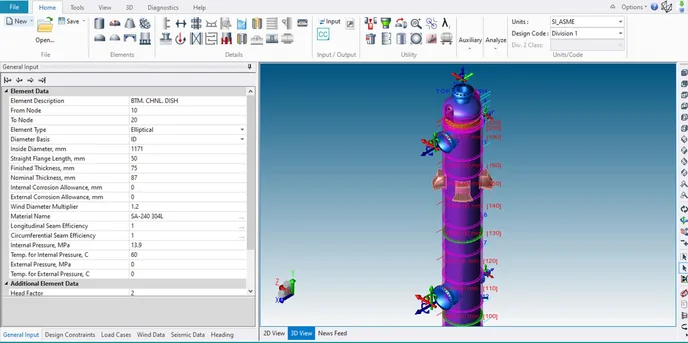
7. PV-ELITE and COMPRESS Software Features

8. Modeling and Analysis of DIV 1 and DIV 2 Vessels

9. Codecalc 26 Component Analysis

10. Common Errors & resolving strategies

Opportunities that await you!

Skills & tools you'll gain

PVEliteCOMPRESS

Career opportunities

Certifications

Completion

Training details

This is a live course that has a scheduled start date.

Live session

Starts

Mon, Dec 23, 2024

3:00 PM UTC· your timezone

Duration

2 hours per day

10 days total

COMPLETED

Dec 23, 2024 · 3:00 PM

Questions and Answers

A: Gauge range and location decide whether any pressure reading means anything. Option C feels tempting because everyone remembers the 1.3× MAWP number, but without a valid gauge you don't know what pressure you actually hit. Option D matters for code compliance, yet it doesn't invalidate a pressure hold if paperwork lags. Option B mixes up sequence; reinforcing pad leak tests come after hydro, but they don't govern whether the hydro itself was acceptable.

A: Hydro pressure scales MAWP by the ratio of allowable stresses. 1.3 × 20 × (152/138) lands at about 26.6 barg. Option B assumes 1.5× MAWP, a refinery habit that doesn't belong here. Option C forgets the stress ratio and under-tests. Option D applies the ratio but bumps the multiplier incorrectly, a slip that shows up often when someone mixes Div 1 memory with Div 2 habits.

A: SA-516 Gr.70 with NACE controls fits the pressure vessel rules and sour service damage mechanisms. Option B sounds right if your background is piping, but it's not a vessel plate material. Option C targets high-temperature hydrogen attack, which isn't the threat at 65°C. Option D resists corrosion, yet chloride stress cracking and cost make it a poor default for this duty.

A: A trapped liquid expands fast with temperature and has nowhere to go. Option D explains pressure rise, but only if a blanket exists and is connected. Option C is real, yet the rate is usually slow and small. Option B would show telltale chatter and loss, not a steady climb with no discharge.