Skip to main contentEngineering Courses, Mentoring & Jobs | EveryEng
Finite Difference Methods: Theory, Application, and Python Programming banner

Finite Difference Methods: Theory, Application, and Python Programming

Finite Difference Methods: Theory, Application, and Python Programming banner
Self-paced Beginner

Finite Difference Methods: Theory, Application, and Python Programming

4(1579)
3 enrolled
1361 views
₹ 999
120 min
Anytime
English
Team EveryEng
Team EveryEngMechanical Engineering
  • 7-day money-back guarantee
  • Lifetime access
  • Certificate of completion
Volume pricing for groups of 5+

Why enroll

People enroll in a Finite Difference Methods course to learn how to numerically solve differential equations that model real-world physical systems. The course provides a solid foundation in both the theory and practical implementation of these methods, helping students develop the skills to analyze and program solutions for problems in engineering, physics, and applied mathematics. It is especially valuable for those interested in computational modeling, simulations, and scientific computing across various industries and research fields.

Is this course for you?

You should take this if

  • You work in Automotive or Aerospace
  • You're a Mechanical Engineering professional
  • You prefer self-paced learning you can revisit

You should skip if

  • You need a different specialisation outside Mechanical Engineering
  • You need live interaction with an instructor

Course details

The Finite Difference Methods: Theory, Application, and Python Programming course is designed to equip engineers, researchers, and students with a thorough understanding of numerical techniques for solving differential equations commonly encountered in fluid dynamics, heat transfer, and other engineering applications.The course covers the theoretical foundations of finite difference methods (FDM), including explicit, implicit, and Crank–Nicolson schemes, and demonstrates how to discretize partial differential equations for computational solutions.Participants gain experience using Python programming to implement these methods, solve benchmark problems, and analyze results for real-world scenarios.By combining theory, and coding exercises, learners develop the ability to create their own numerical models, validate solutions, and apply FDM techniques to optimize engineering systems in fields such as HVAC, heat exchangers, and fluid flow analysis.

Course suitable for

Key topics covered

  • Introduction to FDM

  • Taylor Series Approximation

  • Discretization scheme in FDM

  • Order of accuracy of discretization scheme

  • Time Marching Explicit scheme

  • Time Marching Semi-Implicit scheme

  • 1D steady heat diffusion solution using FDM Python coding

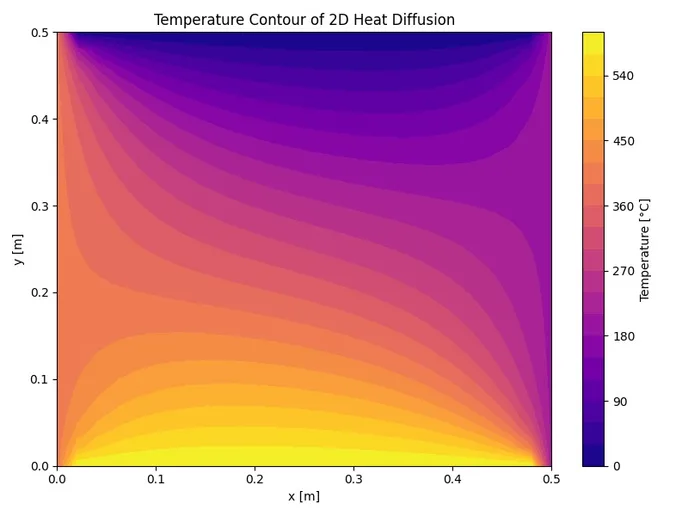
  • 2D steady heat conduction solution using FDM Python coding

  • 2D unsteady heat conduction solution using Python coding

Course content

The course is readily available, allowing learners to start and complete it at their own pace.

2 lectures2 hr

Opportunities that await you!

Skills & tools you'll gain

Python

Career opportunities

₹999

Access anytime

Questions and Answers