<link href="https://fonts.googleapis.com/css2?family=Caveat:wght@500;700&family=JetBrains+Mono:wght@400;500;600&display=swap" rel="stylesheet" /> Skip to main contentEngineering Courses, Mentoring & Jobs | EveryEng
Heat Exchanger Design with HTRI banner

Heat Exchanger Design with HTRI

Heat Exchanger Design with HTRI banner
Live online Advanced

Heat Exchanger Design with HTRI

4(33)
4 enrolled
1326 views
COMPLETED

Tell us and we’ll notify you when the next batch is scheduled.

12 hrs
-
English
1326 views
Trinergy Engineering
  • 7-day money-back guarantee
  • Session recordings included
  • Certificate of completion
Volume pricing for groups of 5+

Why enroll

Professionals and students join this workshop to gain hands-on HTRI software experience through real industrial examples while bridging the gap between theory and practical thermal design. It helps enhance career prospects in process design, heat transfer, and EPC roles, offers a recognized certificate, provides lifetime access to recordings for continuous learning, and enables direct interaction with industry experts for design and troubleshooting guidance.

What enrolled engineers say

14 verified reviews
  • Feb 25, 2026

    This course turned out to be more technical than I anticipated. The early refresh on LMTD and NTU methods helped close a gap that had crept in over the years, especially when switching between hand checks and HTRI results. What stood out was how closely the examples matched real work in oil & gas and energy utilities, like crude preheat trains and steam condensers for power plants, rather than clean textbook cases. The biggest challenge was getting consistent process data into HTRI without over‑simplifying it. Small assumptions around fouling factors or allowable pressure drop quickly pushed designs out of spec, which is something that also shows up on chemical and pharmaceutical utility exchangers. Working through TEMA class selection and multi‑pass configurations made it clearer why some past designs were hard to operate. A practical takeaway was learning how to sanity‑check HTRI outputs against heat balance and pressure drop limits before trusting the software. That alone will save time on reviews and rework. The discussion on vibration and thermal stress felt very close to field issues seen during revamps. I can see this being useful in long-term project work.

    Trinergy E. · DIRECTOR Verified
  • Feb 25, 2026

    At first glance, the topics looked familiar, but the depth surprised me. The refresher on heat balance, LMTD, and NTU methods went beyond textbook treatment and tied directly into how HTRI actually solves the problem. Coming from oil & gas projects, the sections on TEMA selection and shell-and-tube layouts were immediately relevant to a crude preheat train I’ve been supporting. The discussion on pressure drop trade-offs also connected well with energy & utilities work, especially around condenser sizing and pump limitations. One challenge during the course was keeping up with the multi-pass exchanger modeling in HTRI. The software logic isn’t always intuitive, and a few trial-and-error runs were needed to understand how small input changes affect thermal performance and vibration checks. That part felt very real-world. A practical takeaway was learning how to validate HTRI results against operating constraints instead of just accepting the software output. The fouling and thermal stress examples mirrored issues seen on-site and helped close a knowledge gap between design and operations. Overall, the course sharpened how design decisions translate into actual plant behavior. It definitely strengthened my technical clarity.

    SONU K. Verified
  • Feb 25, 2026

    Coming into this course, I had some prior exposure to the subject from refinery work, but it was mostly rule-of-thumb sizing and vendor back-and-forth. This workshop filled a real gap around doing defensible thermal design in HTRI instead of just reviewing datasheets. The refresher on LMTD versus NTU methods was useful, especially when tied to actual process data from oil & gas crude preheat trains and energy utilities like boiler feedwater exchangers. Walking through TEMA classifications and seeing how pass arrangements affected pressure drop and vibration risk made the trade-offs clearer than in day-to-day work. One challenge during the course was balancing thermal performance against allowable pressure drop in multi-pass shell-and-tube designs; it took a few iterations in HTRI to see how small changes ripple through the design. The fouling and thermal stress discussions were very practical, particularly for exchangers handling dirty services common in chemical and pharmaceutical utility systems. A key takeaway was a repeatable workflow for validating HTRI results against process constraints before issuing anything to mechanical design. This is something that can be applied immediately and refined over time. I can see this being useful in long-term project work.

    Humaidur R. Verified

Is this course for you?

You should take this if

  • You work in Oil & Gas Downstream or Energy & Utilities
  • You're a Chemical & Process / Mechanical Engineering professional
  • You have 3+ years of hands-on experience in this field
  • You want to build skills in Engineering & Design

You should skip if

  • You're new to this field with no prior experience
  • You need a different specialisation outside Chemical & Process
  • You need fully self-paced, on-demand content

Course details

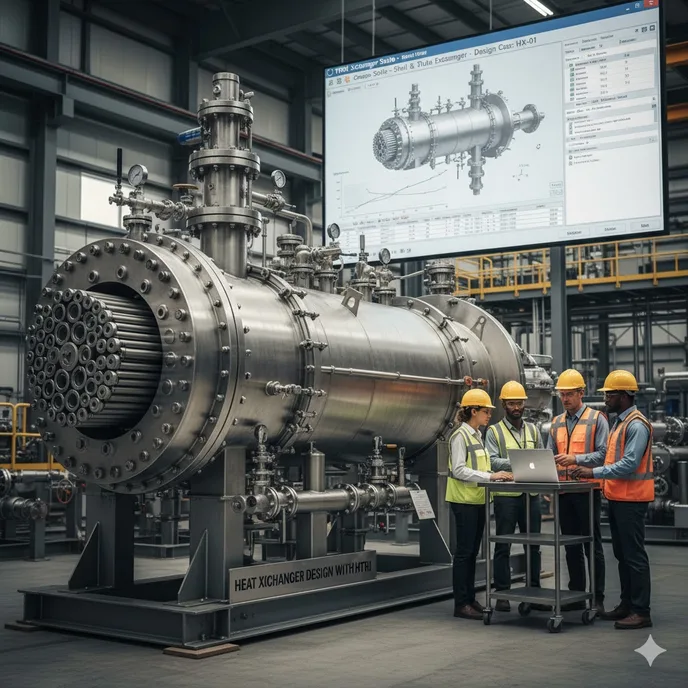
This two-day intensive workshop is designed to provide participants with a strong foundation and practical understanding of heat exchanger thermal design using HTRI software.The program begins with core heat transfer concepts, including heat balance, LMTD, and NTU methods, to build a solid theoretical base.Participants will learn how to analyze real process data and calculate heat loads accurately.The workshop covers TEMA classifications and selection of suitable shell-and-tube heat exchanger configurations.Hands-on HTRI sessions guide participants through complete exchanger design workflows.Advanced topics such as multi-pass exchangers and pressure drop analysis are explained in detail.Participants will learn how to validate thermal performance against industrial standards.Common operational issues like fouling, vibration, and thermal stress are discussed with practical solutions.Real industrial case studies are used to connect theory with field applications.By the end of the workshop, participants will be confident in handling real-world heat exchanger design and troubleshooting challenges.

Course suitable for

Key topics covered

  • Basics of heat transfer

  • LMTD and NTU methods

  • TEMA classifications and standards

  • Introduction to HTRI software

  • Hands-on design of a shell-and-tube heat exchanger using HTRI
    Advanced heat exchanger design concepts

  • Multi-pass heat exchanger configurations

  • Pressure drop analysis

  • Thermal performance validation

  • Troubleshooting operational issues such as fouling, vibration, and thermal stress

Opportunities that await you!

Skills & tools you'll gain

Engineering & DesignHTRI Xchanger Suite

Career opportunities

Training details

This is a live course that has a scheduled start date.

COMPLETED

-

Questions and Answers

A: A: Cuts peak cross-flow velocity. Fouling trend slows and ΔP growth flattens without touching pressure envelope. B: Longer tubes raise shell-side residence time and ΔP. Trend keeps worsening. C: Tighter spacing spikes local shear. Heat transfer improves short-term, fouling accelerates offshore. D: Pass count change shifts tube-side hydraulics. Shell-side fouling mechanism stays untouched.

A: A: Q = U·A·ΔT. 12e6 / (600·25) lands just under 800 m². That's the right scale. B: Off by a factor of ten. Confuses heat flux with total duty. C: Assumes U an order lower than stated. That's crude fouling panic. D: Pass arrangement doesn't multiply area. Geometry changes effectiveness, not physics.

A: A: Added resistance lowers U. With fixed area, duty falls and outlet temps slide. B: LMTD is set by process temps, not fouling math. C: Tube fouling doesn't directly drive shell hydraulics. D: Metal temperature rise follows severe fouling, not the first-order effect.

A: A: Two-pass shell smooths temperature profile and vibration risk. B: Simplicity doesn't fix high local ΔT and tube excitation. C: K shell targets low ΔP, not temperature cross issues. D: J shell handles expansion but keeps the same thermal pinch.