


Article details
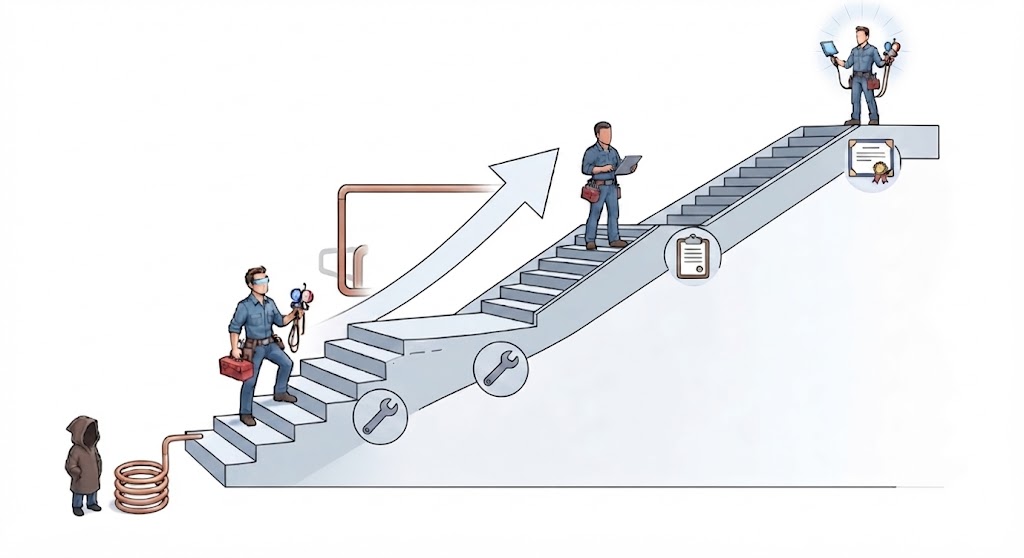
Ask ten people in HVAC-R how they got where they are, and you'll get ten different starting points — a mechanical engineering degree, a diploma in draftsmanship, an apprenticeship on the tools, a lateral move from a related trade. What's striking about this field, compared to many engineering disciplines, is how little that starting point ends up mattering next to what someone can actually do.
A draftsman who's genuinely fluent in load calculations and psychrometrics will often outpace a fresh mechanical engineering graduate who hasn't yet built hands-on system judgment. That's not to say a degree is irrelevant — it opens specific doors, and we'll be honest about where — but in HVAC-R, demonstrated skill tends to be the real currency of career progression, arguably more so than in many other technical fields.
Foundational Skills: The Real Gatekeepers
Regardless of background, a few skills function as the actual entry threshold into doing real engineering work in this field — not the credential on paper, but whether you can genuinely reason through these:
Reading a psychrometric chart — dry bulb, wet bulb, relative humidity, dew point, and how they relate. This underlies sizing, comfort, and troubleshooting alike.
Refrigeration cycle fluency — not just naming the four components, but genuinely understanding how pressure controls the boiling point of refrigerant, and why that's the mechanism behind everything else.
Reading and interpreting drawings — P&IDs, equipment schedules, control diagrams. Someone who can read a drawing critically, not just follow it, is already ahead of most beginners.
Basic load calculation logic — understanding what actually drives a building's heating/cooling load, even before you're the one running the full calculation independently.
These four are genuinely learnable without a four-year degree — through mentorship, self-study, on-the-job exposure, or focused courses — which is exactly why they function as the real gatekeeper, rather than the diploma itself.
Applied Skills: Where Real Differentiation Happens
Once the foundations are solid, the next tier is where career trajectories actually start to diverge:
Equipment selection — translating a load calculation into an actual, buildable system specification
Energy modeling software fluency — increasingly expected across design-adjacent roles, and a genuine differentiator for anyone who's picked it up independently
Controls logic literacy — understanding how a building automation system actually executes a sequence of operation; a design that's excellent on paper can still fail if the controls logic behind it is weak
Reviewing and redlining drawings critically — catching design issues before they become field problems, a skill that often develops faster through mentorship than through formal coursework
This is also the stage where the gap between a strong technician and a strong engineer often narrows the most — both are competing on judgment and applied knowledge, not credentials.
Specialized and Leadership Skills
At the senior end, the skills that matter shift again — toward things that are almost entirely built through experience rather than study:
Commissioning judgment — knowing when a deviation from design intent is a real problem versus an acceptable field variation
Troubleshooting instinct — diagnosing symptoms (short-cycling, abnormal head pressure, uneven comfort) quickly, often faster than a textbook approach would allow
Mentoring and technical authority — the ability to actually teach what you know, which is its own distinct skill from knowing it
Where a Degree Genuinely Does Matter
To be honest rather than falsely encouraging: there are a small number of gates in this field that a degree — specifically an accredited engineering degree — does control, regardless of skill level.
Professional Engineer (PE) licensure, required to independently stamp drawings on many commercial and institutional projects, generally requires an accredited engineering degree as a prerequisite in most regions. This is a real ceiling for a highly skilled non-degree-holder — not a reflection of their competence, but a regulatory reality worth knowing early rather than discovering years into a career.
Beyond that specific gate, though, formal education mostly affects pace — how quickly certain concepts click, how naturally certain software or modeling work comes — rather than an absolute ceiling on where someone can go.
Building Skills Without a Formal Program
For anyone without a full engineering degree — a draftsman, a technician, a diploma holder — the honest path forward is deliberate, self-directed skill-building rather than waiting for the "right" credential:
Shadowing engineers on real projects, specifically asking to understand the why behind design decisions, not just the what
Pursuing focused certifications (NEBB for commissioning-adjacent work, manufacturer-specific certifications for equipment fluency) that build credibility without requiring a full degree
Deliberately practicing load calculations and psychrometric reasoning on real or sample projects, rather than treating these as one-time coursework
Seeking structured mentorship — this is genuinely one of the fastest ways to close the gap between "technically capable" and "trusted with real design decisions," and it's part of why platforms built specifically around engineer-to-engineer mentorship, like EveryEng, exist — closing exactly this kind of gap is the point.
The Honest Bottom Line
HVAC-R rewards demonstrated competence unusually generously compared to many engineering fields — a genuinely skilled draftsman or technician can build a serious, senior career here, PE licensure being the one clear exception. That's worth knowing early, both as encouragement if you didn't start with a traditional engineering degree, and as a nudge if you did — a degree gets you in the door, but it doesn't do the skill-building for you. For anyone serious about accelerating that process, seeking out real mentorship — whether through a senior colleague or a platform like EveryEng built around exactly that kind of engineer-to-engineer guidance — tends to compress years of trial-and-error into a much shorter runway.


 Aug 29, 2026


