


Article details
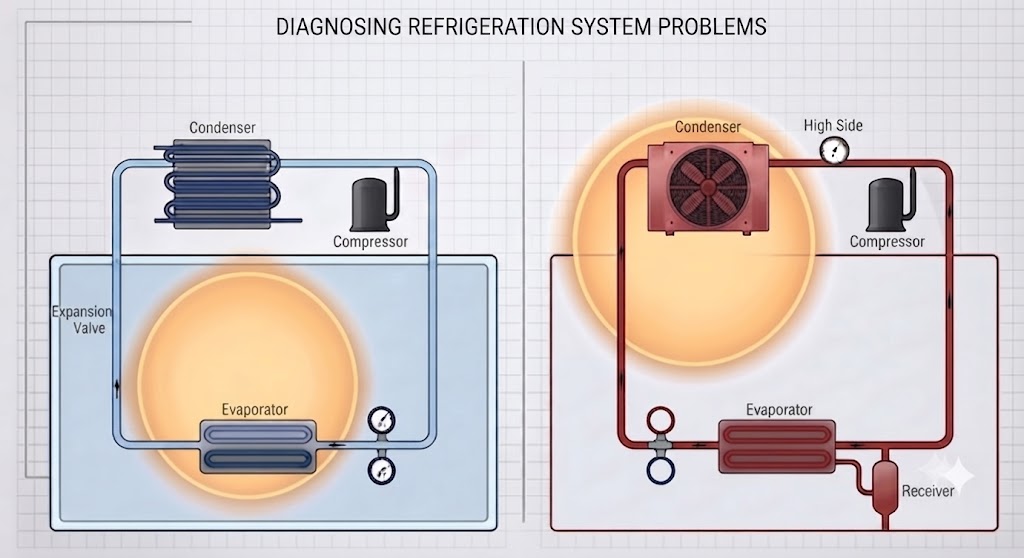
Pressure gauges on a refrigeration system tell a story, but only if you know how to read it. Two of the most common abnormal readings a technician or engineer will encounter are low suction pressure and high head pressure, and while they can occur independently or together, each points toward a genuinely different set of underlying causes. Learning to read these symptoms correctly is often the fastest path to an accurate diagnosis.
A Quick Refresher on What These Pressures Represent
Suction pressure is the low side pressure, measured at the compressor's inlet, reflecting conditions in the evaporator where refrigerant is boiling off and absorbing heat. Head pressure is the high side pressure, measured at or near the compressor's discharge, reflecting conditions in the condenser where refrigerant is rejecting heat and condensing back into a liquid. Both pressures should sit within a predictable range for a given system and set of operating conditions. When either one drifts outside that expected range, it's a genuine diagnostic signal, not just a number to note and move past.
Low Suction Pressure: What It's Actually Telling You
Low suction pressure generally means the evaporator isn't receiving or boiling off refrigerant the way it should. A few distinct causes commonly produce this symptom.
Restricted refrigerant flow to the evaporator is one of the most frequent causes. A partially blocked filter drier, a restricted or malfunctioning metering device, or a kinked line all limit how much refrigerant actually reaches the evaporator, starving it and dropping suction pressure as a result.
Low refrigerant charge reduces the overall amount of refrigerant available to boil off in the evaporator, which similarly drops suction pressure, often alongside other symptoms like reduced cooling capacity and, in more severe undercharge situations, evidence of superheat running abnormally high.
Reduced airflow across the evaporator coil, commonly from a dirty filter, a failing blower motor, or blocked return air, means less heat is available for the refrigerant to absorb. With less heat load to boil off, suction pressure drops, and in more severe cases, the coil can get cold enough to freeze entirely, which compounds the airflow restriction further.
A failing or misadjusted metering device can also underfeed the evaporator even when refrigerant charge and airflow are both correct, producing the same low suction symptom through a different mechanical cause entirely.
The common thread across all of these causes is that the evaporator side of the system is being deprived of what it needs to properly boil off refrigerant, whether that deprivation comes from too little refrigerant reaching it, too little heat available to absorb, or a mechanical restriction limiting flow.
High Head Pressure: What It's Actually Telling You
High head pressure generally means the condenser isn't rejecting heat effectively, or too much refrigerant or non condensable gas is present in the high side of the system.
Reduced airflow across the condenser coil is one of the most common causes, whether from a dirty condenser coil, a failing condenser fan motor, or physical obstruction blocking airflow around an outdoor unit. With less air moving across the coil, the system can't reject heat efficiently, and pressure backs up on the high side as a result.
Overcharge of refrigerant increases the total volume of refrigerant the condenser has to handle, which can raise head pressure even when the condenser itself is functioning correctly, simply because there's more refrigerant present than the system was designed to condense efficiently.
Non condensable gases, primarily air, trapped in the system raise head pressure because air doesn't condense the way refrigerant does. Its presence adds to the total pressure in the high side without contributing any useful refrigeration effect, a genuine reminder of why proper evacuation before charging matters so much for long term system health.
High ambient temperature around the condenser can also elevate head pressure even on an otherwise correctly functioning system, since the condenser's ability to reject heat depends on a meaningful temperature difference between the refrigerant and the surrounding air. On a very hot day, or in a poorly ventilated equipment location, that temperature difference shrinks, and head pressure rises as a natural consequence.
The common thread here is that the condenser side of the system is either struggling to reject heat effectively, or is being asked to handle more total pressure than it should, whether from overcharge, trapped air, or simply too little temperature difference to work with.
When Both Symptoms Appear Together
Some conditions produce low suction pressure and high head pressure simultaneously, and recognizing this combined pattern is its own diagnostic skill. A significantly restricted metering device, for example, can starve the evaporator (dropping suction pressure) while simultaneously backing refrigerant up on the high side (raising head pressure), since the restriction is preventing normal flow between the two sides of the system entirely. Recognizing this combined symptom pattern, rather than treating the two pressures as unrelated observations, often points diagnosis directly toward the metering device or a similar flow restriction between high and low sides, rather than toward a condenser or evaporator problem in isolation.
Reading the Symptoms Systematically
The genuinely useful diagnostic habit is comparing both pressures together, alongside other available readings such as superheat, subcooling, and actual airflow, rather than reacting to a single abnormal number in isolation. A pressure reading rarely tells the whole story on its own, but a pressure reading combined with superheat and subcooling values, and a basic visual and airflow check of both coils, very often narrows the likely cause down to one or two genuine possibilities rather than leaving a technician guessing across the full range of things that could theoretically cause an abnormal reading.
EveryEng. For everyone in Engineering.


 Aug 29, 2026


