

Article details
Refrigerant charging gets the attention. Controls get the attention. Evacuation — pulling a vacuum on a system before it's ever charged — rarely does. And yet it may be the single step most responsible for whether a system performs as designed for its full service life, or fails early in ways that are hard to trace back to a root cause.
That gap between importance and attention is worth examining, especially as modern systems become less forgiving of the shortcuts this step is prone to.
Why This Matters More With Modern System Design
Older mineral-oil systems tolerated moisture and non-condensables reasonably well. Today's systems generally don't.
Modern compressors run on polyolester (POE) oils, which are more hygroscopic — meaning they absorb moisture more readily — than the mineral oils used in older equipment. When moisture reacts with refrigerant and oil inside a sealed system, it can form acidic compounds, and sustained acid exposure degrades compressor windings, bearings, and internal components over time. This isn't a workmanship issue that shows up on day one — it's a reliability variable that erodes system life over months or years.
Non-condensable gases (mainly trapped air) create a separate problem: they raise head pressure and reduce heat transfer efficiency at the condenser, forcing the compressor to work harder than the design calls for. Over the system's lifespan, that translates to higher energy consumption and increased mechanical stress than the original efficiency rating assumed.
Tighter manufacturing tolerances in modern equipment compound both issues — there's simply less room for contamination before performance measurably degrades. And in ductless and heat pump systems, which often lack a replaceable filter-drier, evacuation isn't just the best opportunity to remove moisture before startup. It's frequently the only one.
Put simply: a system's rated efficiency and expected service life are calculated assuming a clean, dry, evacuated system at startup. Skipping or shortcutting evacuation means the as-built system no longer matches the assumptions its performance rating was based on.
Where the Process Commonly Breaks Down
The failures here are rarely a knowledge gap — they're procedural shortcuts that seem harmless in isolation but compound into real reliability problems.
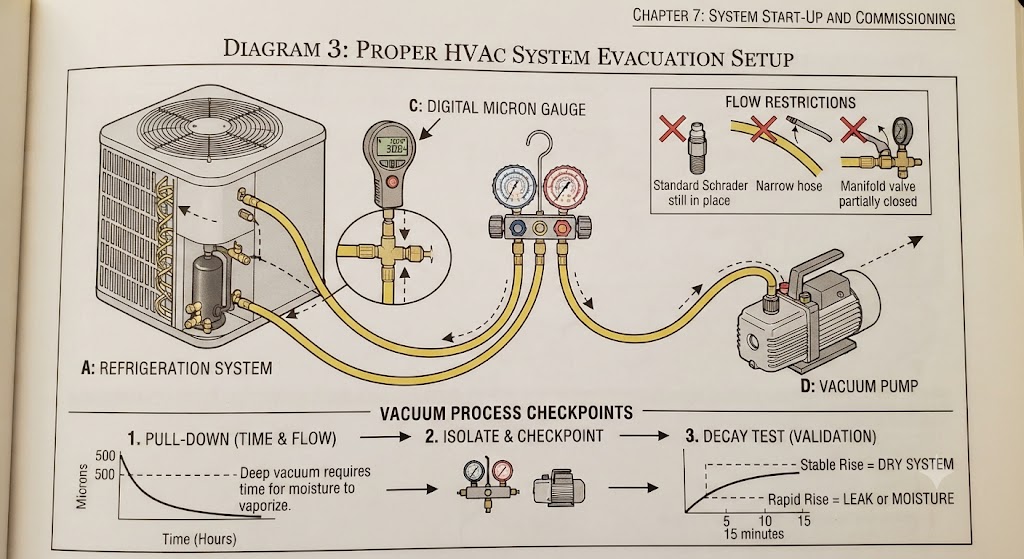
Treating a micron target as a finish line, not a checkpoint. Reaching a target vacuum level (commonly 500 microns) confirms low pressure — it doesn't confirm dryness. Moisture removal is a function of time and flow, not just pressure. A system that appears to hit target can still have residual moisture that shows up as rising pressure once it's isolated from the pump.
Restricted flow paths. Small-diameter hoses, Schrader valve cores left in place, or evacuating through a manifold all restrict flow and slow the rate at which trapped moisture can vaporize and be removed — extending the real evacuation time well beyond what the gauge suggests.
Gauge placement errors. Reading vacuum level at the pump, rather than at the system itself, gives a falsely favorable reading — line and connection losses mean the pump can show a deeper vacuum than actually exists inside the system.
The Validation Step That Actually Matters
A micron reading is a checkpoint. A decay test is the actual proof.
Once a system reaches target vacuum, it should be isolated from the pump and observed. A slow, stable pressure rise indicates a genuinely clean, dry system. A rapid rise indicates either a leak in the system or residual moisture still vaporizing inside it.
If a system can't hold vacuum during a decay test, it isn't ready for refrigerant — regardless of what the initial micron reading showed.
Getting It Right in the Field
For the technicians and experts actually performing evacuation, the theory above translates into a few concrete habits that consistently separate reliable systems from problematic ones:
Maximize flow, not just vacuum depth. Use large-diameter hoses, remove Schrader valve cores, and connect directly to both the high and low sides of the system. Every restriction in the path slows the rate at which moisture can vaporize and leave the system, even if the gauge eventually shows a good number.
Place the micron gauge at the system, not at the pump. This is the single most common source of misleading readings. A gauge at the pump reads pump performance, not system condition — the two are not the same once line losses are accounted for.
Keep vacuum pump oil clean and pumps well maintained. A pump working against degraded oil takes longer to reach target vacuum and is more prone to giving misleading readings.
Use a nitrogen sweep during brazing to limit oxidation and contamination before evacuation even begins — it complements the evacuation step rather than replacing it.
Always run a decay test before charging. Isolate the system after reaching target vacuum and observe. A slow, stable rise confirms the system is genuinely dry and leak-free. A rapid rise means it isn't ready — no matter how good the initial number looked.
None of this requires exotic tooling — a reliable digital micron gauge and a well-maintained vacuum pump, used with attention to flow and gauge placement, cover the fundamentals. The differentiator is process discipline, not equipment brand.
Design and Commissioning Implications
For engineers specifying systems or writing commissioning requirements, evacuation is worth treating as a design-adjacent variable, not purely a field execution detail:
Flow path matters more than pump capacity. A high-capacity vacuum pump connected through restrictive fittings will still evacuate slowly. Specifying large-diameter service ports and connections at both high and low sides meaningfully affects real-world evacuation time.
Gauge placement should be specified, not assumed. Commissioning documentation that requires micron readings at the system — not at the pump — closes a common gap between field practice and actual system condition.
Decay testing deserves to be a checklist item, not an informal habit. Requiring documented decay test results as part of startup or commissioning sign-off creates a paper trail that a system met design assumptions before charging — useful both for quality control and for troubleshooting premature failures later.
Nitrogen sweeps during brazing and installation reduce oxidation and contamination inside the system, complementing (not replacing) proper evacuation.
Why This Deserves Attention From Everyone in the Chain
Evacuation sits in an unusual spot: it's executed by technicians, but its consequences — compressor life, efficiency degradation, callback rates — are squarely engineering and business concerns. A system engineered well on paper can still underperform its design life if this step is treated as a formality during installation rather than a controlled process with defined acceptance criteria.
For technicians and field experts, that means treating the decay test as non-negotiable, not optional. For engineers, it means specifying evacuation and verification requirements explicitly in commissioning documents, rather than assuming good practice will happen by default. And for companies managing installation quality or callback rates, it's a low-cost, high-leverage place to tighten standards — the tools required are inexpensive relative to the cost of a premature compressor failure or a repeat service call.
As refrigerant chemistry, oil formulations, and system tolerances continue to evolve, the margin for error here keeps shrinking. Evacuation is no longer just a legacy trade practice — it's a shared responsibility across everyone involved in getting a system into the field correctly.
Further reading: www.achrnews.com/articles/166431-why-deep-evacuation-is-not-a-checkbox-it-is-system-protection , ACHR News


 Aug 29, 2026