


Article details
There is a sound that older engineers still remember from factory floors. A soft, rhythmic click. Somewhere inside a grey steel panel, a relay coil was pulling in an armature, closing a contact, and letting current pass to a motor. That click was automation in its earliest honest form. No processor, no code, no dashboard. Just copper, iron, and a rule baked permanently into the way wires were run.
Everything that follows in this article grew out of that click.
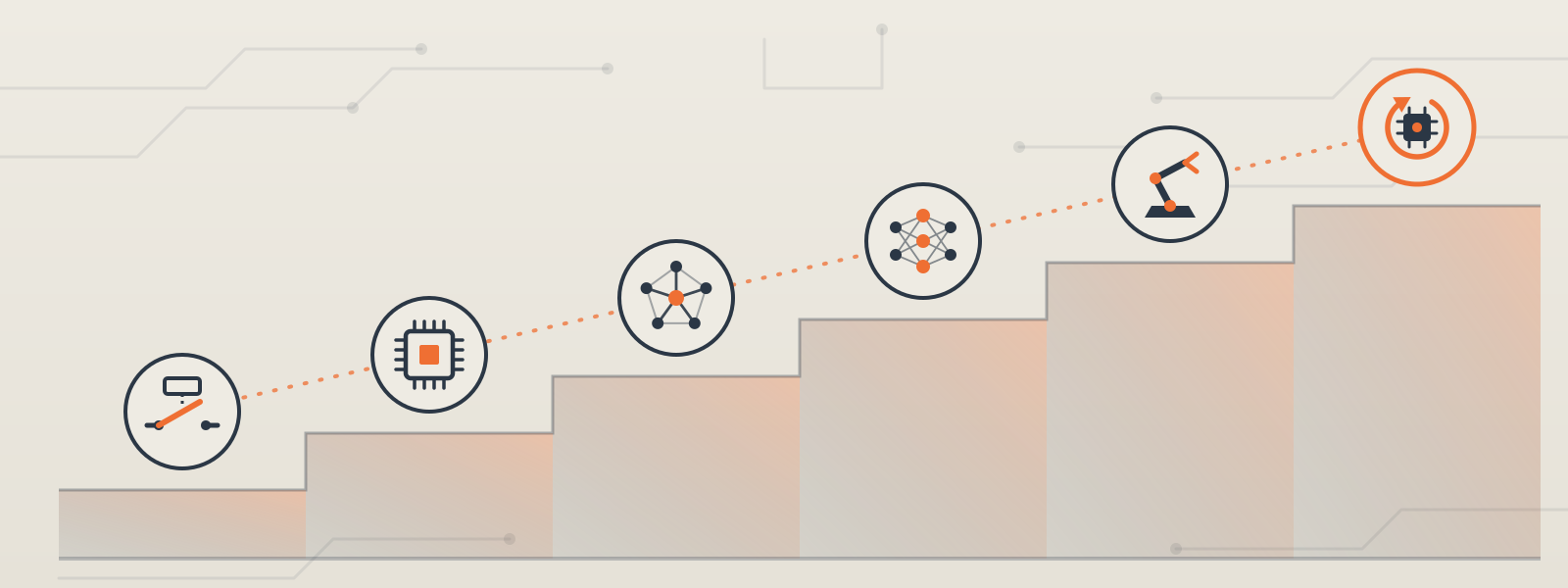
The reason it is worth starting there is that automation in electronics and communication engineering did not arrive as one invention. It arrived as a ladder. Each rung solved the problem the rung below it could not, and each rung created a new problem that pushed engineers upward. If you understand the ladder in order, the frontier stops looking like magic and starts looking like the obvious next step.
So let us climb it properly, one rung at a time.
Rung 1: Hardwired logic, where the circuit is the program
In the beginning, the logic lived in the wiring itself.
If you wanted a motor to start when a button was pressed and stop when a limit switch tripped, you built that behaviour physically. Relays in series became an AND. Relays in parallel became an OR. A normally closed contact became a NOT. Engineers were writing Boolean algebra with screwdrivers.
It worked beautifully and it failed in exactly one way. Changing the behaviour meant changing the panel. A small process modification could mean days of rewiring, new drawings, and fresh testing. The logic was correct but it was frozen.
That single frustration created the entire industry that followed.
Rung 2: The PLC, when logic became editable
In 1968, General Motors put out a request for a device that could replace relay panels without forcing a rewire every time production changed. What came back was the programmable logic controller.
The genius of the PLC was not raw computing power. It was empathy for the existing workforce. Instead of asking panel technicians to learn an unfamiliar programming language, the interface mimicked the relay ladder diagrams they already read every day. Ladder logic looked like a wiring drawing and behaved like software.
For an ECE student today, the PLC is where three ideas first come together in one box. Deterministic scan cycles, meaning the controller reads inputs, solves logic, and writes outputs in a predictable loop. Industrial input and output conditioning, meaning noisy 24 volt field signals get cleaned before they touch logic. And separation of logic from hardware, meaning behaviour can now change without a soldering iron.
That separation is the philosophical seed of everything on the higher rungs. Once you accept that logic is soft and hardware is a platform, you have already agreed to the world of 2026.
Rung 3: Feedback, where automation gets a sense of consequence
A PLC follows rules. It does not know whether the rule worked.
The next rung fixes that. Feedback control closes the loop between what a system does and what actually happened. A thermocouple reads oven temperature, the controller compares it against a setpoint, and the difference drives the correction. Proportional response handles the size of the error. Integral response handles the stubborn residual offset. Derivative response damps the overshoot before it happens.
PID control is roughly a century old and it still runs an enormous share of the physical world. Speed control on drives, tension control on winders, pressure loops in process plants, attitude loops in drones.
This rung matters for a subtle reason. It is the first time a machine holds an internal target and works to defend it. Everything above this rung is a more sophisticated answer to the same question: what should the system do about the gap between intention and reality?
Rung 4: The microcontroller, when intelligence gets cheap and small
The PLC lived in a cabinet. The microcontroller moved control into the product itself.
A modern MCU carries a processor core, memory, timers, converters, and communication peripherals on one die that costs less than a cup of coffee. Suddenly automation stopped being a factory concept and became a device concept. Washing machines, insulin pumps, electricity meters, car mirrors, thermostats. Each one quietly running a control loop nobody sees.
For ECE graduates this rung is where the curriculum finally becomes tangible. The ADC chapter becomes a sensor reading. The timer chapter becomes a PWM output driving a motor. The interrupt chapter becomes the difference between a responsive product and one that misses events. The serial communication chapter becomes the reason two boards can talk at all.
Nothing above this rung makes sense without this one. Edge AI is not a replacement for embedded engineering. It is embedded engineering with a heavier payload.
Rung 5: Connection, when isolated machines became a system
Once thousands of controllers existed, the obvious question followed. Why should each one work alone?
Industrial networking answered it. Fieldbus protocols, then industrial Ethernet, then SCADA layers that gathered plant wide visibility into one screen. Later, IoT extended the same idea to devices that were never inside a plant at all.
The technical work here is unglamorous and absolutely essential. Deterministic timing, so a control message arrives when it must and not merely eventually. Protocol translation, because a plant typically runs four generations of equipment simultaneously. Data hygiene, because a sensor stream with no timestamp discipline is noise wearing a lab coat.
This is also where the first serious cracks appeared. Connecting operational technology to information technology exposed machines that were designed in an era when nobody imagined a remote attacker. Security stopped being an add on and became a design constraint. The EU Cyber Resilience Act has since pushed that expectation into law, which means secure boot, signed firmware updates, and threat modelling are now part of an embedded engineer's basic job description rather than a specialist's.
Rung 6: Edge intelligence, when the sensor started thinking
Here is where the ladder stops being history and becomes current events.
For years the assumption was that if a device needed intelligence, it would send data to the cloud and wait for an answer. That assumption broke on four constraints. Latency, because a safety decision cannot wait for a round trip. Bandwidth, because streaming raw vibration data from a thousand motors is economically absurd. Privacy, because some data should never leave the building. And availability, because networks fail exactly when you need them most.
The response is TinyML and edge AI. Machine learning models compressed hard enough to run on a microcontroller, doing inference locally in milliseconds. Wake word detection, gesture recognition, anomaly detection on bearing vibration, arrhythmia detection on a wearable.
The hardware caught up fast. Ultra low power MCUs in 2026 routinely pair a control core, often ARM Cortex M or RISC-V, with a small neural accelerator or DSP block that cuts energy per inference dramatically compared to running the same model on a general purpose core. Above that sit dedicated NPUs delivering roughly 2 to 10 TOPS in a two to six watt envelope for vision analytics, and above those, full edge SoCs for heavier workloads.
RISC-V deserves a paragraph of its own. What began as an academic instruction set architecture has become a mainstream option for embedded designers who want customisation, cost control, and freedom from licensing dependence. At Embedded World 2026, RISC-V vendors were not showing proofs of concept. SiFive demonstrated an AI oriented core combining scalar, vector, and matrix compute running TinyML workloads, and Tenstorrent showed a lightweight language model running on embedded IP. Compact, power conscious cores are now doing work that would have needed a workstation a decade ago.
For an Indian ECE student, this is the most immediately actionable rung on the ladder. A model compression project on a board you can buy for a few thousand rupees is a genuine portfolio piece in 2026.
Rung 7: Perception and closed loop AI, when automation started to see
Add a camera to an intelligent edge device and the capability changes character entirely.
Machine vision has been around for decades, but classical vision needed carefully controlled lighting, fixed part positions, and hand written rules for every defect type. Learned vision does not. It handles variation, partial occlusion, and defects nobody explicitly described.
Industry analysts tracking automation into the second half of 2026 place AI at the edge and advanced sensing, particularly machine vision, among the strongest accelerating trends, with cybersecurity as a major driver of edge adoption. The interesting shift is not that factories are buying more automation. It is that automation is being stitched together with AI into closed loop control, so decisions get made automatically and earlier.
One observation from the electronics manufacturing side is worth carrying around. The most valuable automation projects are not the ones that remove people. They are the ones that shorten the gap between a defect signal appearing and a correction being applied. That framing turns automation from a headcount conversation into an engineering latency conversation, which is a far more useful place to stand.
Alongside vision sits the digital twin. A live simulated model of a machine, fed continuously by real sensor data, running slightly ahead of the physical asset so you can see failure coming. Predictive maintenance in semiconductor fabs now leans on vibration analysis and thermal imaging to catch wafer equipment problems before a failure stops the line, and the market for that capability is projected to grow at over fifteen percent annually into the next decade.
Rung 8: Autonomy, when machines started moving on their own terms
Fixed robots do the same motion forever inside a safety cage. Autonomous systems decide where to go.
Autonomous mobile robots have advanced quickly precisely because they inherit everything from the rungs below: edge compute, machine vision, sensor fusion, and reliable networking. Collaborative robots have followed a similar path, moving out of niche use after years of slow adoption, largely because high mix production lines need frequent reconfiguration and rigid caged installations make that impractical.
Two developments here are worth watching closely as an ECE person.
The first is software defined automation. Control is being decoupled from the specific hardware it runs on, moving from an innovation talking point to an actual platform strategy. That is the same separation the PLC introduced in 1968, applied at plant scale.
The second is wireless power transfer. Industrial applications are moving toward wireless charging for mobile robots, drones, and sensors, removing the productivity loss of battery swaps. This is a genuinely deep ECE problem involving high frequency resonant circuits, inductive and capacitive coupling, field optimisation, and safety interlocks. If you enjoy electromagnetics, this is where it pays.
Rung 9: The top of the ladder, where automation turns around and designs itself
Now the loop closes in a way that is genuinely new.
Every rung so far has been about engineers building automation. The frontier in 2026 is automation building electronics.
At the Design Automation Conference in July 2026, the three dominant EDA companies all crossed the same threshold at once. Synopsys presented fully autonomous long running agentic workflows for chip and electronics system design, including a verification agent that orchestrates the whole verification cycle, with claimed improvements up to fifty times faster time to validated RTL. Cadence introduced a super agent completing a silicon to system agent portfolio. Siemens added self verifying agents to its EDA agent system. Separately, Synopsys announced autonomous workflows developed with Microsoft and evaluated by AMD, where an autonomous debug closure flow showed up to a forty percent cut in cycle time.
The vocabulary the industry has adopted is telling. Vendors borrowed the automotive L1 to L5 autonomy ladder to describe chip design, with agentic workflows currently pitched around level four. Even the executives involved are candid that agents sit at the peak of the hype cycle right now and that the value still has to be proven. That honesty is healthy, and it is also a signal that this is early enough for a young engineer to matter.
Note what has happened structurally. Verification, the biggest bottleneck in chip development, is being handed to agents. Thermal and physical closure, where costly respins originate, is being pulled into the same loop. A startup ecosystem has formed around exactly these problems.
The engineer's role does not disappear. It moves up a level of abstraction, from writing the implementation to specifying intent, constraining the search space, and judging whether the result is trustworthy. Which, if you look back at rung two, is exactly what happened when panel wiring became ladder logic.
What to actually do with this ladder
The ladder is useful because it tells you what you cannot skip.
You cannot understand edge AI without embedded systems. You cannot debug an industrial network without understanding signals and timing. You cannot evaluate an agentic design tool without knowing what a good design looks like. Every fashionable capability at the top rests on unfashionable competence lower down.
A reasonable path for an ECE student or early career engineer in 2026 looks something like this. Get genuinely comfortable with one microcontroller family and one real time operating system. Build one closed loop project where you tune the controller yourself and can explain why it behaves as it does. Learn one industrial protocol properly rather than five superficially. Deploy one compressed model onto constrained hardware and measure the energy per inference. Read a datasheet fully, including the errata. Learn enough about secure boot and signed updates to talk about them without hand waving.
Do that and you are not chasing trends. You are standing on the ladder at a place where the next rung is within reach.
The relay in that grey panel is still clicking somewhere. It just has considerably better company now.


 Aug 29, 2026


