

Article details
Assumptions of hooks law
1. Material is homogenous (Properties are equal at all points)
2. Material is isotropic (Properties are equal in all direction)
3. Material is elastic
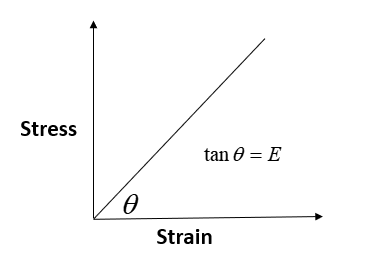
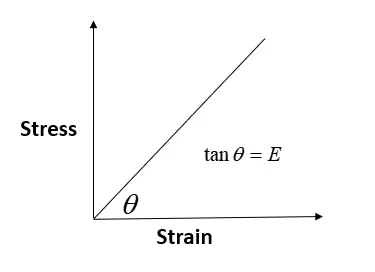
It states that under direct loading, within proportionality limit, stress is directly proportional to strain.

Here,  is the strain,
  is the stress, and
  is the young modulus of elasticity.
Hook’s law is valid up to the limit of proportionality.
For Mild steel, Proportionality limit and elastic limit are almost equal.
For other metals elastic limit may be higher than proportionality limit. E.g. Rubber
The slope of stress-strain curve is called modulus of elasticity. Modulus of elasticity is the constant of proportionality which is defined as the intensity of stress that causes unit strain.
Application of Hook’s Law
Case 1: Effect of uniaxial direct loading
Consider the direct stress is acted at a face of rectangular parallelopiped.

The uniaxial stress system produces 3D strain system, so the direct strain in the x-direction.
Longitudinal strain in the x-direction, 
Lateral strain in the y-direction, 
Lateral strain in the z-direction,

Case 2: Effect of triaxial direct loading

Linear strain in the x-direction,

Linear strain in the y-direction,

Linear strain in the z-direction, 


 Aug 29, 2026


