


Article details
A refrigeration cycle has one job: move heat from one place to another. Most people first encounter this idea through air conditioning — heat gets pulled out of a room and dumped outside. But that same basic cycle, run in reverse, is exactly how a heat pump warms a space in winter. It's not a different technology bolted onto an air conditioner. It's the same refrigeration cycle, made to run both directions.
The Refrigeration Cycle, Briefly
Any refrigeration circuit relies on four core components — a compressor, a condenser, a metering device (restriction), and an evaporator — cycling refrigerant continuously between them. The evaporator absorbs heat from wherever it's positioned; the condenser rejects heat from wherever it's positioned. In a standard air conditioner, the evaporator sits indoors (absorbing heat from the room) and the condenser sits outdoors (rejecting that heat outside).
That indoor/outdoor role assignment is a matter of physical piping arrangement — not something fundamental to the components themselves. And that's the entire basis for how a heat pump works.
The Reversal: Same Components, Swapped Roles
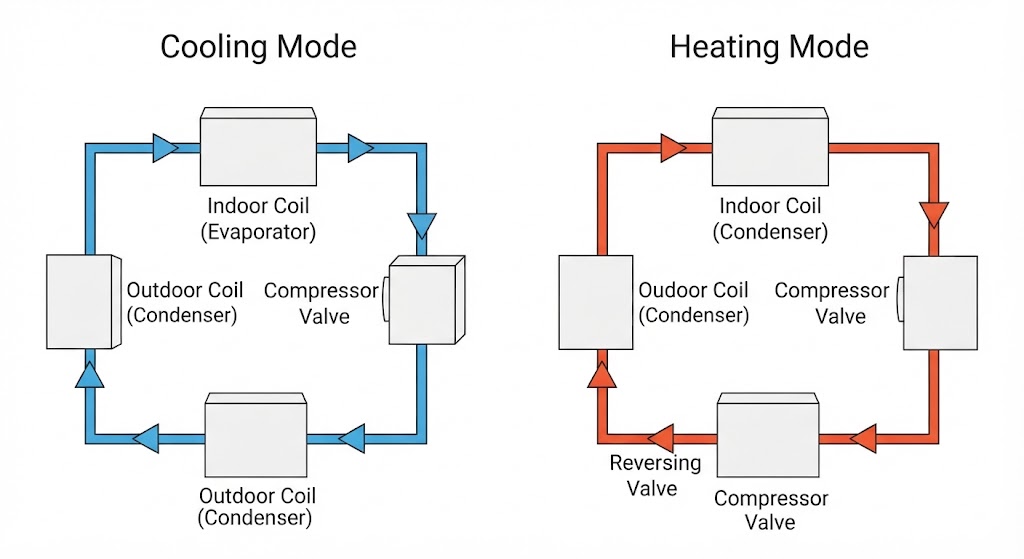
A heat pump adds one key component to a standard refrigeration circuit: a reversing valve. This valve controls which coil acts as the evaporator and which acts as the condenser at any given moment, by changing the direction refrigerant flows through the circuit.
In cooling mode, the heat pump behaves exactly like a standard air conditioner: the indoor coil is the evaporator (absorbing heat from inside), and the outdoor coil is the condenser (rejecting that heat outside).
In heating mode, the reversing valve flips the refrigerant flow direction. Now the outdoor coil becomes the evaporator, and the indoor coil becomes the condenser. The system absorbs heat from outside air and rejects it inside the building — heating the space using the exact same compressor, coils, and metering device, just with refrigerant flowing the opposite direction through the circuit.
This is the part that surprises people who haven't thought it through: even cold outdoor air still contains some heat energy (as long as it's above absolute zero), and a heat pump's evaporator can extract that heat, even from air that feels cold to a person standing in it. The colder the outdoor air gets, the harder that extraction becomes — which is the practical limit on heat pump performance in very cold climates — but the underlying physics works across a genuinely wide temperature range.
Why This Matters: One System, Two Jobs
The practical significance of this reversal is straightforward but substantial: a heat pump can provide both heating and cooling from a single piece of equipment, using a single refrigeration circuit, rather than requiring separate heating and cooling systems.
This has real consequences for system design and building operation:
Simplified equipment and space requirements. One outdoor unit and one refrigerant circuit handles both seasons, rather than a furnace or boiler for heating plus a separate air conditioner for cooling.
Genuine efficiency advantage over resistance heating. A heat pump isn't generating heat the way an electric resistance heater does — burning energy directly to produce heat — it's moving existing heat from outside to inside. Moving heat is fundamentally more efficient than generating it from scratch, which is why heat pumps commonly achieve significantly more heating output per unit of electricity consumed than resistance heating does.
A shared maintenance and failure profile. Because heating and cooling share the same compressor, coils, and refrigerant circuit, a mechanical issue doesn't stay isolated to one season — a compressor problem discovered in winter heating mode has direct implications for how the same system will perform in summer cooling mode, since it's the identical hardware doing both jobs.
Where the Reversing Valve Fits in the Cycle
To place this concretely within the four-component cycle: the reversing valve sits between the compressor and the two coils, directing the compressor's high-pressure discharge gas toward whichever coil is currently acting as the condenser, and directing the return path from whichever coil is acting as the evaporator back toward the compressor's suction side. The metering device also needs to function correctly in both flow directions — which is why many heat pump metering device designs incorporate a check valve or bidirectional flow path, rather than the simpler one-directional design sufficient for a cooling-only DX system.
The Bigger Picture
Once the four-component refrigeration cycle is genuinely understood — not just memorized as compressor-condenser-restriction-evaporator, but understood as pressure controlling where heat is absorbed and rejected — a heat pump stops looking like a separate technology and starts looking like exactly what it is: the same cycle, made reversible. That's a useful lens for a lot of HVAC-R technology broadly — many apparent innovations turn out to be the same small set of underlying thermodynamic principles, applied or arranged in a new way.
EveryEng. For everyone in Engineering.


 Aug 29, 2026


