


Article details
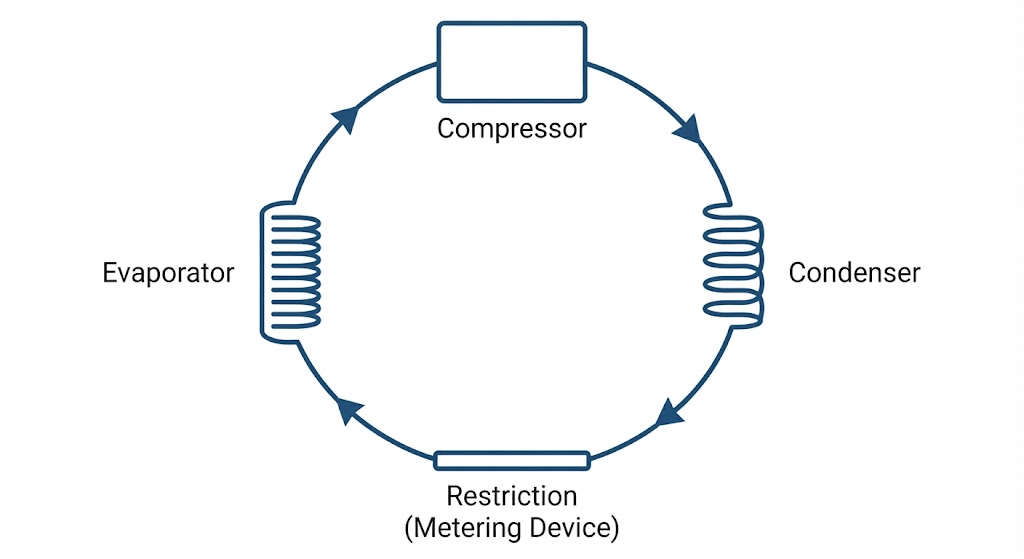
A refrigeration circuit runs on four components — compressor, condenser, restriction, and evaporator — cycling refrigerant continuously between them. But knowing the parts doesn't explain why the cycle actually works. That comes down to one relationship: pressure and temperature.
Heat Is Relative
Before getting into pressure and temperature, it's worth resetting an intuition most people carry around without noticing: heat is entirely relative to context, not an absolute feeling.
A day that feels uncomfortably hot in one climate would feel mild in another. A body of water that feels freezing on a warm day would feel warm compared to liquid nitrogen. Neither "hot" nor "cold" is an absolute property — they're comparisons, and refrigeration only makes sense once you stop thinking of temperature as a fixed feeling and start thinking of it as a number that can be manipulated relative to whatever's around it.
This matters because refrigeration doesn't work by "making things cold" in any mystical sense. It works by moving heat from somewhere it isn't wanted to somewhere it is more acceptable — nothing more exotic than that.
The Real Key: Pressure Controls Boiling Point
Here's the detail that unlocks the entire cycle: the temperature at which a substance changes from liquid to gas — its boiling point — isn't fixed. It depends on pressure.
Water is commonly associated with boiling at 100°C, but that's only true at standard atmospheric pressure, at sea level. Reduce the pressure — say, at high altitude — and water boils at a noticeably lower temperature. Reduce the pressure enough, using a vacuum, and water can be made to boil at room temperature.
Refrigerants exploit this same principle deliberately, just at a much more extreme range — many common refrigerants can boil at temperatures as low as -40°C, simply by controlling the pressure they're kept at.
This is the entire mechanism behind the refrigeration cycle: manipulate a refrigerant's pressure, and you control the temperature at which it changes state between liquid and gas. Everything the compressor, condenser, restriction, and evaporator do is built around this single principle.
Following the Pressure Through the Cycle
If you split the refrigeration circuit into a low-pressure side and a high-pressure side, the dividing lines are the compressor (which raises pressure) and the restriction (which drops pressure back down).
From the compressor through the condenser: high pressure
From the restriction through the evaporator: low pressure
The compressor is what creates the high-pressure side by compressing the gas. The restriction (metering device) is what allows the pressure to drop back down before the refrigerant enters the evaporator — this pressure drop is exactly what allows the liquid refrigerant to boil at a much lower temperature than it could at the high-pressure side, which is what enables it to absorb heat effectively in the evaporator.
Three States, Three Terms Worth Knowing
To describe refrigerant condition precisely, refrigeration uses three specific terms:
Superheat — heat added to refrigerant vapor beyond its boiling point, ensuring it's fully in a gas state with no liquid remaining. This matters because compressors compress gas — they are not designed to handle liquid. Liquid refrigerant reaching the compressor can cause serious mechanical damage, so ensuring adequate superheat before the compressor is a genuine safeguard, not just a technical formality.
Saturated — the state where refrigerant exists as both liquid and gas simultaneously, right at its boiling/condensing point. This happens in the middle portion of both the condenser and evaporator, exactly where the refrigerant is actively changing state.
Subcooled — heat removed from refrigerant below its condensing point, ensuring it's fully liquid with no gas remaining. This matters at the other end of the cycle: only pure liquid refrigerant should reach the metering device, since this maximizes the system's overall capacity, efficiency, and reliability.
The Complete Cycle, Start to Finish
Putting all of this together, here's the full sequence:
Refrigerant enters the compressor as a low-pressure superheated gas.
The compressor raises its pressure, turning it into a high-pressure superheated gas.
Inside the condenser, the gas cools, passes through a saturated (mixed liquid/gas) state, and finally becomes a high-pressure subcooled liquid.
The subcooled liquid passes through the metering device into a low-pressure environment, causing it to begin vaporizing immediately.
Inside the evaporator, the refrigerant absorbs heat from the space being cooled, boiling into a vapor and then, by the end of the coil, a superheated gas — ready to enter the compressor and begin the cycle again.
Every physical behavior in this sequence — where heat is absorbed, where it's rejected, why the compressor never sees liquid, why only pure liquid reaches the metering device — traces back to the single principle of pressure controlling boiling point. Once that clicks, the rest of the cycle stops being a memorized sequence and starts being something you can actually reason through.


 Aug 29, 2026


