
Article details
Seam welding is a highly efficient, continuous resistance welding process fundamentally designed to create durable, leak-proof joints. While traditional spot welding is ideal for localized structural fastening, seam welding evolves this concept by creating a continuous sequence of overlapping weld nuggets, making it essential for manufacturing sealed containers, pipes, and automotive components.
Working Principle

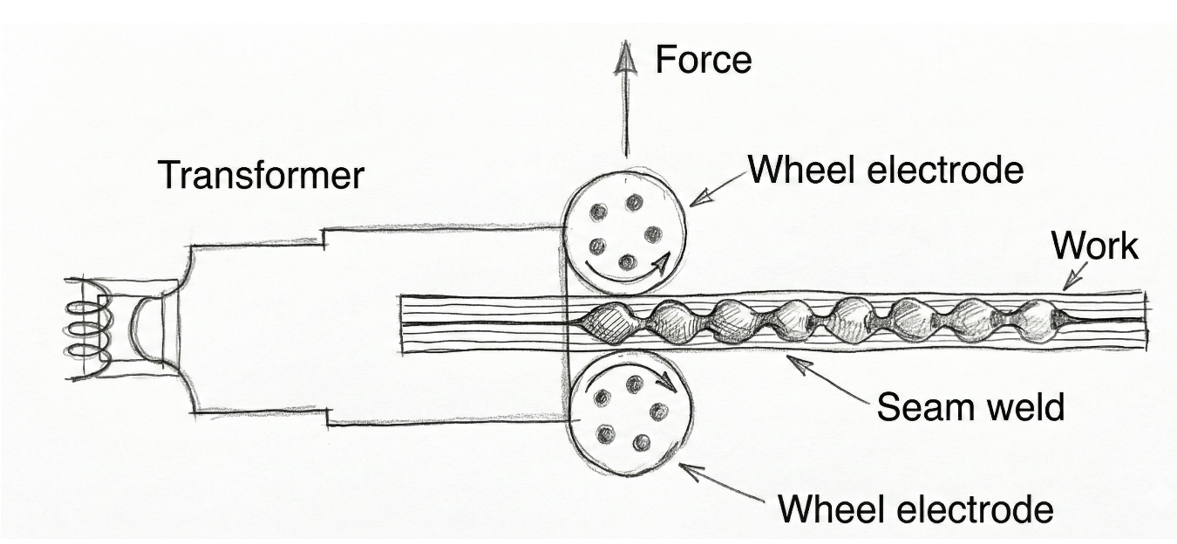
seam welding operates on the same electrical resistance principles as standard spot welding, but it replaces static, point-shaped electrodes with rotating wheel or roller electrodes.
As the workpieces (typically overlapping sheet metals) are fed between these rotating wheels, a welding transformer supplies a continuous or pulsed electrical current. Simultaneously, mechanical force is applied through the wheels. The electrical resistance at the faying surfaces of the metal generates intense, localized heat, melting the material. The applied pressure then fuses the molten metal into a solid nugget as it passes through the wheels.
The "Stitch Weld" and Leak-Proofing
The defining characteristic of seam welding is its ability to produce overlapping spot welds. Because the wheel electrodes rotate continuously over the joint, the individual weld nuggets overlap one another. This continuous chain of fused metal is sometimes referred to as a stitch weld.
This overlapping is the critical factor that allows seam welding to produce hermetically sealed, leak-proof joints, differentiating it from intermittent fastening methods. To achieve this at higher production speeds, the synchronization of current pulsing, wheel rotation speed, and applied force must be tightly controlled.
Process Characteristics
Continuous Operation: Unlike the discrete "clamp-weld-release" cycle of standard spot welding, seam welding is a continuous, high-speed process. The workpieces are constantly moving between the rollers.
Electrode Configuration: The use of wheel or roller-shaped electrodes allows for both the transmission of current and the mechanical feeding of the workpiece.
Thermal Management: Because seam welding is a continuous process handling high currents, the wheel electrodes are subjected to extreme, sustained heat. If left unmanaged, the electrodes will rapidly overheat, leading to degradation and poor weld quality. Consequently, constant cooling—typically achieved by flooding the electrode wheels and the immediate weld area with water—is a mandatory requirement for this process.


 Aug 29, 2026