


Article details
Most rotating equipment in a refinery is running blind. Not badly maintained, not neglected, just unobserved between one manual inspection round and the next.
The figure MEMSYS put in front of the room at Oil & Gas Automation and Digitalisation Congress (Automa) 2025 was 87%. That is the share of rotating equipment with no continuous monitoring at all, broken down further: 57% left to run until it fails, 24% covered by periodic manual rounds, 5% on battery-powered sensors and 1% on energy-harvesting sensors. Only 13%, the genuinely critical assets, get wired online monitoring. Meanwhile the reliability-related lost profit opportunity for a single refinery sits somewhere between $20 million and $50 million a year.
Read those two numbers together and a fairly specific problem appears. The economics of monitoring everything have never worked, so the industry monitors what it must and accepts the rest as risk. What changes that equation is not a bigger platform from a bigger vendor. It is usually something small, cheap and narrow enough to install without shutting anything down.

What a round-based inspection actually costs
MEMSYS COO Philip Seijger broke the alternatives down in a way that is hard to argue with. On a route-based regime, a piece of equipment is unobserved for 96% of the year, and someone walks into a hazardous zone twelve times a year to keep it that way. When a defect does start developing, detection can take up to 30 days and the repair another 14. That is six weeks between the beginning of a problem and the end of it, most of it spent not knowing.
Battery-powered sensors solve part of this and introduce a strange failure mode of their own. The energy budget is fixed, so the sensor has to ration measurements. As a defect develops and the need for closer monitoring increases, the battery drains faster, precisely when the information matters most.
MEMSYS harvests energy from the vibration of the equipment it monitors. The logic inverts cleanly: more vibration means more available energy, which means more measurements exactly when the machine is signalling a problem. No batteries to replace on a three to five year cycle, a claimed service life beyond 15 years and ATEX certification expected in the fourth quarter of 2026.

The valve nobody can see
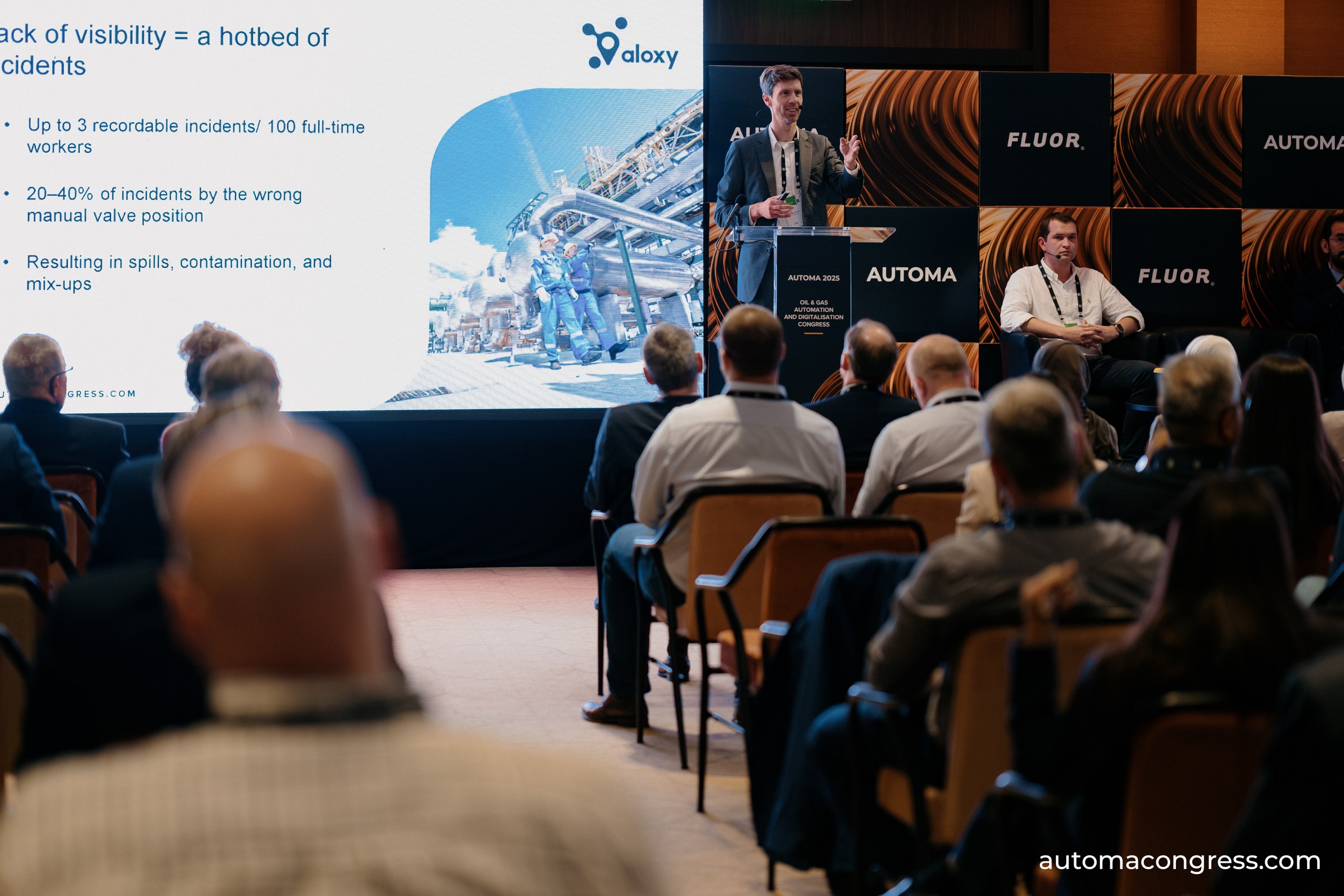
Aloxy arrived at Automa 2025 with a narrower problem and an equally specific set of numbers. On tank terminals, between 20% and 40% of incidents trace back to a manual valve being in the wrong position. Each site records one to five incidents a year, and a single one can run to $500,000 in damage once lost product, regulatory penalties and reputational cost are counted. By 2026, on Aloxy's own projection, 45% of valves in the industry will still be manual with no real-time position visibility.
The illustration Dries van der Kleij (Sales Director) used was the Elizabeth River spill in Chesapeake, Virginia, in February 2025, where 2,100 gallons of fuel were lost.
What makes the solution interesting for an engineering audience is the constraint it respects. The sensor retrofits onto any existing manual valve, installs in about two minutes and requires no process interruption. It runs on LoRaWAN, works on-premise or in the cloud and pays back somewhere between three months and 18 months depending on the site.
Neither of these is a moonshot. Both are small companies attacking a gap that the incumbents priced themselves out of.
The engineer who tested the hype and published the result
The same panel included a useful corrective, and it came from someone with the standing to deliver it. Sigifredo Nino, president of Summa Control Solutions and co-author of the ISA-5.9 PID Technical Report, has spent a career on distillation control with the receipts to match: over $300,000 a year saved on propane recovery at one gas plant, more than $2.5 million a year on a xylene column optimisation, over $1 million a year on composition control in benzene-toluene fractionation.
He gave three AI models a real problem: recommend a control strategy for a depentaniser, 30 theoretical trays, D/F around 0.208, reflux ratio around 1.7, relative volatility around 2.13. ChatGPT-4o, ChatGPT-5 Thinking and Gemini 2.5 Flash all converged on the same answer, the conventional LV strategy, with varying degrees of confidence about why.
The problem is not the wrong answer. The problem is that it is the textbook answer, arrived at without analysing the specific column. Nino showed a trend from a real plant where the LV strategy was implemented and then abandoned, because it kept failing and the site had to move to an SV configuration instead. He also caught one model fabricating a citation outright, a 1974 paper on a "Level-Velocity strategy" that does not exist.
His conclusion fits on one line: "AI could be advisory, not a defense." The engineer still signs off, still carries the liability and still has to know when the confident answer is a recital rather than an analysis.
How a 70,000-person contractor goes looking for small companies
The fourth speaker approached the same theme from the opposite end. Aref Boualwan, VP of Information Systems and Technology and CISO at Consolidated Contractors Company, presented on bridging the gap between corporates and startups. CCC operates on a different scale: 73 years old, more than $300 billion in delivered projects, 54 countries, around 70,000 employees, with a portfolio that includes 26 LNG projects and the world's largest green hydrogen plant.
What he described was a process rather than an attitude. On one side, a bottom-up route: identify engineers under 40, send out a structured questionnaire, collect and evaluate the ideas that come back, approve and launch the ones worth funding, then make the whole thing permanent through an Innovation and R&D Committee. On the other, a partnership route: identify projects that need advanced technology, run them through the same committee, go looking for startups working on it, get to a breakthrough, formalise the partnership and then fold what worked into the company's standard construction methodology.
That last step is the one that matters and the one most innovation programmes never reach. A successful pilot that stays a pilot has changed nothing. The point of the funnel is that the output rewrites the standard method.
From sensing to acting
Look across the whole 2025 programme rather than one panel and the through-line is not really IoT, AI or startups. It is autonomy, in the unglamorous engineering sense: reducing the number of situations where a human has to physically go somewhere to find out what is happening, and then decide what to do about it.
A self-powered vibration sensor removes twelve hazardous-zone visits a year. A wireless valve position sensor removes a category of incident that exists purely because nobody could see the valve. A control strategy debate is, underneath, a debate about how much judgement an engineer is willing to delegate, and to what.
Framed that way, robotics stops being a separate topic and becomes the next increment of the same one. If the goal is fewer people walking into hazardous areas to gather information, a fixed sensor is one answer and a mobile platform that goes and looks is another.

Robotics gets its own room in 2026
At Automa 2026 in Amsterdam this October, that becomes explicit. Roundtable on advanced robotics in industrial operations, covers autonomous robotics for remote and offshore operations, AI-powered robotics and drones for inspection, monitoring and hazard prevention, robotic innovations for extreme environments and human-robot collaboration alongside operational safety and intelligent decision support.
That last theme is the one that connects back to Nino's argument. Human-robot collaboration and intelligent decision support are, in practice, the same question he was asking about AI in control design: where does the machine's recommendation end and the engineer's accountability begin.
The same problem, one year on
The 2026 closing panel keeps the startup thread running, and the lineup shows how the space is developing rather than repeating.
Security Robotics sends a robotics engineer, Max Leon Fritsche, to talk about securing oil and gas operations with robotic solutions. A robotics startup presenting in the startup session is the clearest signal available that the two agendas are not separate tracks.
exelonix arrives with cellular IoT for valve monitoring and asset tracking in hazardous environments. Set that beside Aloxy's LoRaWAN approach from 2025, and two independent companies are attacking the same visibility gap on different radio technology one year apart. That is what a maturing market looks like, and it suggests the problem was real rather than a single vendor's pitch.
Fieldnode comes from a different angle again, with digital inventory and on-demand manufacturing for maintenance supply chains. Same underlying logic, applied to spares instead of sensors: stop holding physical stock against every eventuality and produce the part when the failure actually happens.
Why this matters for the engineer in the middle of it
None of this changes anything by itself. A retrofit sensor still needs someone to specify it, integrate it with the CMMS, work out what the alert thresholds should be and defend the change through whatever management-of-change process governs the site. A robot in a hazardous area still needs someone who understands both the hazard and the robot.
Procurement alone will not close the gap the 87% figure describes. It gets closed by engineers who can evaluate a small company's claim, run a contained pilot, read the results honestly and then argue for scaling it or killing it. Both the 2025 and 2026 programmes are full of people doing exactly that, in public, with numbers attached.
The full business programme is available on request through the Automa 2026 website: https://sh.bgs.group/4nv.


 Aug 29, 2026


