


Article details
HVAC-R doesn't stay still. Refrigerants are being phased down and replaced. Data centers are shifting from air to liquid cooling. AI and IoT are changing how buildings are controlled and maintained. Someone who stopped learning the day they finished their training is, quietly, already behind — not because they've forgotten anything, but because the field itself has kept moving.
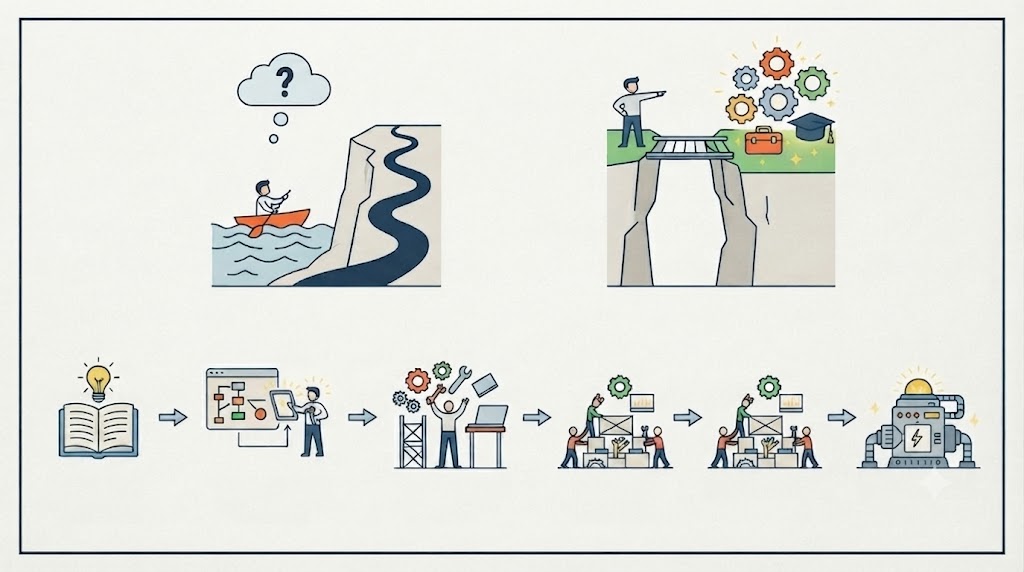
That's the honest case for upskilling: not as a vague career-advice platitude, but as a practical response to an industry that changes faster than most formal education can track. Here's why it matters concretely, and — more usefully — how to actually go about it.
Why This Matters More Than It Might Seem?
A few forces are converging that make continuous upskilling genuinely necessary, not optional, in this field right now:
Refrigerant transitions — as low-GWP alternatives replace older refrigerants under regulatory pressure, engineers who don't stay current on refrigerant properties and handling risk making decisions based on outdated assumptions.
New system categories — liquid cooling, solid-state caloric cooling, and other emerging technologies didn't exist in most people's original training, regardless of how recent that training was.
Controls and software convergence — HVAC increasingly overlaps with data, sensors, and predictive algorithms, a skill set traditional mechanical training rarely covered in depth.
Rising performance expectations — sustainability requirements and energy codes keep tightening, meaning "how we did it ten years ago" is often no longer good enough on its own.
None of this means starting over. It means treating learning as a continuous, ongoing part of the job rather than something that ends at graduation or certification.
How to Actually Upskill: Four Practical Channels
1. On-the-job and mentorship-driven learning
This is consistently the fastest way to build real judgment, not just knowledge. Concretely, this looks like:
Asking to shadow someone handling a type of project or system you haven't worked on yet
Requesting stretch assignments slightly beyond your current comfort zone, with a more experienced colleague available to check your work
Actively asking "why" during design reviews or troubleshooting, not just absorbing the "what"
Structured mentorship compresses this dramatically compared to learning purely by trial and error — this is exactly the gap platforms like EveryEng are built to close, connecting engineers directly with experienced mentors rather than leaving people to figure things out alone.
2. Formal certifications and credentials
Certifications are most valuable when chosen deliberately, tied to where you actually want to go, rather than collected generically:
NEBB — valuable specifically for commissioning and testing/balancing work
LEED accreditation — relevant if you're moving toward sustainability-focused or green-certified building projects
Manufacturer-specific certifications — genuinely useful for applications/field engineering tied to particular equipment lines
PE licensure — the one credential that functions as a hard gate for independently stamping drawings in many regions, worth pursuing early if design authority is the goal
3. Self-directed technical study
This is the least glamorous but most foundational channel:
Working through ASHRAE Handbooks and technical standards directly, rather than only secondhand summaries
Deliberately practicing psychrometric chart reading and load calculation logic on real or sample projects, not just once during initial training
Following industry technical publications for emerging developments — new refrigerants, new cooling technologies, updated codes
4. Communities and peer learning
Learning doesn't have to be solitary:
Professional bodies and local chapters (ASHRAE, ISHRAE, and similar organizations) often run technical sessions specifically designed for continuing education
Online technical forums and discussion communities, where real field problems get debated by practitioners
Structured mentorship platforms, which combine peer learning with more experienced guidance in one place
How to Choose What to Upskill In
With limited time, prioritization matters more than breadth. A reasonable approach:
If you're early-career: prioritize foundational fluency — psychrometrics, refrigeration cycle reasoning, reading drawings critically — before chasing advanced certifications
If you're mid-career: identify the one adjacent skill that would meaningfully expand what projects you're trusted with (controls literacy for a design engineer, energy modeling for a facilities engineer) and go deep on that one thing rather than spreading thin
If you're senior: consider that mentoring others is itself a skill worth deliberately building — teaching what you know well is a distinct capability from simply knowing it
The Bottom Line
Upskilling in HVAC-R isn't a one-time event tied to a new certification or a new job title — it's an ongoing habit, and the field currently rewards that habit more visibly than it has in years, given how much is genuinely changing. Whether that means finding a mentor, working through a technical handbook, or picking one adjacent skill to go deep on, the engineers who treat learning as continuous are the ones who stay ahead of a field that shows no sign of slowing down.


 Aug 29, 2026


