

Article details
Introduction
Young’s modulus is an important mechanical property used to describe the stiffness of a material. It explains how much a material deforms when subjected to an external force, provided the material remains within its elastic limit. Engineers use this property to select suitable materials, evaluate structural performance, and design components that can withstand different loading conditions.
Young’s modulus is particularly important in mechanical, civil, aerospace, automotive, and manufacturing engineering. It helps determine whether a material can maintain its shape under applied loads or experience significant deformation during operation.
What Is Young’s Modulus?
Young’s modulus, also known as the modulus of elasticity, is a measure of a material’s resistance to elastic deformation under tensile or compressive stress. It describes the relationship between the stress applied to a material and the resulting strain when the material behaves elastically.
A material with a high Young’s modulus is generally stiff and experiences relatively little deformation under a given stress. A material with a low Young’s modulus is more flexible and deforms more easily under the same loading conditions.
For example, steel has a much higher Young’s modulus than rubber. When subjected to comparable stress within their elastic ranges, steel experiences considerably less strain than rubber.
Young’s modulus is an intrinsic material property under specified conditions, although its measured value can vary with temperature, material composition, manufacturing processes, and direction of loading in anisotropic materials.
Formula and Mathematical Expression
Young’s modulus is calculated by dividing normal stress by normal strain within the linear elastic region of a material.
Young’s Modulus Formula:
E = σ / ε
Where:
E = Young’s modulus
σ = Normal stress applied to the material
ε = Normal strain produced by the applied stress
Stress is defined as the force acting per unit cross-sectional area. Strain represents the ratio of the change in length to the original length of a material.
The stress formula is:
σ = F / A
Where F represents the applied force and A represents the original cross-sectional area.
The strain formula is:
ε = ΔL / L₀
Where ΔL is the change in length and L₀ is the original length.
Combining these expressions gives:
E = (F/A) / (ΔL/L₀)
Therefore, Young’s modulus can also be expressed as:
E = FL₀ / (AΔL)
This relationship is applicable to uniform specimens subjected to axial loading when the material behaves within the linear elastic range and the assumptions of the calculation are satisfied.
Units of Young’s Modulus
Young’s modulus has the same units as stress because strain is dimensionless. In the International System of Units (SI), it is expressed in pascals (Pa), equivalent to newtons per square metre (N/m²).
Since engineering materials often have high stiffness values, Young’s modulus is commonly expressed in megapascals (MPa) or gigapascals (GPa).
One gigapascal equals 1,000 megapascals, or one billion pascals. Metals such as steel and aluminium are commonly described using GPa because their elastic moduli are relatively large.
In the imperial system, Young’s modulus may be expressed in pounds per square inch (psi) or million pounds per square inch (Mpsi).
Using consistent units is essential when calculating stress, strain, deformation, and structural response.
Stress-Strain Relationship and Elastic Behaviour
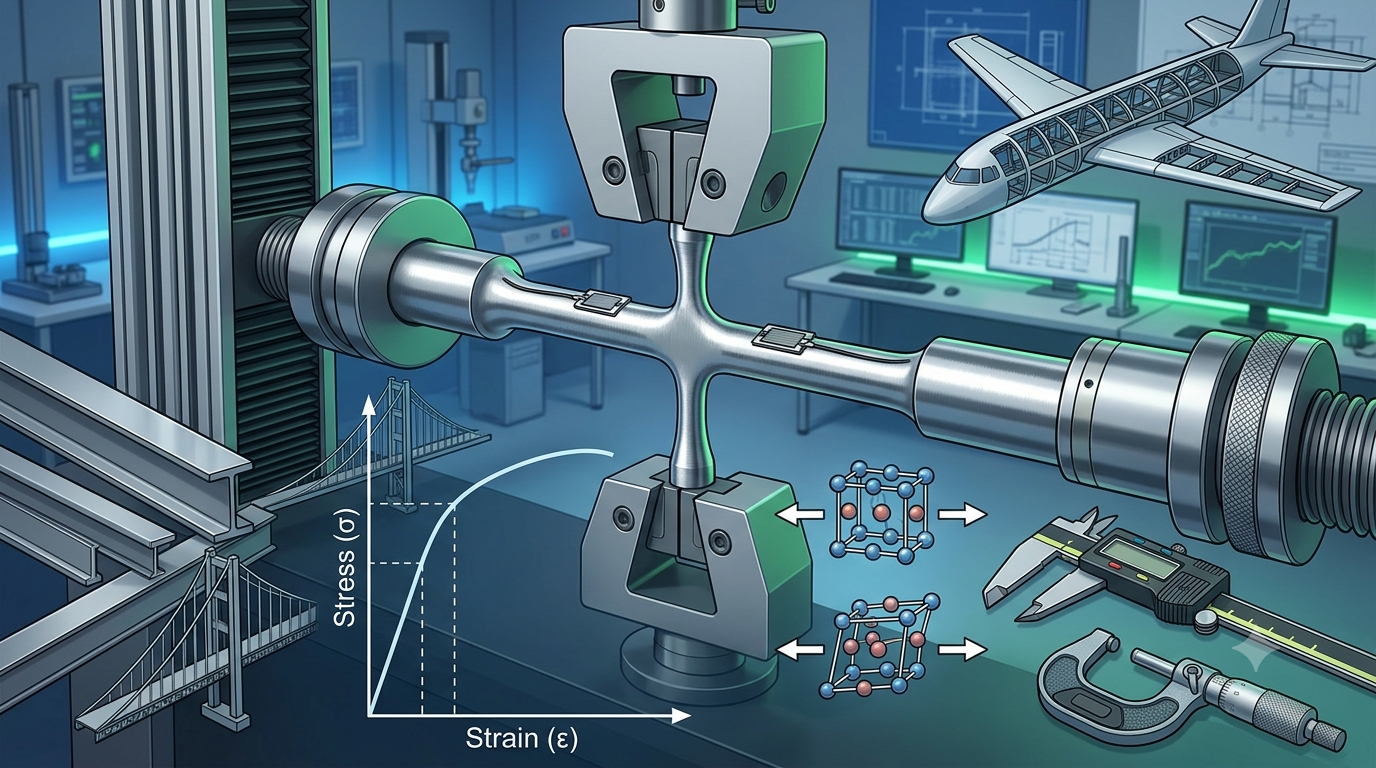
The stress-strain relationship describes how a material responds when an external force is applied. During a tensile test, a specimen is subjected to a gradually increasing pulling force while its deformation is measured.
In the initial linear portion of the stress-strain curve, stress increases proportionally with strain. The slope of this region represents Young’s modulus for a material exhibiting linear elastic behaviour.
When the applied load is removed within the elastic range, the material returns to its original dimensions, provided no permanent deformation has occurred.
As the load increases beyond the elastic limit, some materials begin to experience plastic deformation. In this region, the material may not return completely to its original shape after unloading.
Young’s modulus should therefore not be confused with yield strength, ultimate tensile strength, or hardness. Young’s modulus describes elastic stiffness, while yield strength indicates the stress at which significant permanent deformation begins, and ultimate tensile strength represents the maximum engineering stress reached during a tensile test.
A material can have a high Young’s modulus without necessarily having a high yield strength or excellent resistance to fracture.
Factors Affecting Young’s Modulus
Young’s modulus depends on the material’s internal structure and the conditions under which it is evaluated.
Material composition: Different chemical compositions and alloying elements influence atomic bonding and the overall stiffness of a material. For example, different metal alloys may exhibit different elastic moduli.
Temperature: Increasing temperature generally reduces the elastic modulus of many metals, although the magnitude of the change depends on the material. Temperature must be considered when designing components for furnaces, engines, power plants, and other high-temperature applications.
Material structure: Porosity, cracks, inclusions, and manufacturing defects can affect the effective stiffness of a component. Composite materials may also exhibit different moduli depending on fibre orientation and loading direction.
Direction of loading: Isotropic materials have approximately the same elastic properties in every direction under equivalent conditions. Anisotropic materials, including many fibre-reinforced composites and certain crystalline materials, can exhibit different Young’s modulus values along different directions.
Testing conditions: Measurement accuracy, specimen geometry, alignment, and the testing method can influence the reported value. Reliable results require appropriate specimen preparation and controlled testing procedures.
Young’s Modulus of Common Engineering Materials
Young’s modulus varies considerably between material groups. Many steels have an elastic modulus of approximately 200 GPa, while aluminium alloys typically have values around 69–72 GPa. Copper is commonly around 110–130 GPa.
Titanium alloys often have values around 100–120 GPa, depending on their composition and condition. Glass generally has a modulus of approximately 50–90 GPa, depending on its type. Polymers have much lower values, which can vary widely with composition, temperature, and loading rate. Rubber-like materials are considerably more flexible than structural metals.
These figures are approximate and should not replace certified material data for engineering calculations. The appropriate value depends on the specific grade, product form, operating temperature, and applicable design standard.
Young’s modulus alone is not sufficient for material selection. Engineers must also consider strength, fatigue resistance, corrosion behaviour, density, toughness, cost, and service conditions.
Engineering Applications of Young’s Modulus
Young’s modulus is used in many engineering calculations because it helps predict elastic deformation and evaluate the stiffness of components.
Structural engineering: Civil engineers use Young’s modulus to calculate the deformation of beams, columns, bridges, and building components under service loads. It helps evaluate deflection and maintain structural serviceability.
Mechanical engineering: Machine components such as shafts, brackets, fasteners, and supporting frames are designed with suitable stiffness to control deformation and maintain alignment during operation.
Automotive engineering: Young’s modulus is used when evaluating vehicle frames, suspension components, engine parts, and body structures. Material stiffness contributes to dimensional stability and load distribution.
Aerospace engineering: Aircraft structures require materials with appropriate stiffness and weight characteristics. Young’s modulus supports calculations involving wing deflection, fuselage deformation, and structural response under flight loads.
Manufacturing and materials testing: Tensile testing provides information about elastic modulus and other mechanical properties. Engineers use these results for quality control, material comparison, and verification of specified material performance.
Pressure vessels and piping: Young’s modulus contributes to calculations of elastic deformation in pipes, pressure vessels, and connected equipment subjected to internal pressure, external loads, and temperature changes.
Conclusion
Young’s modulus is a fundamental mechanical property that measures a material’s resistance to elastic deformation. It is calculated as the ratio of normal stress to normal strain within the appropriate elastic range and is commonly expressed in GPa for engineering materials.
Its value helps engineers predict deformation, compare material stiffness, and design safe and reliable structures and machine components. However, Young’s modulus must be considered alongside strength, temperature limits, durability, and other material properties to ensure suitable performance under actual operating conditions.
