


Article details
Business cards tell a lot about you in more ways than just the printed message. They must be handled appropriately. In the US we consider cards rather casually, but that is not the case in other cultures – especially Oriental ones. Whenever you travel, you should be aware of certain business customs. Compliance with these protocols can affect your first impression with your customer and ultimately the success of your meeting.
For example:
• always have ample cards available in your pocket or card case
• cards should be printed in the proper language of the customer (with English on the obverse)
• present your card after an appropriate greeting – handshake, bow or kiss on the cheek
• orient your card for proper reading by the person (in his/her language) to whom you are presenting
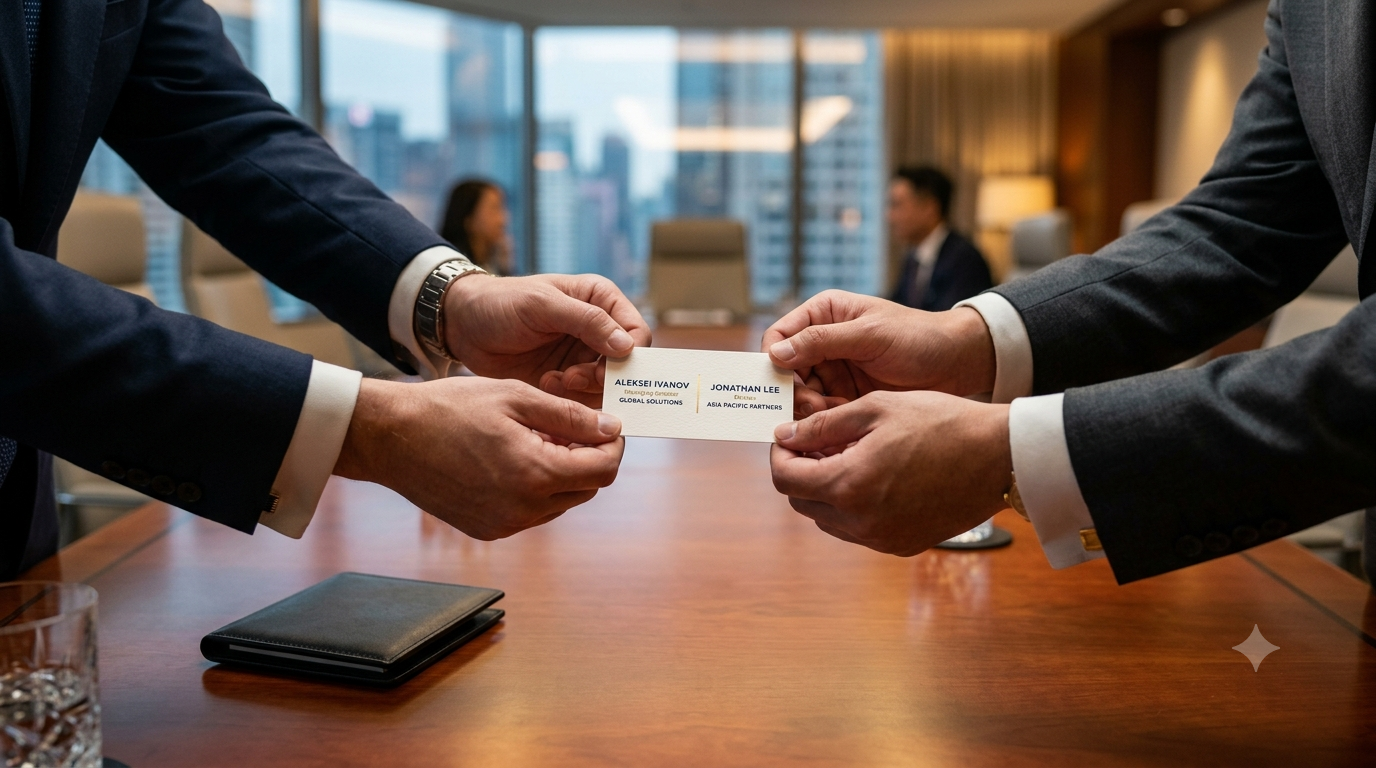
• in many cultures the card should be presented with both hands – it is often disrespectful to present it with one hand – but observe what others do.
The above exchange takes some practice to pull off smoothly – to sequence the greeting gesture, speak, and handoff the card properly. Mainly it involves thinking ahead, being prepared and knowing the customs of the parties involved. After this initial exchange there is another set of practices that can be critical:
1. Never throw your business card on the desk or table – that shows disrespect for yourself and the company you represent.
2. Receive the other person’s card with both hands. Study it for several seconds. It brings good will to ask a question or make a positive comment about the person’s company or schooling. That shows you are interested in the person. And be sure to get the pronunciation correct – even repeating it for confirmation. In many cultures you should use a title (Dr., Professor, Sheik) and the last name. First names are OK in the US, but be thoughtful in other cultures; use of first names may be inappropriate at the first meeting.
3. Place the card gently on the table in front of you. Arrange the cards in the order that people are seated so you can address them properly. Do not put the card in your pocket during the meeting.
4. Do not write on the card* – this action is disrespectful in many cultures. In the US we do this without thinking as a way to remember certain facts. But our customer may be thinking, “Why would you ever write on the back of a person’s card?” This seemingly harmless action becomes highly offensive to some cultures – and may kill the deal.
5. At the end of the meeting, do not throw the card in a briefcase or stick it into a pocket or wallet. Place it neatly in a leather or metal card case (never use plastic because that is low class).
6. Always carry the customer’s card back with you for the next meeting. It is poor manners to ask for a card again the next time you meet. Your customer may think that you did not consider him important. At a meeting in the Orient, the transfer of business cards is your first chance to get close to an Asian colleague.
The Business Card or Name Card is an extension of oneself. It represents one’s esteem, one’s honor, and one’s identity. That is why it must be treated with the utmost respect and care. This is more than a preoccupation with image. In the words of one expert, “The card exchange is a sincere moment. There are things in life you savor. Make this one of them.”
An engineer with international experience clarifies the issue: “When you write on the back of YOUR card and give it to someone…that shows a close relationship as you are adding more contact information (home number, cell number) that you do not want to share with others. It is especially nice if you do this to somebody below you or your customer.” So if you choose to write on your own card, for your own reasons, there is no issue. Just don’t write on someone else’s card.


 Aug 29, 2026


