<link href="https://fonts.googleapis.com/css2?family=Caveat:wght@500;700&family=JetBrains+Mono:wght@400;500;600&display=swap" rel="stylesheet" /> Skip to main contentEngineering Courses, Mentoring & Jobs | EveryEng
Basic Fundamentals of HVAC banner

Basic Fundamentals of HVAC

Basic Fundamentals of HVAC banner
Live online Beginner

Basic Fundamentals of HVAC

4(69)
10 enrolled
1322 views
COMPLETED

Tell us and we’ll notify you when the next batch is scheduled.

1 hrs
-
English
1322 views
Yogesh Kulkarni
Yogesh Kulkarni
  • Session recordings included
  • Certificate of completion
  • Foundational Learning
  • Access to Study Materials
Volume pricing for groups of 5+

Why enroll

Mastering the Basic Fundamentals of HVAC is a crucial step towards a rewarding career in the heating, ventilation, and air conditioning industry. With this foundational knowledge, you'll be well-positioned to advance into roles such as HVAC Technician, Installation Specialist, or Maintenance Supervisor. As you progress, you can move into senior positions like Service Manager, Operations Manager, or even start your own HVAC business. Moreover, HVAC constitutes around 70% of overall building MEP (Mechanical Electrical Plumbing) services and hence understanding the basics of HVAC systems can also lead to opportunities in related fields like energy auditing, building management, and sustainability. By learning the fundamentals of HVAC, you'll unlock a world of possibilities for career growth and advancement in this in-demand industry.


What enrolled engineers say

6 verified reviews
  • May 3, 2026

    Early modules lay down the physics cleanly without fluff, which helped frame everything that follows. The psychrometric chart walkthrough in Chapter 2, especially the example tracing mixed air at 55°F and 60% RH, stuck because it's exactly what comes up when reviewing HVAC specs. Explanations map well to day-to-day arch and infra conversations, like translating load calcs into duct sizing choices you can defend in a PR or design review. It’s beginner-friendly but doesn’t talk down, though I wished there was a bit more on controls logic and how it shows up in obs once systems hit prod. Some slides lingered on terminology, and a few diagrams could be tighter, but that’s a minor gripe. After finishing, I’m quicker to make HVAC calls and sanity-check arch tradeoffs without bouncing everything to a specialist.

    Neelam R. · CEO Verified
  • May 3, 2026

    Feels like annotated notes from someone who's been in the field, aimed at getting a team aligned fast without fluff. The psychrometrics section where he walks a mixed-air example step by step, then sanity-checks humidity against comfort bands, stuck with me. As a TeamLead watching budget, it's mostly practical, though I wasn't sold on the brief controls overview and wished there was more on commissioning checks across the system arch and building infra. Still, the way it calls out oddball cases: shoulder-season short cycling and undersized returns, helps avoid mistakes that show up later.

    Chilakapati A. · junior trainee Verified
  • May 3, 2026

    The psychrometric chart walkthrough in Chapter 3 clicked for sizing airflow; it's mostly clear, though I wished for a quick field calc example.

    Shinde S. Verified

Is this course for you?

You should take this if

  • You work in HVAC
  • You're a Mechanical Engineering professional
  • You prefer live, instructor-led training with Q&A

You should skip if

  • You need a different specialisation outside Mechanical Engineering
  • You need fully self-paced, on-demand content

Course details

This introductory course covers the essential principles and concepts of Heating, Ventilation, and Air Conditioning (HVAC) systems. Students will learn the basic fundamentals of HVAC, including:

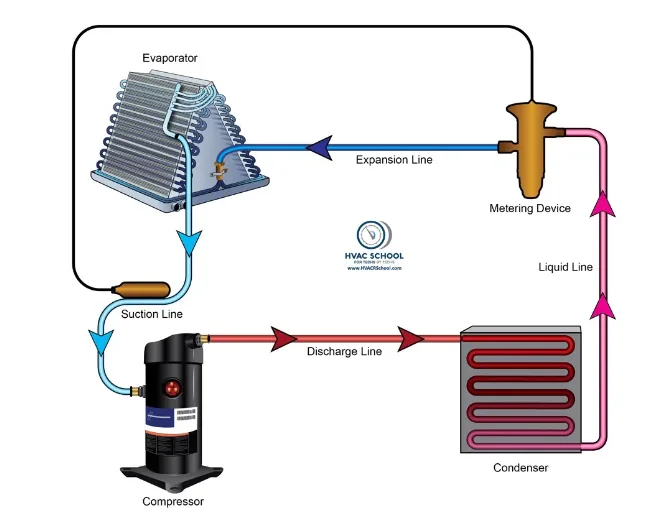
- Understanding the basics of refrigeration

- Identifying components and functions of HVAC systems

- Exploring types of HVAC systems and their applications

- Understanding airflow, ductwork, and ventilation principles

- Familiarizing with HVAC Maintenance and Energy saving

Course suitable for

Key topics covered

- Sensible Heat
- Latent Heat
- Dry Bulb Temperature
- Wet Bulb Temperature
- Dew Point Temperature
- Definition of Ton Enthalpy
- Relative Humidity
- Refrigeration Cycles
- Vapour Compression Cycle
- Vapour Absorption cycle

Opportunities that await you!

Career opportunities

Training details

This is a live course that has a scheduled start date.

Live session

Starts

Sat, Mar 21, 2026

12:00 AM UTC· your timezone

Duration

1 hour per day

COMPLETED

-

Questions and Answers

A: This placement preserves control accuracy by measuring the variable the coil actually controls. B sounds plausible but EMI isn't the limiting error source for temperature sensors here. C is convenient but doesn't justify the standard’s intent. D mixes up airflow measurement practice with temperature sensing.

A: The correct response keeps volumetric flow at setpoint despite density change. B assumes heating mode logic that's not yet active. C is an AHU-level response, not the terminal’s first move. D confuses zone load response with terminal control sequencing.

A: This sequence proves normal operation before testing the safety function. B skips baseline operation and can mask mis-stroking. C mixes control verification with safety testing and risks false conclusions. D trusts paperwork over physical behavior.

A: The dashed blade communicates the default or fail state to the reviewer. B confuses actuation with graphic convention. C applies architectural section logic, not HVAC symbology. D invents a project control meaning that isn’t standard.