Skip to main contentEngineering Courses, Mentoring & Jobs | EveryEng
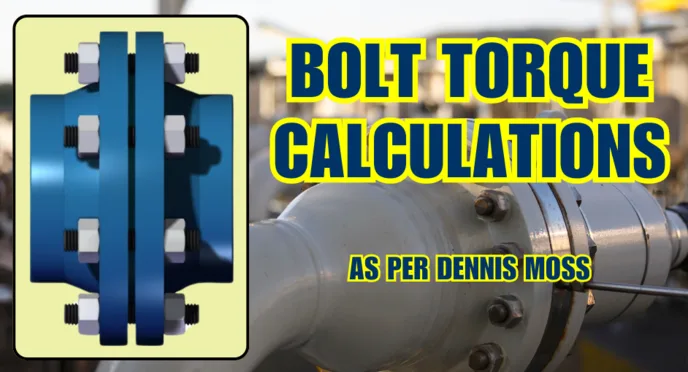
Bolt Torque Calculations as per Dennis Moss banner

Bolt Torque Calculations as per Dennis Moss

Bolt Torque Calculations as per Dennis Moss banner
Self-paced Advanced

Bolt Torque Calculations as per Dennis Moss

4(24)
7 enrolled
1574 views
FREE
57 min
Anytime
English
1574 views
Sachin Pol
Sachin PolFounder & Head Design
  • Lifetime access
  • Certificate of completion
  • Anytime Learning
  • Learn from Industry Expert

Why enroll

People enroll in the course “Bolt Torque Calculations as per Dennis Moss to gain practical knowledge of how to correctly tighten bolted joints and ensure safety in real engineering applications. Bolt tightening is critical in industries like oil & gas, construction, and mechanical engineering, where improper torque can lead to leakage, equipment failure, or even accidents.

What enrolled engineers say

6 verified reviews
  • May 3, 2026

    Feels like the reference you crack open when the arch assumptions start wobbling. The section where Moss walks through torque scatter using the K-factor shift from 0.18 to 0.25 on a flanged joint stuck, especially the oil & gas flange example and how clamp load collapses in prod. I've wired similar checks into CI for mech calcs alongside software PRs, so the math-to-ops bridge landed. mostly good, though I wasn't sold on the brief treatment of lubrication variability; more obs data would help.

    Aung N. Verified
  • May 3, 2026

    No-nonsense framing of the hard math helped keep this moving between meetings. The section on Dennis Moss’s torque–tension relationship where he walks the K-factor sensitivity with friction ranges and shows the oilgas flange example at 60% proof load stuck. It's mostly aligned with how we review fastener calcs before pushing to prod specs, though I wasn't sold on skipping measurement methods; wished there was more on scatter control beyond tables. I've already flagged it in the repo notes for my team—useful for PR reviews when bolts cross safety boundaries.

    Swaraj G. Verified
  • May 3, 2026

    The scenarios feel pulled from real plants, not classroom math, which kept me engaged between meetings. The advanced framing filled gaps I’ve had since bootcamp, especially how he walks from load cases to torque with all the caveats that show up in prod. Section 4’s worked example on a spiral‑wound gasket with 3/4" studs stuck with me, including the moment he adjusts for nut factor drift after a re-torque. I liked the quick checks against flange ratings and the nod to oilgas realities, even if the spreadsheet flow wasn’t always obvious on first pass. wasn't sold on the brief treatment of thermal cycling; wished there was more on how repeated heat-up changes assumptions over time. Still, I’ve already bookmarked it as a reference when arch reviews wander into bolting details or infra questions sneak in.

    bikash S. · Engineer Verified

Is this course for you?

You should take this if

  • You work in Oil & Gas Upstream or Automotive
  • You're a Mechanical Engineering / Onshore Pipeline Engineering professional
  • You have 3+ years of hands-on experience in this field
  • You prefer self-paced learning you can revisit

You should skip if

  • You're new to this field with no prior experience
  • You need a different specialisation outside Mechanical Engineering
  • You need live interaction with an instructor

Course details

Bolt torque calculation is a method used to determine the amount of torque required to tighten a bolt so that it achieves the desired clamping force (preload). In industrial applications—especially pressure vessels, piping, and oil & gas equipment—accurate torque ensures joint integrity and prevents leakage or failure.

When you tighten a bolt, the applied torque creates a tensile force (preload) in the bolt. This preload holds the joint components together and must be sufficient to resist external loads.

Bolt torque calculation, as outlined by Dennis Moss, provides a practical and widely used approach to achieve proper bolt preload. Understanding the relationship between torque, friction, and preload is essential for safe and efficient mechanical design and assembly.


With this course you will be able to the Bolt Torque Calculations as per Dennis Moss method.

This course covers and in-depth step by step demonstration with solved examples.

Course suitable for

Key topics covered

- Bolt torque manual calculations as per Dennis Moss.

- For sealing flanges

- Steps for calculations

Course content

The course is readily available, allowing learners to start and complete it at their own pace.

1 lectures57 min
  1. Bolt Torque Calculations
    57 min

Opportunities that await you!

Career opportunities

Why people choose EveryEng

Industry-aligned courses, expert training, hands-on learning, recognized certifications, and job opportunities-all in a flexible and supportive environment.

What learners say about this course

Avatar icon
Yousuf Ahmed
May 3, 2026

Fast-paced and uneven by design; the advanced tracks land harder than the beginner ones, and it's clear this assumes you've touched prod and CI before. The CI chapter wiring a GitHub Actions PR to a k8s canary and reading RPS on rollback stuck, though I wasn't sold on the thin obs coverage.

Swaraj Gothankar
Swaraj Gothankar
May 3, 2026

No-nonsense framing of the hard math helped keep this moving between meetings. The section on Dennis Moss’s torque–tension relationship where he walks the K-factor sensitivity with friction ranges and shows the oilgas flange example at 60% proof load stuck. It's mostly aligned with how we review fastener calcs before pushing to prod specs, though I wasn't sold on skipping measurement methods; wished there was more on scatter control beyond tables. I've already flagged it in the repo notes for my team—useful for PR reviews when bolts cross safety boundaries.

bikash sahoo
bikash sahoo Engineer
May 3, 2026

The scenarios feel pulled from real plants, not classroom math, which kept me engaged between meetings. The advanced framing filled gaps I’ve had since bootcamp, especially how he walks from load cases to torque with all the caveats that show up in prod. Section 4’s worked example on a spiral‑wound gasket with 3/4" studs stuck with me, including the moment he adjusts for nut factor drift after a re-torque. I liked the quick checks against flange ratings and the nod to oilgas realities, even if the spreadsheet flow wasn’t always obvious on first pass. wasn't sold on the brief treatment of thermal cycling; wished there was more on how repeated heat-up changes assumptions over time. Still, I’ve already bookmarked it as a reference when arch reviews wander into bolting details or infra questions sneak in.

Training .
Training . Design Engineer
May 3, 2026

Moves fast and doesn't linger on stuff you already know, which fit my pace between meetings. The worked example on the 3/4" ASTM A193 B7 flange with K=0.18 and a spiral-wound gasket stuck, especially seeing preload swing with lubrication. I've already pulled the calc sheet into our repo, sanity-checked it against a live oilgas job, and referenced it in a PR before prod. Wasn't sold on the brief treatment of scatter vs torque control—I wished for more on tensioning—but it was a good use of PD time.

FREE

Access anytime

Questions and Answers

A: A: Back-of-envelope holds. 7/8" B7 at 60% yield lands ~80–90 kips. Multiply by diameter in feet and K=0.18 and you're in the high-400s. That's Moss 101. B: That's a table memory bleed-over from 3/4" hardware. Order of magnitude is off. C: That torque would put the shank past yield even before accounting for scatter. D: Lubrication reduces K, it doesn't erase preload. Subtracting gasket compression double-counts the same force.

A: A: That's the target. Torque is a proxy; friction noise dominates. PCC-1 is about reducing that spread. B: Bolt-to-bolt interaction exists, but PCC-1 isn't a vessel code check. C: Relaxation is real, but PCC-1's preload focus is upstream of that problem. D: Thread damage is a maintenance issue; PCC-1 assumes intact hardware.

A: A: Heat-up unloads bolts if materials and lengths aren't matched. Leak shows after temperature, not at pressure test. B: Extrusion would show immediately and worsen with pressure, not temperature. C: Flange rotation leaks show up cold and during hydro. D: Pitting causes chronic seepage, not a clean post-startup alarm.

A: A: Pressure adds load to the joint. Adding torque stacks stresses unpredictably. B: Star pattern doesn't fix combined pressure and thermal load. C: Local tightening induces flange rotation and worsens the leak. D: Pressure seating is a myth here; it unloads bolts further.