<link href="https://fonts.googleapis.com/css2?family=Caveat:wght@500;700&family=JetBrains+Mono:wght@400;500;600&family=Plus+Jakarta+Sans:wght@600;700;800&display=swap" rel="stylesheet" /> Skip to main contentEngineering Courses, Mentoring & Jobs | EveryEng
CFD Analysis Of Nozzle banner

CFD Analysis Of Nozzle

CFD Analysis Of Nozzle banner
Self-paced Beginner

CFD Analysis Of Nozzle

4(1581)
13 enrolled
1749 views
₹ 149
16 min
Anytime
English
1749 views
Team EveryEng
Team EveryEngMechanical Engineering
  • 7-day money-back guarantee
  • Lifetime access
  • Certificate of completion
Volume pricing for groups of 5+

Why enroll

Participants join this course to gain practical skills in CFD simulation and understand complex fluid flow behavior in nozzle systems used in aerospace and engineering applications. It helps them enhance their design and analysis capabilities, making them industry-ready for roles involving simulation, optimization, and performance improvement.

What enrolled engineers say

2 verified reviews
  • Oct 8, 2024

    usefull

    VIKAS_D_ N. Verified
  • Sep 12, 2024

    Should have discussed ddetails like 1.why density based solver. 2.why pressure boundary conditions. 3.How pressure values affect the working of nozzle etc

    Sampath G. Verified

Is this course for you?

You should take this if

  • You work in Aerospace or Automotive
  • You're a Mechanical Engineering / Piping & Layout Engineering professional
  • You prefer self-paced learning you can revisit

You should skip if

  • You need a different specialisation outside Mechanical Engineering
  • You need live interaction with an instructor

Course details

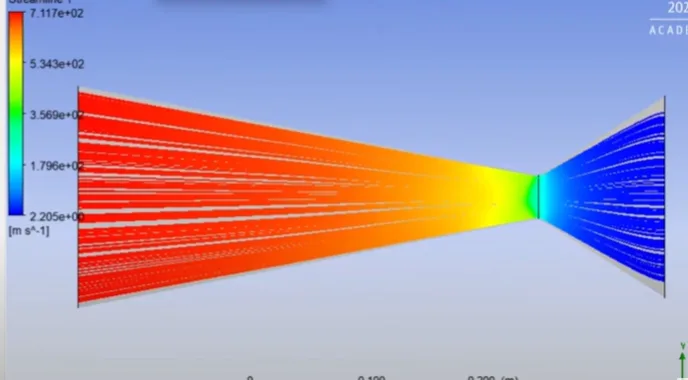
This course on CFD Analysis of Nozzle provides a comprehensive understanding of fluid flow behavior through nozzles using advanced computational tools. Participants will learn the fundamentals of Computational Fluid Dynamics (CFD), including governing equations such as continuity, momentum, and energy equations. The course covers nozzle types like convergent, divergent, and convergent-divergent (De Laval) nozzles, along with their practical applications in aerospace and mechanical engineering. Learners will gain hands-on experience in geometry creation, meshing techniques, boundary condition setup, and solver selection using industry-standard CFD software. Emphasis is placed on analyzing flow parameters such as pressure, velocity, temperature, and Mach number distribution. The course also explores compressible flow, shock waves, and supersonic flow behavior within nozzles. Post-processing techniques for result visualization and interpretation are included to help participants draw meaningful insights. Real-world case studies and simulations enhance practical knowledge and problem-solving skills. By the end of the course, learners will be equipped to perform accurate nozzle flow simulations and optimize designs for performance and efficiency.

Course suitable for

Key topics covered

  • Geometry

  • Name Selection

  • Meshing

  • Setup and Solution

  • Results


Course content

The course is readily available, allowing learners to start and complete it at their own pace.

4 lectures16 min
  1. Import Geometry and Name Selection
    2 min
  2. Meshing
    5 min
  3. Setup and Solution
    2 min
  4. Results
    7 min

Opportunities that await you!

Career opportunities

₹149

Access anytime

Questions and Answers

A: 0.528 is the ratio that matters. For air with γ≈1.4, once P_out/P_0 is below about 0.528, the throat is sonic and mass flow is locked. Lowering outlet pressure or tightening the boundary just changes shock structure, not ṁ. The only levers left are inlet total conditions or geometry, and anything else is CFD self-harm.

A: Mach 1 is the boundary that bites. ISO 5167 flow nozzles are calibrated for subsonic regimes without shock systems, so the discharge coefficient logic breaks once you introduce choking and shock–boundary-layer interaction. Using it past that point gives false confidence, not traceability.

A: 1×10⁻⁴ m² is the scale setter. Choked mass flow goes as A·P₀·√(γ/RT₀) times a constant near 0.68 for air. Plugging 10 bar and 300 K lands you in the mid‑tenths of a kg/s, not single digits and not hundredths. If CFD is far off that band, something basic is broken.

A: 0.528 shows up again. Choking limits mass flow but does not cap upstream pressure. With a blocked outlet, pressure will climb until something yields: MAWP, flange, or weld. Sonic isolation stops downstream disturbances, not upstream accumulation, and confusing the two kills hardware.