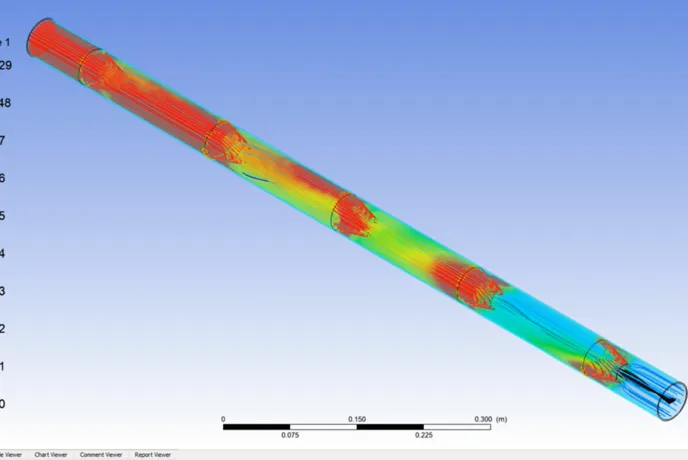
CFD Analysis of Tube With Conical Ring And Twisted Tape Insert
CFD Analysis of Tube With Conical Ring And Twisted Tape Insert

- 7-day money-back guarantee
- Lifetime access
- Certificate of completion
Why enroll
What enrolled engineers say
At first glance, the topics looked familiar, but the depth surprised me. Even though this is positioned as a beginner course, the walkthrough of turbulence modeling and heat transfer around twisted tape inserts maps well to problems seen in automotive exhaust heat exchangers and aerospace cooling ducts. The discussion on how conical rings alter secondary flow patterns felt closer to real CFD work than textbook examples. One challenge was getting stable convergence when meshing the twisted tape geometry. Skewed cells near the tape edges caused oscillations, which mirrors what happens in industry when CAD detail fights solver robustness. The course handled this reasonably, though I would have liked a clearer comparison between k‑ε and k‑ω SST models and when each breaks down, especially at lower Reynolds numbers. A useful takeaway was the systematic way pressure drop penalties were evaluated alongside heat transfer gains. That trade-off is often glossed over, but it’s critical at the system level, whether sizing an automotive radiator or managing pumping power in aerospace thermal management loops. Some edge cases, like transitional flow regimes, were only briefly touched, but that’s understandable at this level. I can see this being useful in long-term project work.
Coming into this course, I had some prior exposure to the subject. The content is positioned as beginner, but it still touches on issues that show up in real programs, especially around heat transfer augmentation and pressure drop management. The CFD walkthroughs on twisted tape inserts reminded me of similar work done in automotive thermal management, where small geometric changes can quietly blow up pumping power. The discussion on turbulence modeling, even at a basic level, lines up with what’s typically done in industry when quick RANS models are used instead of high‑fidelity approaches. One challenge was getting stable convergence once the conical ring and twisted tape were combined. Mesh quality around sharp edges became an issue, and the course could have spent a bit more time on edge cases like transitional Reynolds numbers or near-wall treatment. That said, the practical takeaway was clear: always evaluate heat transfer gains against system-level penalties, not in isolation. This is directly applicable to aerospace heat exchangers, where added mass flow or pressure loss has downstream impacts on compressors and fuel burn. Compared to industry practice, it’s simplified, but the workflow is realistic. I can see this being useful in long-term project work.
At first glance, the topics looked familiar, but the depth surprised me. The course walks through CFD fundamentals using a tube with conical rings and twisted tape, which maps well to real problems seen in automotive exhaust heat exchangers and aerospace thermal management ducts. The discussion around turbulence modeling and how swirl devices alter boundary layer behavior felt closer to industry practice than most beginner material. One challenge was keeping the setup stable when meshing the twisted tape geometry. Small changes in mesh density around the tape edges had an outsized impact on pressure drop predictions, which is an edge case that often gets ignored. Seeing how that affects convergence was useful, especially when comparing k‑ε assumptions to lower Reynolds number flows where those models start to break down. A practical takeaway was learning how to balance Nusselt number gains against pumping power penalties. That trade-off matters at the system level, whether it’s an automotive coolant loop or an aerospace environmental control system. Some simplifications were made, but they were called out clearly. The content felt aligned with practical engineering demands.
Your instructor
Team EveryEng
Engineer
Mechanical Engineering
Is this course for you?
You should take this if
- You work in Mechanics & Turbomachinery
- You're a Mechanical Engineering / CAD & Analysis professional
- You prefer self-paced learning you can revisit
You should skip if
- You need a different specialisation outside Mechanical Engineering
- You need live interaction with an instructor
Course details
Course suitable for
Key topics covered
Course content
The course is readily available, allowing learners to start and complete it at their own pace.
- Prepare the twisted shape7 min
- Run Calculations9 min
- Volume Rendering And Time step Animation8 min
Opportunities that await you!
Career opportunities
Why people choose EveryEng
Industry-aligned courses, expert training, hands-on learning, recognized certifications, and job opportunities-all in a flexible and supportive environment.


 Aug 29, 2026