Skip to main contentEngineering Courses, Mentoring & Jobs | EveryEng
Computational Fluid Dynamics (CFD) Analysis of Pipe banner
Self-paced Beginner

Computational Fluid Dynamics (CFD) Analysis of Pipe

4(3)
1 enrolled
2015 views
$ 5
52 min
Anytime
English
2015 views
Team EveryEng
Team EveryEngMechanical Engineering
  • 7-day money-back guarantee
  • Lifetime access
  • Foundational Learning
  • Access to Study Materials

Why enroll

Participants join this course to build a strong foundation in Computational Fluid Dynamics (CFD) and fluid flow analysis.It helps them gain practical skills in simulation, modeling, and using industry-standard software tools.The course enhances career opportunities in engineering fields like mechanical, civil, and chemical.It also provides hands-on experience with real-world applications, making learners job-ready.

Is this course for you?

You should take this if

  • You work in Aerospace or Automotive
  • You're a Mechanical Engineering professional
  • You prefer self-paced learning you can revisit

You should skip if

  • You need a different specialisation outside Mechanical Engineering
  • You need live interaction with an instructor

Course details

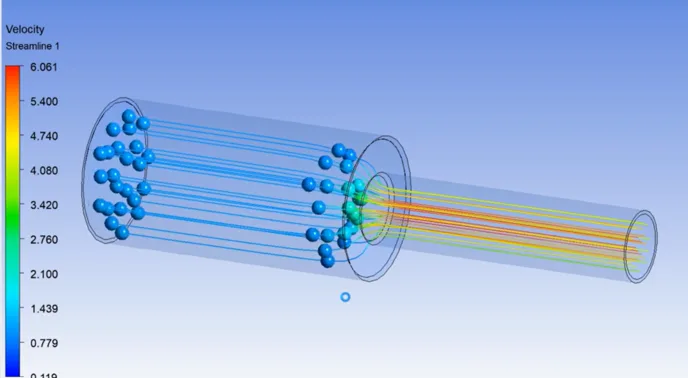
This course offers a comprehensive and in-depth understanding of Computational Fluid Dynamics (CFD) with a focus on analyzing fluid flow through pipe systems. It introduces the fundamental principles of fluid mechanics, including the conservation of mass, momentum, and energy, which are essential for understanding flow behavior. Participants will explore fluid properties, flow regimes, and boundary conditions specific to internal pipe flows. The course also covers numerical methods used in CFD to solve complex fluid flow equations accurately. Learners will gain hands-on experience with industry-relevant software tools to simulate and visualize flow patterns within pipes. Emphasis is placed on interpreting simulation results and understanding pressure drop, velocity distribution, and turbulence effects. Real-world case studies and practical examples are included to bridge the gap between theory and application. By the end of the course, students will be able to set up, run, and analyze CFD simulations for pipe flow problems effectively. This course is ideal for engineering students and professionals aiming to enhance their skills in fluid analysis and simulation. It provides a strong foundation for applying CFD techniques in various industrial and research applications.

Course suitable for

Key topics covered

  • Fluid Flow Simulation In 3D Circular Pipe

  • Fluid flow pipe simulation in pipe with sudden contraction (Part 01)

  • Fluid flow pipe simulation in pipe with sudden contraction (Part 02)

  • Fluid flow pipe simulation in pipe with sudden enlargement (Part-01)

  • Fluid flow pipe simulation in pipe with sudden enlargement (Part-02)

Course content

The course is readily available, allowing learners to start and complete it at their own pace.

5 lectures52 min
  1. Fluid Flow Simulation In 3D Circular Pipe
    12 min
  2. Fluid flow pipe simulation in pipe with sudden contraction (Part 01)
    11 min
  3. Fluid flow pipe simulation in pipe with sudden contraction (Part 02)
    10 min
  4. Fluid flow pipe simulation in pipe with sudden enlargement (Part-01)
    11 min
  5. Fluid flow pipe simulation in pipe with sudden enlargement (Part-02)
    8 min

Opportunities that await you!

Career opportunities

Why people choose EveryEng

Industry-aligned courses, expert training, hands-on learning, recognized certifications, and job opportunities-all in a flexible and supportive environment.

$5

Access anytime

Questions and Answers

A: Acting on the wrong step risks burning days reworking a model that was never wrong. A 3%–10% delta during hydrotest is often instrumentation geometry, not physics. Verifying tap locations and temporary hardware aligns the measured control volume with the CFD control volume, removing false pressure losses before touching mesh or correlations.

A: Choosing turbulence where none exists inflates shear stress and pressure loss, which can cascade into an undersized pump. At Re below transition, laminar physics dominate and adding turbulence models injects non-physical momentum transport that the real pipe never sees.

A: If you trust ideal geometry, the pump may miss duty once real welds and mill tolerances stack up, and that shows up during SAT. Codes bake in conservatism to cover as-built reality; CFD is still a supplement unless those factors are explicitly modeled.

A: Missing this by a decade leads to false CFD confidence or unnecessary design churn. Using Darcy–Weisbach with realistic f and L/D lands you in the low kilopascal range, which matches physical expectation for short, smooth runs.