<link href="https://fonts.googleapis.com/css2?family=Caveat:wght@500;700&family=JetBrains+Mono:wght@400;500;600&display=swap" rel="stylesheet" /> Skip to main contentEngineering Courses, Mentoring & Jobs | EveryEng
Pipe (Branch) Simulation In ANSYS CFX banner
Preview this course

Pipe (Branch) Simulation In ANSYS CFX

Pipe (Branch) Simulation In ANSYS CFX banner
Preview this course
Self-paced Beginner

Pipe (Branch) Simulation In ANSYS CFX

4(1581)
5 enrolled
1875 views
₹ 149
20 min
Anytime
English
1875 views
Team EveryEng
Team EveryEngMechanical Engineering
  • 7-day money-back guarantee
  • Lifetime access
  • Certificate of completion
Volume pricing for groups of 5+

Why enroll

By the end of the course, participants will gain the skills required to perform pipe (branch) flow simulations with confidence.They will be able to set up models, apply boundary conditions, and run simulations using ANSYS CFX.Learners will develop the ability to interpret simulation results and evaluate fluid flow behavior.This knowledge will enable them to solve real-world engineering problems effectively.

What enrolled engineers say

5 verified reviews
  • May 3, 2026

    Good primer for CFX basics; the Y-branch example in the 'Boundary Conditions' section—setting mass flow inlet vs outlet static pressure, matched what I see in prod CFD setups. It's mostly clear for beginners, though I wasn't sold on the mesh quality discussion and wished there was more on residual targets and monitoring convergence.

    sarath S. · Offshore Construction Engineer Verified
  • May 3, 2026

    Quality stayed pretty even from module to module, which helped when skimming ahead and then circling back between meetings. The early setup around inlet profiles vs fully developed flow bridged the old hand-calc way I learned in oilgas with how we actually check things in CFX now. The bit that stuck was the branch junction example where you compare pressure drop across the T before and after the mesh refinement pass, then sanity-check against the loss coefficient table; seeing the numbers settle made it click. it's beginner, but it doesn’t talk down to you, and the screenshots line up with the UI I’m seeing today. I wasn’t sold on the post-processing segment being so brief; wished there was a little more on obs and exporting plots for a PR or arch deck. Still, I’ve bookmarked the boundary condition checklist and will probably reopen it before our next arch review.

    Merle M. Verified
  • May 3, 2026

    Grabbed this mainly to sanity-check how state propagates across a branched pipe, since that’s where our arch reviews stall. The bit in Section 3 where the T-branch flips to reverse flow at ~200 iterations and they walk through fixing the outlet BC stuck; felt like a real prod issue, not textbook. It’s beginner-friendly and mostly fine, though I wasn’t sold on the turbulence setup rationale and wished for a quick aside on scaling RPS assumptions. Still, I’ve used it to tighten PR feedback and infra decisions—don’t over-abstract where the solver leaks state.

    hicham C. Verified

Is this course for you?

You should take this if

  • You work in Oil & Gas Upstream or Aerospace
  • You're a Chemical & Process / Mechanical Engineering professional
  • You prefer self-paced learning you can revisit

You should skip if

  • You need a different specialisation outside Chemical & Process
  • You need live interaction with an instructor

Course details

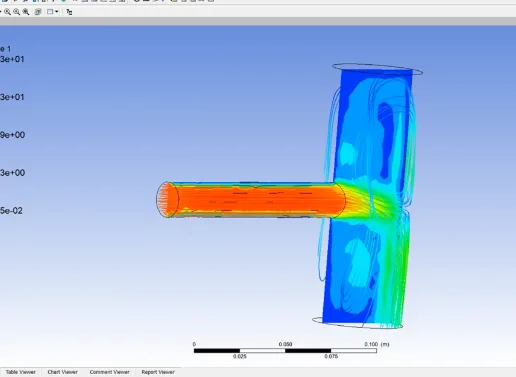
This course provides a comprehensive understanding of pipe branch flow simulation using ANSYS CFX, a powerful Computational Fluid Dynamics (CFD) tool. It focuses on analyzing fluid behavior in branched piping systems commonly used in industrial applications such as oil & gas, chemical processing, and HVAC systems. Participants will begin with the fundamentals of fluid mechanics, including continuity, momentum, and energy equations, and their application to pipe flow. The course then introduces the ANSYS CFX interface, geometry creation, and meshing techniques specific to branch pipe models. Learners will gain hands-on experience in setting up boundary conditions, selecting appropriate turbulence models, and running simulations. Special emphasis is given to understanding flow separation, pressure loss, and velocity distribution at branch junctions. Post-processing techniques will be covered to interpret simulation results effectively using contour plots and streamlines. Real-world case studies will help bridge theory with practical applications. By the end of the course, participants will be able to independently simulate and analyze complex pipe branch systems. This course is ideal for students and professionals looking to enhance their CFD and simulation skills in piping design.

Course suitable for

Key topics covered

  • Create A Geometry In SOLIDWORKS

  • Import Geometry In ANSYS

  • Create A Mesh In Geometry

  • Name Selection In Geomtry

  • Boundary Conditions

  • Solver Control In Flow Analsysis

  • Fluid Flow CFX- CFD POST

  • Animation

Course content

The course is readily available, allowing learners to start and complete it at their own pace.

8 lectures20 min
  1. Create A Geometry In SOLIDWORKS
    3 min
  2. Import Geometry In ANSYS
    2 min
  3. Create A Mesh In Geometry
    2 min
  4. Name Selection In Geomtry
    2 min
  5. Boundary Conditions
    2 min
  6. Solver Control In Flow Analsysis
    2 min
  7. Fluid Flow CFX- CFD POST
    3 min
  8. Animation
    4 min

Opportunities that await you!

Skills & tools you'll gain

ANSYS

Career opportunities

₹149

Access anytime

Questions and Answers

A: That's the most common mistake — confusing where K lives in the equation versus what velocity it's referenced to. Crane’s K is dimensionless and still multiplies dynamic pressure. With ρ≈800 kg/m³ and V=4 m/s, ρV²/2 is about 6.4 kPa, and multiplying by 1.3 lands you just over 8 kPa; rounding up for minor fitting roughness puts you around 10 kPa, not single‑digit hundreds of pascals.

A: That's the most common mistake — trusting calculated behavior before proving the hardware matches the drawing. Valve position and tap orientation can invert or bias a flow signal. If those are wrong, every downstream check is noise, especially when you're commissioning without datasheets.

A: That's the most common mistake — defaulting to chemical corrosion when the physics are mechanical. Sand at those velocities strips protective films faster than they can reform. The CFD shear peaks are telling you where metal loss will localize, long before SSC or sweet corrosion limits are reached.

A: That's the most common mistake — mixing up viscosity bases or geometric terms. Water’s μ around 0.9 mPa·s and a 0.102 m diameter put you solidly in the few‑hundred‑thousand range. No branch correction belongs in the Reynolds definition itself.