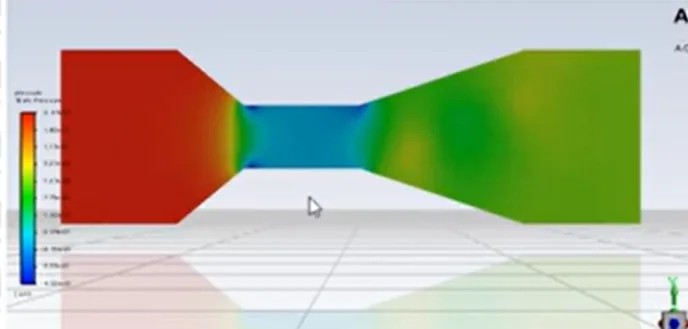
Fluid Flow In Venturimeter in ANSYS 3D Simulation
Fluid Flow In Venturimeter in ANSYS 3D Simulation

- Lifetime access
- Certificate of completion
- Foundational Learning
- Access to Study Materials
Why enroll
What enrolled engineers say
Initially, I wasn’t sure what to expect from this course. The topic looked basic, but it ended up filling a gap I had around setting up simple internal flow problems in ANSYS Fluent without overcomplicating things. The Venturimeter example tied nicely to real hardware used in both automotive intake flow measurement and aerospace pitot-static concepts, which helped ground the theory. The walkthrough on geometry setup, meshing, and applying boundary conditions was especially useful. In past automotive CFD work, intake runners were often treated as black boxes, and this clarified how pressure drop and velocity profiles actually develop. One challenge was getting stable convergence early on; mesh refinement near the throat took a few tries before the pressure results made sense. That struggle felt realistic rather than glossed over. A practical takeaway was understanding how to validate CFD results against Bernoulli-based hand calculations, which is something that translates directly to quick checks on aerospace ducting or automotive airflow simulations. The course didn’t try to do too much, but what it covered was immediately usable. Overall, it felt grounded in real engineering practice.
Initially, I wasn’t sure what to expect from this course. Coming from a senior engineering role, the content is clearly beginner-level, but it does a decent job of walking through a full Venturimeter setup in ANSYS Fluent without skipping steps. The focus on geometry creation, meshing, and pressure/velocity contours aligns with how we validate flow instrumentation in automotive test benches and, to a degree, secondary flow paths in aerospace ECS systems. One challenge was getting stable convergence around the throat region; coarse meshes there gave misleading pressure recovery, which is a common edge case that shows up in real projects too. The course touches Bernoulli’s equation, but it’s useful to mentally contrast that ideal assumption with industry practice, where losses, turbulence models, and even cavitation (in automotive fuel systems) matter. Compressibility isn’t addressed, which is fine for beginners, but aerospace applications would need that called out explicitly. A practical takeaway was the workflow for setting boundary conditions and checking whether pressure drop trends make physical sense before trusting the numbers. At a system level, this reinforces how CFD supports sensor placement and flow measurement decisions, not just pretty plots. The content felt aligned with practical engineering demands.
Initially, I wasn’t sure what to expect from this course. Coming from an automotive background with some exposure to aerospace test setups, the basics of Venturi meters were familiar, but the ANSYS Fluent workflow was a gap for me. The course walked through geometry setup, meshing, and boundary conditions in a way that matched how these problems show up in real projects, like intake airflow estimation in automotive engines and low-speed incompressible flow analysis used in aerospace labs. One challenge was getting a stable solution around the throat region. Mesh refinement there caused convergence issues at first, and it took a bit of trial and error with element sizing and residual monitoring to get meaningful pressure contours. That struggle actually helped connect the theory to what the solver is doing numerically. A practical takeaway was learning how to extract pressure drop correctly and relate it back to flow rate using Bernoulli, instead of just trusting the contour plots. That’s immediately usable for quick validation studies before committing to more complex CFD models. The course didn’t overcomplicate things and stayed focused on what a working engineer needs. It definitely strengthened my technical clarity.
Your instructor
Team EveryEng
Engineer
Mechanical Engineering
Is this course for you?
You should take this if
- You work in Aerospace or Automotive
- You're a Mechanical Engineering professional
- You prefer self-paced learning you can revisit
You should skip if
- You need a different specialisation outside Mechanical Engineering
- You need live interaction with an instructor
Course details
Course suitable for
Key topics covered
Course content
The course is readily available, allowing learners to start and complete it at their own pace.
- Geometry9 min
- Meshing6 min
- Velocity Setup13 min
- Simulation and Results13 min
- Simulation Report4 min
Opportunities that await you!
Skills & tools you'll gain
Career opportunities
Why people choose EveryEng
Industry-aligned courses, expert training, hands-on learning, recognized certifications, and job opportunities-all in a flexible and supportive environment.


 Aug 29, 2026