Skip to main contentEngineering Courses, Mentoring & Jobs | EveryEng
Concentration inequalities banner
Preview this course

Concentration inequalities

Concentration inequalities banner
Preview this course
Self-paced Advanced

Concentration inequalities

3(115)
181 views
FREE
1209 min
Anytime
English
181 views
Engineering Academy
Engineering AcademyLearn Without Limits: Free Engineering Courses
  • Lifetime access
  • Certificate of completion
  • Anytime Learning
  • Learn from Industry Expert

Why enroll

People join this course to build a strong theoretical foundation in probability that is essential for advanced studies and research in data science, machine learning, artificial intelligence, and applied mathematics. It is particularly valuable for students preparing for research-oriented careers, higher education, or competitive exams, as concentration inequalities are frequently used in analyzing algorithms and large-scale data behavior. Learners also benefit from understanding how uncertainty and randomness are controlled in real-world systems

Is this course for you?

You should take this if

  • You work in Telecommunication
  • You're a Electronics & Telecommunication / Instrumentation Engineering professional
  • You have 3+ years of hands-on experience in this field
  • You prefer self-paced learning you can revisit

You should skip if

  • You're new to this field with no prior experience
  • You need a different specialisation outside Electronics & Telecommunication
  • You need live interaction with an instructor

Course details

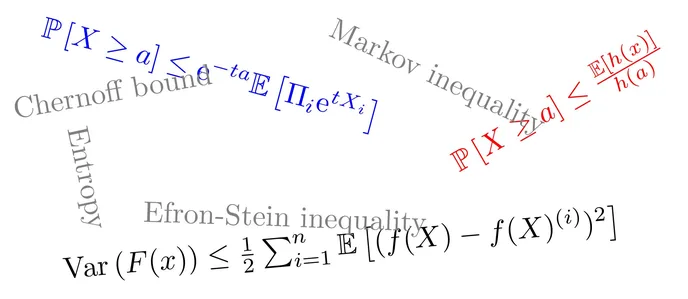
The NPTEL course on Concentration Inequalities introduces powerful mathematical tools used to analyze how random variables deviate from their expected values. The course focuses on probabilistic bounds that quantify the likelihood of large deviations in random processes. These inequalities form the backbone of modern probability theory and are widely used in statistics, machine learning, randomized algorithms, and data science to provide theoretical performance guarantees.

SOURCE - NPTEL [YOUTUBE]

Course suitable for

Key topics covered

  1. Review of probability theory and random variables

  2. Markov and Chebyshev inequalities

  3. Hoeffding’s inequality

  4. Chernoff and Bernstein bounds

  5. Azuma–Hoeffding inequality and martingales

  6. McDiarmid’s inequality

  7. Sub-Gaussian and sub-exponential random variables

  8. Applications in machine learning and randomized algorithms

  9. High-dimensional probability concepts

Course content

The course is readily available, allowing learners to start and complete it at their own pace.

26 lectures20 hr 9 min
  1. mod01lec01 Why study concentration inequalities?
    53 min
  2. mod01lec02 Chernoff bound
    29 min
  3. mod01lec03 Examples of Chernoff bound for common distributions
    40 min
  4. mod02lec04 Hoeffding and Bernstein inequalities
    41 min
  5. mod03lec06 Bounding variance using the Efron-Stein inequality
    58 min
  6. mod03lec07 The Gaussian-Poincare inequality
    33 min
  7. mod03lec08 Tail bounds using the Efron-Stein inequality
    47 min
  8. mod04lec09 Herbst's argument and the entropy method
    46 min
  9. mod04lec10 Log-Sobolev inequalities
    52 min
  10. mod04lec11 Binary and Gaussian Log-Sobolev inequalities and concentration
    52 min
  11. mod05lec12 Variational formulae forKullback-Leibler and Bregman Divergence
    42 min
  12. mod02lec05 Azuma and McDiarmid inequalities
    52 min
  13. mod05lec13 A modified log-Sobolev inequality and concentration
    28 min
  14. mod05lec14 Introduction to the transportation method for showing concentration bounds
    65 min
  15. mod05lec15 Transportationlemma and a proof of McDiarmid's inequality using the transportation method
    42 min
  16. mod06lec16 Concentration bounds for functions beyond bounded difference using transportation method
    32 min
  17. mod06lec17 Marton's conditional transportation cost inequality
    44 min
  18. mod06lec18 Isoperimetry and concentration of measure
    35 min
  19. mod06lec19 Isoperimetry and bounded difference
    23 min
  20. mod07lec20 Equivalence of Stam's inequality and log Sobolev inequality
    48 min
  21. mod07lec21 An information theoretic proof of log Sobolev inequality
    40 min
  22. mod07lec22 Hypercontractivity and strong data processing inequality for Rényi divergence
    67 min
  23. mod07lec23 An information theoretic characterization of hypercontractivity
    47 min
  24. mod07lec24 Equivalence of Gaussian hypercontractivity and Gaussian log Sobolev inequality
    72 min
  25. mod08lec25 Uniform deviation bounds for random walks and the law of the iterated logarithm
    67 min
  26. mod08lec26 Self normalized concentration inequalities and application to online regression
    54 min

Opportunities that await you!

Career opportunities

Why people choose EveryEng

Industry-aligned courses, expert training, hands-on learning, recognized certifications, and job opportunities-all in a flexible and supportive environment.

What learners say about this course

Boora Mahesh
Boora Mahesh civil engineer
Mar 14, 2026

drtudfjygfygughihj

Hemanth TK
Hemanth TK
Feb 27, 2026

Fhjfkgc

Jayalaxmi Sudi
Jayalaxmi Sudi
Feb 15, 2026

Good

Engineering Academy
Engineering Academy Engineer
Feb 7, 2026

Nice Explanation

FREE

Access anytime

Questions and Answers

A: The right choice achieves a smaller exponent by combining variance and range, which matters when deviations aren't extreme; Hoeffding drops variance and pays a penalty, Markov ignores almost all structure and blows up the tail, and Chebyshev uses variance but decays too slowly to meet a guardband set this tight.

A: This works because bounded MGF growth is the defining property you're about to assume; a Q–Q plot is visual and fragile in the tails, Chebyshev sidesteps the question rather than verifying it, and kurtosis can look benign while tails still violate sub-Gaussian decay.

A: The goal is a tail bound under dependence with bounded steps, which Azuma-Hoeffding delivers; Chernoff relies on independence, Bernstein needs variance control that martingales may not give, and LLN doesn't quantify finite-sample tails.

A: This choice targets stability under sample replacement, which is exactly the bounded-difference condition; Hoeffding ignores the function-level sensitivity, Bennett needs variance and skew detail you didn't quantify, and a union bound loses the concentration structure.