Skip to main contentEngineering Courses, Mentoring & Jobs | EveryEng
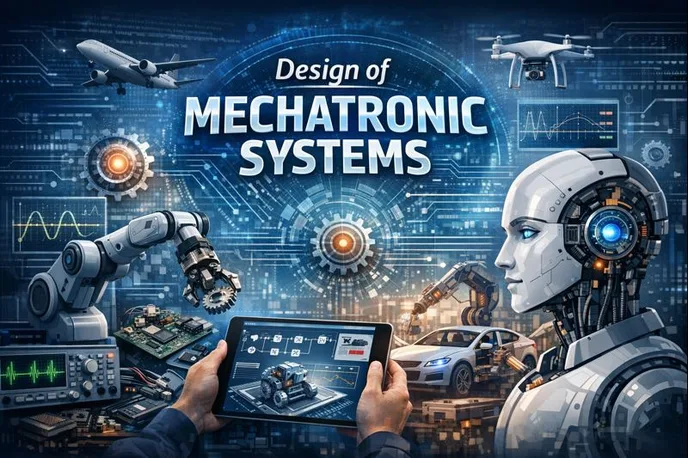
Design of Mechatronic Systems - I banner
Preview this course

Design of Mechatronic Systems - I

Design of Mechatronic Systems - I banner
Preview this course
Self-paced Advanced

Design of Mechatronic Systems - I

3(115)
216 views
FREE
950 min
Anytime
English
216 views

Engineering Academy
Engineering AcademyLearn Without Limits: Free Engineering Courses
  • Lifetime access
  • Certificate of completion
  • Anytime Learning
  • Learn from Industry Expert

Why enroll

Participants join Design of Mechatronic Systems to develop a strong interdisciplinary skill set that is essential for designing modern intelligent and automated products. The course enables learners to understand how mechanical, electrical, electronic, control, and software components interact within a single system, allowing them to move beyond isolated domain knowledge to a complete system-level design perspective.

Many participants are motivated to gain practical competence in modeling, simulation, sensor and actuator selection, control system design, and embedded implementation—skills that are highly valued in industries such as robotics, industrial automation, automotive, aerospace, medical devices, and smart manufacturing. The course helps bridge the gap between theoretical concepts and real-world applications through structured design methodologies and practical case studies.

Participants also join to enhance their career prospects by acquiring industry-relevant expertise in mechatronics, preparing them for roles in product design, system integration, automation engineering, and R&D. Additionally, the course supports academic growth by strengthening fundamentals needed for advanced studies and research in mechatronics, robotics, and control systems, making it valuable for both students and working professionals.

Is this course for you?

You should take this if

  • You work in Industrial Automation or Manufacturing & Industrial
  • You're a Mechatronics and Robotics / Mechanical Engineering professional
  • You have 3+ years of hands-on experience in this field
  • You prefer self-paced learning you can revisit

You should skip if

  • You're new to this field with no prior experience
  • You need a different specialisation outside Mechatronics and Robotics
  • You need live interaction with an instructor

Course details

Design of Mechatronic Systems is an interdisciplinary subject that deals with the systematic integration of mechanical engineering, electrical and electronic systems, control engineering, and computer-based intelligence to design and develop advanced engineering products and automated systems. The course adopts a holistic, system-oriented design philosophy, emphasizing how individual subsystems—mechanical structures, sensors, actuators, controllers, and embedded software—work together to achieve precise, efficient, and reliable system performance.

The course begins with an overview of mechatronic system architecture and the role of mechatronics in modern engineering applications such as robotics, industrial automation, automotive systems, aerospace, medical devices, and smart manufacturing. It introduces fundamental concepts of system modeling using physical laws and mathematical representations, including mechanical dynamics, electrical circuits, and electromechanical energy conversion. Participants learn to develop dynamic models and transfer functions, which form the basis for simulation and performance analysis.

A significant portion of the course is dedicated to sensors and actuators, covering principles of measurement, signal conditioning, and data acquisition. Various sensing technologies for position, velocity, force, pressure, temperature, and displacement are discussed, along with actuator types such as electric motors, hydraulic and pneumatic actuators, and smart materials. Emphasis is placed on selection criteria, interfacing, and practical limitations affecting system accuracy and responsiveness.

Control system design is a core component of the subject. Participants study classical and modern control techniques, including feedback control, PID tuning, state-space modeling, and digital control implementation. The course highlights how control strategies are integrated with embedded processors and real-time software to ensure stability, precision, and robustness under varying operating conditions and disturbances.

The course also addresses embedded system design and software development for mechatronic applications. Topics include microcontrollers, real-time operating concepts, communication protocols, and hardware–software co-design. System integration, prototyping, testing, and validation are emphasized to ensure that the final design meets functional, safety, and reliability requirements. By combining theoretical knowledge with practical design methodologies and case studies, the Design of Mechatronic Systems course equips participants with the skills required to conceive, design, and implement intelligent engineering systems in real-world applications.

source: NPTEL[youtube]

Course suitable for

Key topics covered

  • introduction of design of mechatronic systems

  • element of mechatronic systems

  • integrated mechanical-electronics philosophy

  • smart sensors concept

  • microprocessor memory and addressing

Course content

The course is readily available, allowing learners to start and complete it at their own pace.

30 lectures15 hr 50 min
  1. Course Introduction - Design of Mechatronic Systems
    7 min
  2. Introduction
    43 min
  3. Elements of Mechatronic Systems – Part I
    28 min
  4. Elements of Mechatronic Systems - Part II
    36 min
  5. Elements of Mechatronic Systems - Part III
    25 min
  6. CD-ROM Part I
    36 min
  7. CD-ROM Part II
    21 min
  8. Scanner
    32 min
  9. Integrated Mechanical-Electronics Philosophy – Part I
    38 min
  10. Integrated Mechanical-Electronics Philosophy – Part II
    26 min
  11. Smart Sensors Concept
    22 min
  12. Compliant Mechanisms
    27 min
  13. Microprocessor Building Blocks I- Combinational Circuits
    31 min
  14. Microprocessor Building Blocks II - Sequential Circuits
    40 min
  15. Microprocessor Memory and Addressing
    33 min
  16. Timing and control unit: Primitive Microprocessor
    42 min
  17. Microcontroller Architecture I
    35 min
  18. Microcontroller Architecture II
    29 min
  19. Microcontroller Programming Philosophy
    25 min
  20. Hardware Interfaces
    41 min
  21. Interfacing Actuator using PWM in Tiva Microcontroller
    43 min
  22. Interfacing Encoder using QEI in Tiva Launchpad + ISR
    51 min
  23. Mathematical Modelling: Overview and Context
    36 min
  24. Modelling Friction in a System
    31 min
  25. Modelling DC Motor with loads
    39 min
  26. Lagrange formulation fundamentals
    29 min
  27. Lagrange formulation examples
    39 min
  28. Dynamics: 2-R Manipulator
    29 min
  29. Control formulation: Regulation and Tracking
    14 min
  30. Fundamentals of Simulation of dynamics using MATLAB
    22 min

Opportunities that await you!

Career opportunities

Why people choose EveryEng

Industry-aligned courses, expert training, hands-on learning, recognized certifications, and job opportunities-all in a flexible and supportive environment.

FREE

Access anytime

Questions and Answers

A: Stripped gears and a bent output shaft show up fast if you assume the limiter covers transient torque. The limiter reacts to average torque, not the cold-start spike driven by rising static friction, so it doesn't block that load path. The other effects are real but don't escalate into immediate mechanical damage.

A: A failed SAT with the valve refusing to enable is what happens if logic expects the wrong contact state. The control narrative depends on when that switch changes state, and a mid-stroke NC versus end-of-travel NO mismatch flips the permissive logic. The other issues are paperwork or installation nuisances, not functional blockers.

A: A runaway rotor damages bearings and seals long before alarms help if holding force fades. The standard leans on a physical margin since friction materials age and heat cycles move the numbers, and the margin keeps the brake effective across life. The other points are either overstated or not the driver behind the requirement.

A: Cooked windings and a tripped MCC are the outcome if the brake drags on start. The safeguard is great at holding load and blocking back-drive, but it doesn't prevent a slow-release condition that overloads the motor. The passing spec masks the trend until hardware suffers.