<link href="https://fonts.googleapis.com/css2?family=Caveat:wght@500;700&family=JetBrains+Mono:wght@400;500;600&display=swap" rel="stylesheet" /> Skip to main contentEngineering Courses, Mentoring & Jobs | EveryEng
Ice formation on a cube | CFD Simulation in ANSYS banner

Ice formation on a cube | CFD Simulation in ANSYS

Ice formation on a cube | CFD Simulation in ANSYS banner
Self-paced Beginner

Ice formation on a cube | CFD Simulation in ANSYS

4(1581)
11 enrolled
1384 views
FREE
11 min
Anytime
English
1384 views
Team EveryEng
Team EveryEngMechanical Engineering
  • Lifetime access
  • Certificate of completion
  • Foundational Learning
  • Access to Study Materials
Volume pricing for groups of 5+

Why enroll

Participants join this course to understand how ice formation affects engineering systems and how it can be analyzed using CFD tools. It helps them develop practical simulation skills that are useful in industries like aerospace, energy, and refrigeration. The course also enhances their ability to predict and solve icing-related performance and safety issues. By learning these techniques, participants can improve their technical expertise and career opportunities in advanced engineering fields.

Is this course for you?

You should take this if

  • You work in Aerospace
  • You're a Mechanical Engineering / Onshore Pipeline Engineering professional
  • You prefer self-paced learning you can revisit

You should skip if

  • You need a different specialisation outside Mechanical Engineering
  • You need live interaction with an instructor

Course details

The CFD Simulation of Ice Formation course provides a practical introduction to modeling and analyzing ice formation using Computational Fluid Dynamics (CFD) tools. This course helps participants understand how ice forms on surfaces due to changes in temperature, airflow, and moisture conditions. Learners will explore the basic physics of icing phenomena and how it affects the performance and safety of engineering systems. The course explains how to set up CFD simulations to study ice accumulation on different surfaces and components. Participants will gain hands-on knowledge of mesh generation, boundary conditions, and multiphase flow modeling related to icing. Real-world applications such as aircraft wing icing, wind turbine blade icing, refrigeration systems, and cold climate engineering will be discussed. The course also covers the analysis of simulation results to predict ice growth and its impact on system efficiency. By the end of the course, participants will be able to perform basic icing simulations and interpret CFD results effectively. This course is ideal for engineers, researchers, and students who want to enhance their skills in thermal-fluid analysis and environmental modeling. It provides a strong foundation for understanding and solving practical icing problems using modern CFD techniques.

Course suitable for

Key topics covered

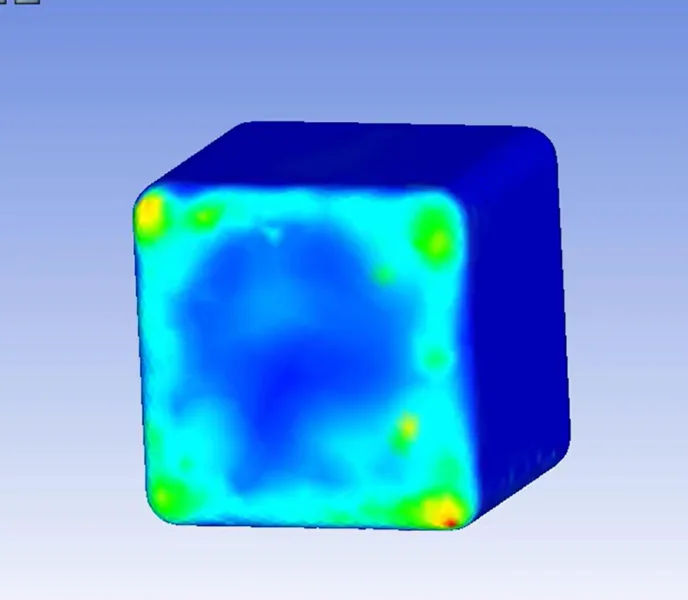
  • Simulation of ice formation on a cube at an altitude of 10 km, 240 K temperature, and traveling at 200 m/s.

Course content

The course is readily available, allowing learners to start and complete it at their own pace.

1 lectures11 min
  1. CFD Simulation in ice formation in cube
    11 min

Opportunities that await you!

Skills & tools you'll gain

ANSYS

Career opportunities

FREE

Access anytime

Questions and Answers

A: −150 W/m² isn’t a rounding error; it flips the energy balance at that face. When the sketch and the boundary table disagree, you’ve lost configuration control, and there’s no way to prove which assumption drove ice accretion rate.

A: 273.15 K is the hard boundary here. If the phase-change material model is wrong, every downstream check is cosmetic because you’re not even allowing ice to exist as a phase.

A: 0.05 m is the trap. Swap in the wrong length scale and you’re off by a factor of four, which directly skews predicted freezing time.

A: The 0 °C phase boundary dominates early behavior. Colder air steepens the temperature gradient, so freezing initiates sooner even before vapor effects matter.