<link href="https://fonts.googleapis.com/css2?family=Caveat:wght@500;700&family=JetBrains+Mono:wght@400;500;600&family=Plus+Jakarta+Sans:wght@600;700;800&display=swap" rel="stylesheet" /> Skip to main contentEngineering Courses, Mentoring & Jobs | EveryEng
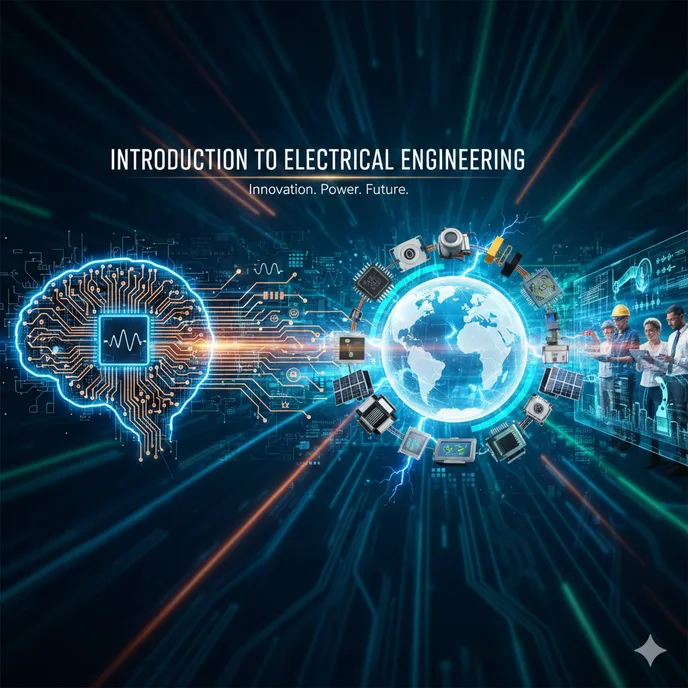
Introduction to Electrical Engineering banner
Preview this course

Introduction to Electrical Engineering

Introduction to Electrical Engineering banner
Preview this course
Self-paced Advanced

Introduction to Electrical Engineering

3(115)
1 enrolled
119 views
FREE
1548 min
Anytime
English
119 views
Engineering Academy
Engineering AcademyLearn Without Limits: Free Engineering Courses
  • Lifetime access
  • Certificate of completion
  • Anytime Learning
  • Learn from Industry Expert
Volume pricing for groups of 5+

Why enroll

Learn directly from IIT Delhi faculty through trusted NPTEL content and build strong fundamentals essential for core electrical engineering subjects. This course is ideal for students, beginners, and exam aspirants preparing for GATE and university exams, as it provides a clear and structured overview of the field, helping learners confidently progress toward advanced or specialized topics.

Is this course for you?

You should take this if

  • You work in Automotive
  • You're a Electrical Engineering professional
  • You have 3+ years of hands-on experience in this field
  • You want to build skills in Engineering & Design, Research & Developmnet

You should skip if

  • You're new to this field with no prior experience
  • You need a different specialisation outside Electrical Engineering
  • You need live interaction with an instructor

Course details

This course offers a comprehensive introduction to Electrical Engineering through 42 well-structured lectures, covering fundamental and applied concepts across the discipline. Sourced from NPTEL, IIT Delhi, it takes learners from basic circuit elements to advanced areas such as power systems and communication, building a strong and well-rounded foundation in electrical engineering.

Course suitable for

Key topics covered

  • Learn basic electrical quantities like voltage, current, and power, and common circuit elements

  • Understand how DC and AC circuits work through simple and clear analysis

  • Get an introduction to electrical machines such as transformers, motors, and generators

  • Learn the basics of power systems and how electrical energy is generated and distributed

  • Gain exposure to digital systems and their basic working concepts

  • Understand basic communication principles used in electrical and electronic systems

Course content

The course is readily available, allowing learners to start and complete it at their own pace.

30 lectures25 hr 48 min
  1. Introduction to Electrical Engineering
    54 min
  2. Elements in an electrical circuits
    60 min
  3. Analysis Of DC Circuits - I
    46 min
  4. Analysis Of DC Circuits - II
    37 min
  5. Analysis Of DC Circuits - III
    52 min
  6. Analysis OF DC Circuits - IV
    72 min
  7. Transient Response Of First Order Circuits - I
    67 min
  8. Transient Response Of First Order Circuits - II
    48 min
  9. Transient Response Of Second Order Circuits - I
    45 min
  10. Transient Response Of Second Order Circuits - II
    55 min
  11. Single Phase AC Circuits - I
    45 min
  12. Single Phase AC Circuits - II
    38 min
  13. Single Phase AC Circuits - III
    33 min
  14. Resonance In AC Circuits
    46 min
  15. Three Phase AC Circuits - I
    48 min
  16. Three Phase AC Circuits - II
    51 min
  17. Diode Based Circuits
    69 min
  18. Two Port Network - I
    35 min
  19. Two Port Network - II
    29 min
  20. Two Port Network - III
    59 min
  21. Biopolar Junction Transistors - I
    60 min
  22. Biopolar Junction Transistors - II
    90 min
  23. Operational Amplifier - I
    48 min
  24. Operational Amplifier - II
    27 min
  25. Digital Circuits - I
    68 min
  26. Digital Circuits - II
    63 min
  27. Digital Circuits - III
    67 min
  28. Transformer - I
    48 min
  29. Transformer - II
    41 min
  30. Transformer - III
    47 min

Opportunities that await you!

Skills & tools you'll gain

Engineering & DesignResearch & DevelopmnetProject Management

Career opportunities

FREE

Access anytime

Questions and Answers

A: The correct choice ensures a low-impedance, deterministic fault return path so touch voltage collapses before injury risk. Using mounting screws assumes contact integrity that vibration and paint destroy. Higher insulation class doesn’t address exposed metal under a fault. An RCD trips on imbalance, not on ensuring fault current magnitude.

A: This option handles fast edges and isolation without saturating or aliasing. A CT distorts under low-frequency components and can saturate with DC bias. A shunt injects loss and EMI into the link and ignores peaks. A bare Rogowski coil gives derivative output and misleads control without conditioning.

A: The right answer explains voltage rise through impedance and reactive current reduction. Capacitors don’t create real power. Tap changers respond slowly and aren’t triggered by a single bank. Resonance affects distortion more than steady fundamental magnitude here.

A: This lands in the few-volt range using known copper resistivity and length. Perfect-conductor thinking ignores real resistance. Skin effect is negligible at mains frequency and this cross-section. Doubling length is already implicit and doesn’t explode the drop.