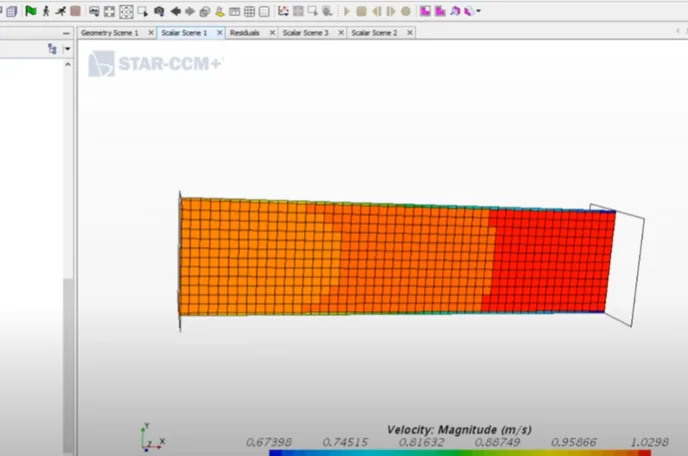
Laminar Flow Simulation in Pipe | Star CCM+
- Lifetime access
- Certificate of completion
- Foundational Learning
- Access to Study Materials
Why enroll
What enrolled engineers say
This course turned out to be more technical than I anticipated. For a beginner module, it went past button-clicking and forced some thinking around Reynolds number selection, entrance length, and how laminar assumptions break down. From an aerospace perspective, the discussion around velocity profiles and wall shear tied directly to boundary layer behavior in small-diameter bleed lines. On the automotive side, pressure drop estimation felt relevant to fuel and coolant routing, where laminar regimes still show up in cold-start or low-flow conditions. One challenge was getting the mesh and boundary conditions stable without STAR-CCM+ quietly converging to something “clean” but wrong. The course touched on this, but recognizing edge cases like over-constrained outlets or unrealistic viscosity values required a bit of trial and error. In industry, this is usually caught by peer review or legacy templates, so it was useful to struggle through it here. A practical takeaway was learning to sanity-check results against analytical solutions before trusting contours. That habit scales well when these pipe models are later embedded into larger thermal or hydraulic systems. Overall, it felt grounded in real engineering practice.
Coming into this course, I had some prior exposure to the subject, mostly from reviewing CFD results rather than setting models up myself. The walkthrough on laminar flow in a pipe using STAR‑CCM+ was helpful in grounding the basics that often get glossed over in industry projects. What stood out was the discussion around Reynolds number limits and how laminar assumptions break down at the edges. In aerospace ducting work, that transition region can quietly invalidate pressure drop estimates, and in automotive thermal loops the same mistake shows up as undersized pumps. The course stayed simple, but those implications were clear if you read between the lines. One challenge was getting the mesh and wall treatment right without overthinking it. Even for laminar cases, near-wall resolution matters, and it took a bit of trial and error to avoid false convergence. Industry workflows often jump straight to turbulence models, so slowing down and validating a laminar baseline felt refreshingly disciplined. A practical takeaway was building a clean, repeatable setup process and checking analytical solutions before trusting contours. At a system level, this reinforces when CFD adds value versus when hand calcs are enough. It definitely strengthened my technical clarity.
Coming into this course, I had some prior exposure to the subject, mostly from automotive cooling work and a bit of aerospace ducting analysis. The content stayed focused on laminar flow basics in STAR‑CCM+, which is appropriate for a beginner level, but it didn’t feel oversimplified. The walkthrough of setting up a straight pipe case tied nicely to fundamentals like Reynolds number limits and pressure drop, and it was useful to see how those relate to real cases such as fuel lines in aerospace systems or low‑Re oil passages in automotive engines. One challenge was getting the mesh and wall treatment right without overthinking it. Coming from industry, there’s a tendency to jump straight to turbulence models, so staying disciplined about laminar assumptions—and checking edge cases where transition might occur—took some adjustment. Convergence behavior also highlighted how sensitive laminar solutions can be to boundary conditions. A practical takeaway was validating results against the Hagen–Poiseuille solution before trusting any contours. That’s something that often gets skipped in fast‑paced projects. From a system-level view, the course reinforced when laminar modeling is actually acceptable and when it can mislead downstream thermal or pump sizing decisions. I can see this being useful in long-term project work.
Your instructor
Team EveryEng
Engineer
Mechanical Engineering
Is this course for you?
You should take this if
- You work in Aerospace or Automotive
- You're a Civil & Structural / Mechanical Engineering professional
- You prefer self-paced learning you can revisit
You should skip if
- You need a different specialisation outside Civil & Structural
- You need live interaction with an instructor
Course details
Course suitable for
Key topics covered
Course content
The course is readily available, allowing learners to start and complete it at their own pace.
- Laminar flow simulation part -017 min
- Laminar flow simulation part -027 min
Opportunities that await you!
Career opportunities
Why people choose EveryEng
Industry-aligned courses, expert training, hands-on learning, recognized certifications, and job opportunities-all in a flexible and supportive environment.
What learners say about this course
good
It. Was so good we'll use for beginners
Good Course
Nice change of pace to see edge cases treated like first-class citizens instead of footnotes, especially for a beginner/intermediate Solidworks track. The moment that stuck was the section on the bolt lug geometry where he intentionally breaks the fillet, runs interference, then walks back tolerances; that’s the kind of thing that shows up later in prod and costs a PR. I’ve shipped CAD that looked fine in a repo but blew up at assembly, so the emphasis on mates failing felt real. The pacing mostly worked, though I wasn’t sold on how quickly configs were introduced; a bit more time on why one config beats another would help. still, the way he frames failure modes and stress paths maps cleanly to how I think about arch and CI checks in infra, even if you’re not building rifles. That framing alone made the time worthwhile between meetings.