Skip to main contentEngineering Courses, Mentoring & Jobs | EveryEng
Large Power Plant Generators : Mfg, Erection, Testing & QC banner

Large Power Plant Generators : Mfg, Erection, Testing & QC

Large Power Plant Generators : Mfg, Erection, Testing & QC banner
Live online Beginner

Large Power Plant Generators : Mfg, Erection, Testing & QC

4(8)
717 views
$ 40
3 hrs
Next month
English
717 views

Vijay Sachdev
Vijay SachdevConsultant - Project & Procurement
  • 7-day money-back guarantee
  • Session recordings included
  • Certificate of completion

Why enroll

Although Generator falls under the category of Electrical Equipment. For Design, Operation and Testing purpose, Electrical Engineers need to be assigned. But for Manufacturing, Transportation, Erection & Maintenance purpose, Generator must be taken care by Mechanical Engineers only.

Is this course for you?

You should take this if

  • You work in Energy & Utilities or Nuclear & Power
  • You're a Power Plant Engineering / Manufacturing Engineering professional
  • You want to build skills in Electrical Maintenance, Mechanical Maintenance
  • You prefer live, instructor-led training with Q&A

You should skip if

  • You need a different specialisation outside Power Plant Engineering
  • You need fully self-paced, on-demand content

Course details

Generator is the most Important and Critical for a Power Plant to generate electricity.

Any mistake in manufacturing, Erection, Testing and / or Operation can lead to major failure or Breakdown of the Generator.

Course suitable for

Key topics covered

1. Introduction

2. Working Principles of Generator: Thermal, Nuclear, Gas, Hydro and Wind.

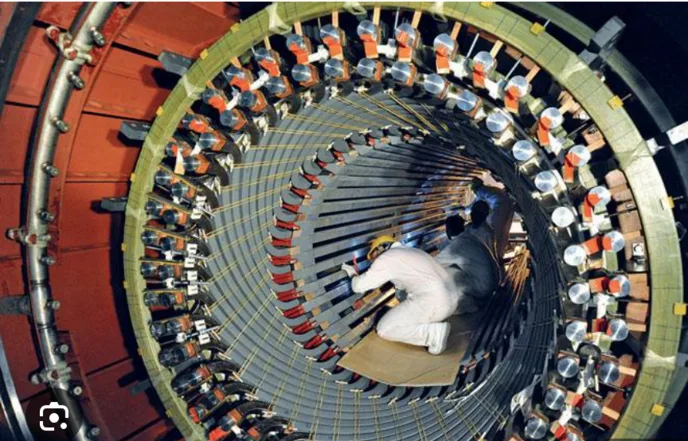
3. Internals / Parts of Large Size Generator (say 500 MW)

4. Comparison of Indian / German / Chinese / Japanese Generator

5. Excitation System

6. Erection Methodogies of Generator Stator

7. Assembly of Generator Complete

8. Inspection & Testing : Mechanical & Electrical

9. Maintenance & Servicing.

10 Few Case Studies

Opportunities that await you!

Skills & tools you'll gain

Electrical MaintenanceMechanical MaintenancePower GenerationQuality & InspectionProject Management

Career opportunities

Training details

This is a live course that has a scheduled start date.

Why people choose EveryEng

Industry-aligned courses, expert training, hands-on learning, recognized certifications, and job opportunities-all in a flexible and supportive environment.

$40

$50

Coming in Next Month

Questions and Answers

A: Uniform rust would bias inspection toward laminations and miss the electrical aging that actually trips you later. Galvanic attack sounds intuitive but lacks a sustained electrolyte inside a properly sealed machine. Chloride pitting is real offshore yet doesn't align with the observed insulation dulling and PD risk. Moisture lowers insulation resistance and accelerates PD, so insulation chemistry and dryness dominate the material call.

A: Cranking voltage skews results and adds heating that confuses diagnosis. Blind acceptance ignores the adverse trend that often precedes failure. Uncontrolled drying can give a false sense of recovery without fixing ingress. Temperature-corrected trending tells you whether the insulation system is stabilizing.

A: Vibration isn't the primary symptom of gas density change in a tight machine. Field tweaks misaddress a thermal problem and can elevate rotor heating. Lower losses is backwards because denser gas increases windage. Purity recovery restores cooling and limits windage heating while seal oil keeps air out.

A: Calling it negligible hides a heat source that stacks on already tight margins. Ignoring density misses why hydrogen is used in the first place. Viscosity-led scaling overstates losses and misguides actions. Density and speed dominate, so small purity shifts matter at high rpm.