
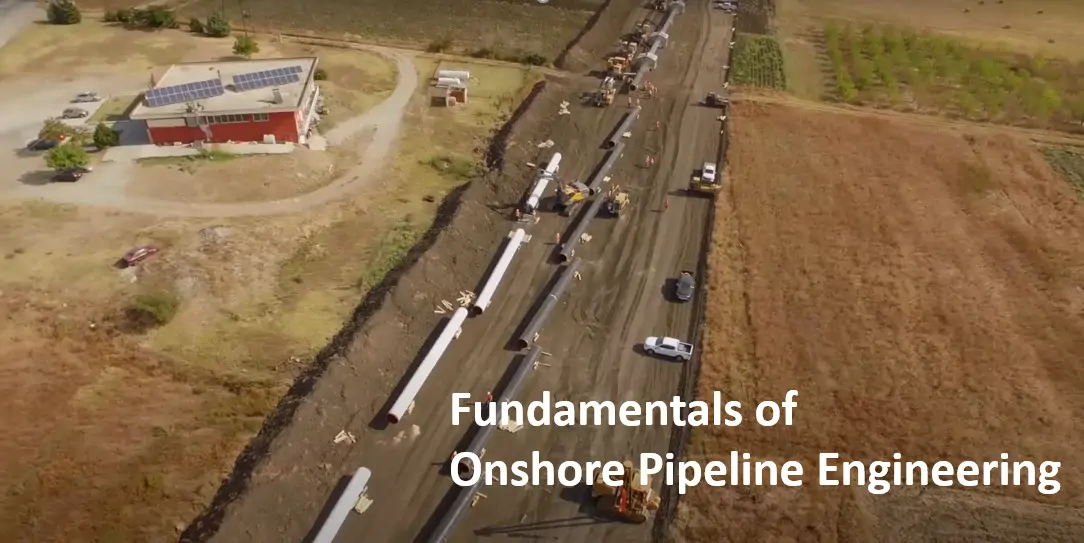
Master Onshore Pipeline Engineering: Comprehensive Course from Basics to Advanced Concepts
Master Onshore Pipeline Engineering: Comprehensive Course from Basics to Advanced Concepts
- 7-day money-back guarantee
- Lifetime access
- Certificate of completion
Why enroll
What enrolled engineers say
At first glance, the topics looked familiar, but the depth surprised me. The sections on hydraulic analysis and stress/flexibility design went beyond the usual oil & gas overview and actually tied assumptions back to field constraints, like elevation-driven transients and seasonal throughput changes. Coverage of ASME B31.4/B31.8 alignment with real construction practices felt closer to what’s done on active onshore projects than what’s typically taught. One challenge was keeping track of the system-level interactions between corrosion control, coating selection, and long-term integrity management. In practice, those decisions get split across teams, and the course made it clear how easy it is to create problems at interfaces, especially for energy utilities that later repurpose lines for water or mixed service. The discussion on edge cases—such as road crossings, unstable soils, and tie-ins near existing facilities—matched issues commonly seen in oil & gas brownfield work. A practical takeaway was the structured way to sanity-check hydraulic models against operating data before locking wall thickness or pump sizing. That’s directly applicable and not common in chemical or pharmaceutical pipeline design, where margins are often handled differently. Overall, it felt grounded in real engineering practice.
Initially, I wasn’t sure what to expect from this course given my background in oil & gas pipeline projects and energy utilities work. The content went deeper than anticipated, especially around hydraulic analysis and stress/flexibility checks tied to ASME B31.4/B31.8. One thing that stood out was how the course handled edge cases like river crossings and high-consequence areas, which often get oversimplified compared to real-world constraints. A challenge came up while working through the transient flow examples. Matching surge analysis assumptions with how compressor stations actually operate in the field took some effort, and the course didn’t completely smooth that gap. Still, it was useful to see the system-level implications of valve closure timing on downstream integrity. Compared to typical industry practice, the integrity management section was more structured, particularly around corrosion control and inline inspection planning. In chemical and pharmaceutical pipelines, that level of rigor is often assumed but not well documented; here it was spelled out. A practical takeaway was the clearer framework for MAOP verification and wall thickness selection when regulatory and land access constraints conflict. That’s something that will directly influence how future route selection studies are framed. I can see this being useful in long-term project work.
This course turned out to be more technical than I anticipated. The depth on onshore pipeline hydraulics and stress analysis went beyond the usual overview and felt closer to what’s actually done on oil & gas transmission projects. Route selection discussions tied soil mechanics and constructability into the design choices, which aligns better with field reality than the purely theoretical approaches often seen. Coverage of ASME B31.4/B31.8 and integrity management practices reflected current industry expectations in both oil & gas and energy utilities, especially around corrosion control and inspection planning. One challenge was keeping up with how many variables interact at once—hydraulics, wall thickness, temperature effects, and construction constraints don’t stay neatly separated. Some edge cases, like river crossings or high-consequence areas near populated zones, highlighted how conservative assumptions can ripple through the whole system design and cost model. A practical takeaway was a clearer framework for linking hydraulic calculations with material selection and long-term integrity strategy, rather than treating them as separate tasks. Compared with past projects, this approach should reduce late-stage redesigns and surprises during commissioning. I can see this being useful in long-term project work.
Is this course for you?
You should take this if
- You work in Oil & Gas Downstream or Energy & Utilities
- You're a Onshore Pipeline Engineering / Petroleum Technology professional
- You have 3+ years of hands-on experience in this field
- You prefer self-paced learning you can revisit
You should skip if
- You're new to this field with no prior experience
- You need a different specialisation outside Onshore Pipeline Engineering
- You need live interaction with an instructor
Course details
Course suitable for
Key topics covered


Course content
The course is readily available, allowing learners to start and complete it at their own pace.
- Course outline15 min
- Pipeline Engineering Introduction19 min
- Advantages over other transport methods11 min
- Historical Background - The First pipelines13 min
- Piping vs Pipeline32 min
- Onshore vs Offshore Pipelines20 min
- Onshore Pipelines types and category30 min
- Animation: How pipelines are installed under the ocean10 min
- Pipeline Project Lifecycle17 min
- Opportunity Analysis & Market Assessment24 min
- Key FEED Deliverables65 min
- FEED VS Detailed Design12 min
- Construction and their phases73 min
- Pipeline codes and standards53 min
- Common Pipeline Codes51 min
- Code Structure and Philosophy66 min
- Line Pipes - SMLs/ LSAW/ERW Pipes63 min
- API 5L19 min
- Pig Traps45 min
- Pipeline Flanges56 min
- Isolating Joints / Anchor Flanges62 min
- Pipeline Route Selection71 min
- Pipeline Survey44 min
- Pipeline Topographical Surveys62 min
- Pipeline Geotechnical Investigation75 min
- Pipeline Routing - I57 min
- Pipeline Routing - II62 min
- Pipeline Valve70 min
- Valve Inspection57 min
- Pipeline Deliverable by phase52 min
- Pipeline Engineering Deliverable77 min
- Piepline Basis of Design64 min
- Location class study77 min
- Pipeline Approach layout and BVS layout85 min
- Drafting - I37 min
- Drafting - II46 min
- Drafting - III64 min
- Code Stress Checks74 min
- Pipeline Wall Thickness Calculation - Code Stress Checks77 min
- Pipeline Crossing Calculations58 min
- Pipeline crossing calculation71 min
- Buoyancy calculation52 min
- Stress analysis on autopipe88 min
- Stress Analysis on Autopipe - II68 min
- Upheavel Buckling Calculation80 min
- Technical Compliance48 min
- Planning and Pipeline75 min
- Pipeline Bending43 min
- Pipeline Welding55 min
- Welding Inspection53 min
- Pipeline Wall Thickness Calculation - Code Stress Check69 min
- Pipeline Crossings82 min
- Hydrostatic Test75 min
- Integrity Cycle and Infrastructure Vitality54 min
- Integrity Programe96 min
Opportunities that await you!
Career opportunities
Why people choose EveryEng
Industry-aligned courses, expert training, hands-on learning, recognized certifications, and job opportunities-all in a flexible and supportive environment.
What learners say about this course

Coming into this course, I had some prior exposure to the subject, mostly from oil & gas transmission projects tied into broader energy utilities networks. What stood out was how the material linked hydraulic design, stress analysis, and integrity management instead of treating them as silos. The sections on ASME B31.4/B31.8 interpretation reflected how these codes are actually applied in industry, including edge cases like road crossings and class location changes that tend to get oversimplified on the job. One challenge was keeping the system-level view during the advanced stress and flexibility modules. It’s easy to run software and miss constructability constraints, especially when soil data is poor or conservative assumptions start driving wall thickness beyond what procurement can realistically source. The course handled that tension better than most, and the discussion around corrosion control trade-offs versus inspection frequency was particularly relevant to long-term operations. A practical takeaway was a clearer framework for route selection decisions, balancing hydraulic efficiency against permitting and maintenance access. Compared to some internal company training, this went deeper into why certain compromises are made. Overall, it felt grounded in real engineering practice.

Coming into this course, I had some prior exposure to the subject, mostly from oil & gas transmission projects tied into broader energy utilities networks. What stood out was how the material linked hydraulic design, stress analysis, and integrity management instead of treating them as silos. The sections on ASME B31.4/B31.8 interpretation reflected how these codes are actually applied in industry, including edge cases like road crossings and class location changes that tend to get oversimplified on the job. One challenge was keeping the system-level view during the advanced stress and flexibility modules. It’s easy to run software and miss constructability constraints, especially when soil data is poor or conservative assumptions start driving wall thickness beyond what procurement can realistically source. The course handled that tension better than most, and the discussion around corrosion control trade-offs versus inspection frequency was particularly relevant to long-term operations. A practical takeaway was a clearer framework for route selection decisions, balancing hydraulic efficiency against permitting and maintenance access. Compared to some internal company training, this went deeper into why certain compromises are made. Overall, it felt grounded in real engineering practice.

At first glance, the topics looked familiar, but the depth surprised me. The sections on hydraulic analysis and stress/flexibility design went beyond the usual oil & gas overview and actually tied assumptions back to field constraints, like elevation-driven transients and seasonal throughput changes. Coverage of ASME B31.4/B31.8 alignment with real construction practices felt closer to what’s done on active onshore projects than what’s typically taught. One challenge was keeping track of the system-level interactions between corrosion control, coating selection, and long-term integrity management. In practice, those decisions get split across teams, and the course made it clear how easy it is to create problems at interfaces, especially for energy utilities that later repurpose lines for water or mixed service. The discussion on edge cases—such as road crossings, unstable soils, and tie-ins near existing facilities—matched issues commonly seen in oil & gas brownfield work. A practical takeaway was the structured way to sanity-check hydraulic models against operating data before locking wall thickness or pump sizing. That’s directly applicable and not common in chemical or pharmaceutical pipeline design, where margins are often handled differently. Overall, it felt grounded in real engineering practice.

This course turned out to be more technical than I anticipated. Coming from an oil & gas background, the deep dive into ASME B31.4/B31.8 requirements and onshore pipeline stress analysis helped close a few gaps left from learning things piecemeal on projects. The sections on hydraulic analysis and pressure control were especially relevant, since current work involves tying a new crude line into existing energy utilities infrastructure. One challenge was keeping pace with the integrity management and corrosion control modules. Concepts like coating selection, CP design basics, and inline inspection data interpretation were dense, and it took a second pass to connect them to real operating scenarios. Still, that effort paid off when reviewing a pigging and inspection plan at work and actually understanding the assumptions behind it. A practical takeaway was a clearer, step-by-step approach to wall thickness calculations and code compliance checks, which is already being reused for early feasibility estimates. The construction and NDT coverage also helped frame better questions for contractors during bid evaluations. Overall, the material filled a real knowledge gap between design theory and field execution. The content felt aligned with practical engineering demands.


 Aug 29, 2026

