Skip to main contentEngineering Courses, Mentoring & Jobs | EveryEng
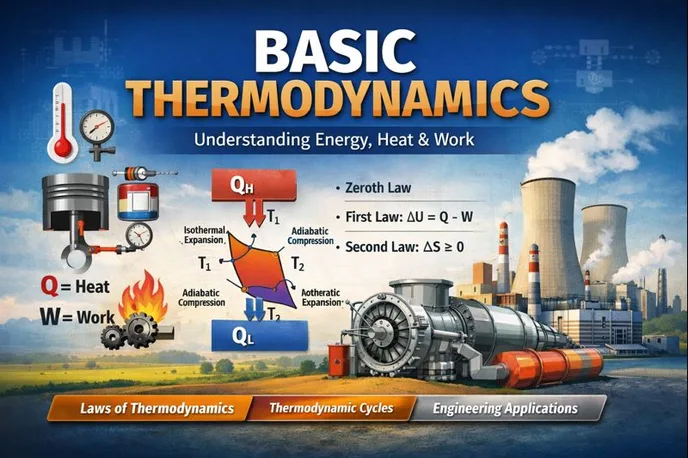
Basic Thermodynamics banner
Preview this course
Basic Thermodynamics banner
Preview this course
Self-paced Advanced

Basic Thermodynamics

4(117)
11 enrolled
363 views
FREE
1985 min
Anytime
English
363 views
Engineering Academy
Engineering AcademyLearn Without Limits: Free Engineering Courses
  • Lifetime access
  • Anytime Learning
  • Learn from Industry Expert
  • Career Option Guideline

Why enroll

Participants join the Basic Thermodynamics course to build a strong foundational understanding of energy, heat, and work, which are essential concepts in core engineering disciplines. The course helps learners develop analytical and problem-solving skills required to analyze thermodynamic systems and processes, while also linking theory with practical engineering applications. It serves as a critical stepping stone for advanced subjects such as heat transfer, fluid mechanics, and thermal engineering, and supports better performance in academic assessments and competitive examinations by strengthening conceptual clarity and application-oriented thinking.

Is this course for you?

You should take this if

  • You're a Mechanical Engineering / Production Engineering professional
  • You have 3+ years of hands-on experience in this field
  • You prefer self-paced learning you can revisit

You should skip if

  • You're new to this field with no prior experience
  • You need a different specialisation outside Mechanical Engineering
  • You need live interaction with an instructor

Course details

Basic Thermodynamics covers the fundamental concepts governing energy interactions in physical systems. The subject introduces thermodynamic systems, properties, and states, followed by a detailed study of the Zeroth, First, and Second Laws of Thermodynamics. Learners explore energy transfer mechanisms such as heat and work, analyze closed and open systems, and study basic thermodynamic cycles. The course emphasizes practical engineering applications, problem-solving techniques, and real-world relevance in mechanical, chemical, and energy engineering domains.

source: NPTEL[ nptelhrd]

Course suitable for

Key topics covered

1. zeroth law and fundamentals

2. Different kinds of energy and first low-I

3. Thermodynamics property relations-I

4. Property of pure substances

5. property of ideal gases

6. vapour power cycle

Course content

The course is readily available, allowing learners to start and complete it at their own pace.

32 lectures33 hr 5 min
  1. Introduction and fundamental concepts
    62 min
  2. Zeroth law and fundamental concepts
    39 min
  3. Different Kind of Energy and First Low-I
    67 min
  4. First Low-II
    66 min
  5. First Low-III
    83 min
  6. Second Law and Its Corollaries-I
    66 min
  7. Second Law and Its Corollaries-II
    64 min
  8. Second law and Its Corollaries-III
    67 min
  9. Second Law and Its Corollaries-IV
    72 min
  10. Second Law and Available Energy-I
    67 min
  11. Second Law and Available Energy-II
    67 min
  12. Second Law and Available Energy-III
    68 min
  13. Thermodynamic Property Relations-I
    69 min
  14. Thermodynamic Property Relations-II
    72 min
  15. Joule-Kelvin Expansion: Properties of Pure substances
    66 min
  16. Properties of Pure Substances-I
    65 min
  17. Properties of Pure Substances-II
    69 min
  18. Properties of Pure Substances: Ideal Gases
    50 min
  19. Properties of Ideal Gases
    59 min
  20. Vapors Power Cycle-I
    66 min
  21. Vapor Power Cycle-II
    70 min
  22. Vapor Power Cycle-III
    52 min
  23. Vapor Power Cycle-IV
    51 min
  24. Gas Power Cycle-I
    68 min
  25. Gas Power Cycle-II
    46 min
  26. Gas Power Cycle-III
    71 min
  27. Thermodynamics of Reacting System-I
    55 min
  28. Thermodynamics of Reacting System-II
    50 min
  29. Thermodynamics of Reacting System-III
    53 min
  30. Thermodynamics of Multi Component System-I
    52 min
  31. Thermodynamics of Multi Component System-II
    54 min
  32. Thermodynamics of Multi Component System-III
    59 min

Opportunities that await you!

Career opportunities

Why people choose EveryEng

Industry-aligned courses, expert training, hands-on learning, recognized certifications, and job opportunities-all in a flexible and supportive environment.

FREE

Access anytime

Questions and Answers

A: A lines up with the evaporation process. As water flashes to steam, mass leaves but most impurities stay, so without a bleed the system walks toward higher chemical potential and fouling. B sounds right if you're thinking control theory, but pressure oscillations are handled by drum geometry and controls, not mandated blowdown. C mixes up thermal effectiveness with water chemistry; residence time doesn’t drift just because blowdown changes. D borrows a real concern from metallurgy, yet the heat carried out in blowdown is tiny compared to furnace duty and doesn’t set metal temperature.

A: A addresses the physics directly: at 25 bar, Z and cp deviate enough that ideal assumptions overstate enthalpy change. B feels safe from a project-risk angle, but it hides a modeling error instead of fixing it and can cascade into oversizing. C jumps domains; isothermal compression is a limit case, not a sizing basis for a finite exchanger. D confuses thermodynamic non-ideality with frictional losses, which live in a different part of the model.

A: A comes from the math: 1 MW / 5 kg/s is 200 kJ/kg. Saturated vapor to 10 kPa has a latent heat on the order of 2,000 kJ/kg, so only a slice of that is used, leaving most vapor intact. B sounds intuitive if you focus only on pressure, but ignores the actual energy extracted. C forgets that any real work output must come from reducing vapor enthalpy, so some condensation is unavoidable. D overweights pressure ratio without tying it back to specific work.

A: A matches the symptom pattern. Non-condensables kill condensation coefficients without changing ΔP much, and the slow drift fits gas accumulation. B would usually show a gradual ΔP increase as well. C affects both heat transfer and pressure drop more abruptly once the valve position changes. D explains bad numbers, but not the real loss of duty observed in downstream equipment.