Sour Water System Optimisation
Sour Water System Optimisation
Tell us and we’ll notify you when the next batch is scheduled.

- Session recordings included
- Certificate of completion
Why enroll
What enrolled engineers say
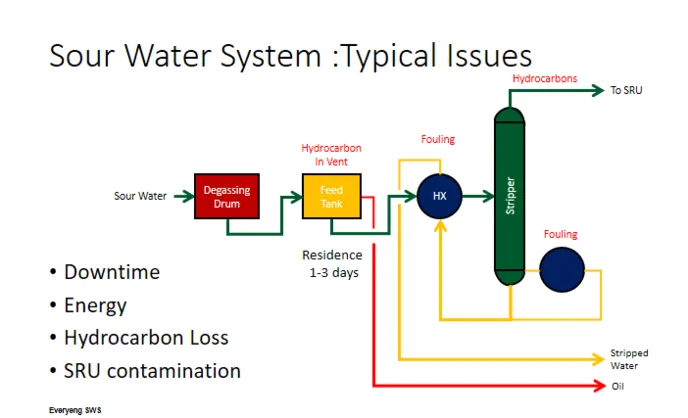
Coming into this course, I had some prior exposure to the subject from refinery operations, mostly dealing with sour water strippers and downstream sulfur recovery units. What was missing was a clear explanation of why oil-in-water emulsions with H2S and NH3 behave so badly in real systems, even when residence time looks fine on paper. The sections on emulsion stability, droplet size distribution, and how it directly drives heat exchanger fouling connected a lot of dots from day-to-day oil & gas troubleshooting. One challenge was keeping up with the balance between theory and field examples, especially around mass transfer limits and separation efficiency. A few case discussions moved fast, but they reflected how issues actually show up during unit upsets. The most practical takeaway was rethinking the “bigger tank fixes everything” mindset. Looking at upstream contamination control, filtration options, and smarter hydraulics is something that can be applied immediately, even without a full revamp. This filled a real knowledge gap between design assumptions and operating reality, and the learnings translate well to other chemical processing systems handling emulsions. I can see this being useful in long-term project work.
At first glance, the topics looked familiar, but the depth surprised me. Sour water stripping and hydrocarbon carryover are everyday oil & gas problems, yet the course went beyond the usual “add residence time” thinking. The discussion around stable oil emulsions, especially in H₂S/NH₃-laden water, aligned well with what’s seen in refineries feeding sulfur recovery units, where even small upsets can cascade downstream. One challenge during the course was reconciling the theoretical droplet settling assumptions with real plant data. In practice, heat exchanger fouling and stripper internals plugging don’t behave anywhere near textbook expectations, and that gap was openly addressed. Comparisons with industry-standard API separators versus advanced filtration approaches were useful, particularly for edge cases like high aromatic content or fine solids that keep emulsions stable. From a chemical processing perspective, the linkage between interfacial chemistry, filtration media selection, and system-level energy penalties was handled well. A practical takeaway was rethinking front-end sour water handling instead of over-designing the stripper itself. That has implications for emissions control and long-term operability, not just short-term throughput. Overall, it felt grounded in real engineering practice.
This course turned out to be more technical than I anticipated. The discussion around sour water stripper upsets in oil & gas facilities went deeper than the usual residence-time arguments seen in many refineries. The treatment of stable oil-in-water emulsions, especially with concurrent H₂S and NH₃ loading, matched issues seen in both refining and chemical/pharmaceutical wastewater systems, where trace hydrocarbons quietly break downstream units. One challenge was mentally reconciling the idealized separator assumptions with messy field reality. Several edge cases were highlighted—like how exchanger fouling accelerates when emulsions bypass upstream tanks, or how small hydrocarbon slips end up causing disproportionate problems in SRU feed quality. That mirrors what happens in pharma effluent polishing, where minor contaminants can shut down biological systems. Compared to standard industry practice of “bigger tanks and longer holdup,” the course pushed more system-level thinking, including separation technology selection and fouling mitigation strategies. A practical takeaway was re-evaluating where separation actually belongs in the process, rather than overloading the stripper to fix upstream design gaps. The content felt aligned with practical engineering demands.
Your instructor
Team EveryEng
Engineer
Mechanical Engineering
Is this course for you?
You should take this if
- You work in Oil & Gas Upstream or Pharmaceutical & Healthcare
- You're a Chemical & Process / Geoscience professional
- You prefer live, instructor-led training with Q&A
You should skip if
- You need a different specialisation outside Chemical & Process
- You need fully self-paced, on-demand content
Course details
Course suitable for
Key topics covered
Opportunities that await you!
Career opportunities
Training details
This is a live course that has a scheduled start date.
Why people choose EveryEng
Industry-aligned courses, expert training, hands-on learning, recognized certifications, and job opportunities-all in a flexible and supportive environment.


 Aug 29, 2026