Skip to main contentEngineering Courses, Mentoring & Jobs | EveryEng
Turbulent Flow: Theory &  CFD Modeling banner
Self-paced Beginner

Turbulent Flow: Theory & CFD Modeling

4(5)
11 enrolled
3110 views
$ 20
353 min
Anytime
English
3110 views
Team EveryEng
Team EveryEngMechanical Engineering
  • 7-day money-back guarantee
  • Lifetime access
  • Foundational Learning
  • Access to Study Materials

Why enroll

People enroll in the Turbulent Flow: Theory & CFD Modeling course to gain a deeper understanding of complex fluid behavior and to develop practical skills in simulating turbulent flows using advanced CFD tools. This knowledge is essential for solving real-world engineering problems in fields like aerospace, automotive, energy, and environmental engineering. The course bridges theory and application, making it valuable for students, researchers, and professionals looking to enhance their expertise and improve their career prospects in fluid dynamics and simulation.

Is this course for you?

You should take this if

  • You work in Automotive or Aerospace
  • You're a Mechanical Engineering professional
  • You prefer self-paced learning you can revisit

You should skip if

  • You need a different specialisation outside Mechanical Engineering
  • You need live interaction with an instructor

Course details

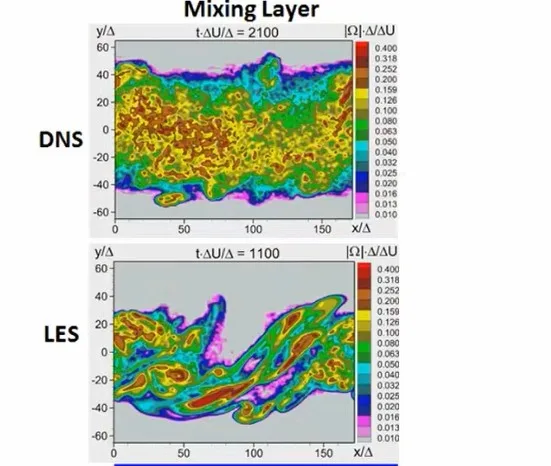
This course provides a comprehensive introduction to the theory and computational modeling of turbulent flows, essential for advanced studies and industrial applications in fluid mechanics. Students will explore the physical principles, mathematical foundations, and numerical methods used to understand and simulate turbulent flows in engineering systems.The course begins with a review of the Navier-Stokes equations and flow regimes, followed by an in-depth examination of turbulence characteristics, statistical analysis, and energy cascades. Students will learn about Reynolds-Averaged Navier-Stokes (RANS) modeling, Large Eddy Simulation (LES), and Direct Numerical Simulation (DNS), including turbulence models such as k-ε, k-ω, and Spalart-Allmaras.

Course suitable for

Key topics covered

  • Introduction to Turbulent Flows

  • Overview of turbulence models: RANS, LES, and DNS

  • Resolution challenge in Turbulence

  • Reynolds Averaged Navier-Stokes Equation Derivation

  • RANS & Eddy Viscosity Based Models

  • Eddy Viscosity Models

  • Turbulence Modeling: Spalart-Almaras Model, k- ε Model & k- ω Model

Course content

The course is readily available, allowing learners to start and complete it at their own pace.

6 lectures5 hr 53 min
  1. Lecture 01
    60 min
  2. Lecture 02
    53 min
  3. Lecture 03
    60 min
  4. Lecture 04
    60 min
  5. Lecture 05
    60 min
  6. Lecture 06
    60 min

Opportunities that await you!

Career opportunities

Why people choose EveryEng

Industry-aligned courses, expert training, hands-on learning, recognized certifications, and job opportunities-all in a flexible and supportive environment.

$20

Access anytime

Questions and Answers

A: This choice lands you solidly in the turbulent regime using the standard Re = ρVD/μ basis expected by RANS wall functions. Option B drops density and quietly swaps to ν without stating it, which shifts the order of magnitude. Option C invents a correction that doesn't exist for a round duct. Option D inflates density to a stagnation value that the flow never sees.

A: This selection gives stable pressure-drop predictions without forcing mesh refinement that the schedule won't tolerate. Option B can work but drives y+ and cell count into a corner you didn't budget. Option C is aimed at attached external flows and misses separation physics here. Option D ignores compute reality and adds no safety margin.

A: This step confirms numerical error is under control before you compare physics. Option B assumes the mesh is already adequate, which is backward. Option C tunes numerics to match data and hides discretization error. Option D checks a local metric only after global correlation has already biased you.

A: This outcome directly skews friction and thermal loads, which feeds into unsafe design decisions. Option B is a time-stepping issue, not a wall-resolution one. Option C can happen but isn't the primary consequence of high y+ misuse. Option D is unrelated to wall treatment entirely.