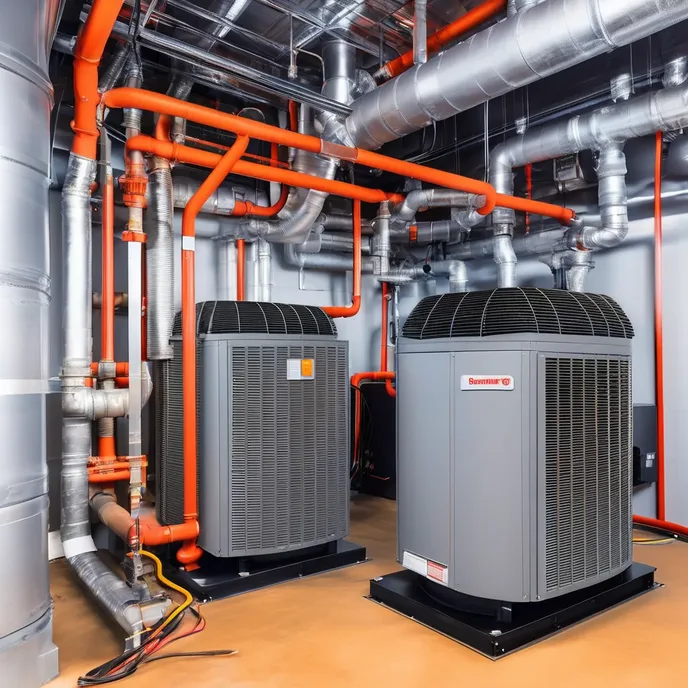
Mastering HVAC Control Systems: A Comprehensive Online Course
$ 20
Beginner course for learners
Mastering HVAC Control Systems: A Comprehensive Online Course
Trainers feedback
5
(1 reviews)
Course type
Instructor led live training
Course duration
2 Hrs
Course start date & time
Coming in Next Month
Language
English
This course format is where trainer will explain you the subject via online live session. Date and time are not decided yet but it will be planned within next 2 weeks after you enroll & pay for this course?. Get in touch with our team if any clarification is required.
Why enroll
Mastering HVAC control systems can catapult your career to new heights in the HVAC industry. With this expertise, you'll be in high demand as a Control System Specialist, HVAC System Designer, or Building Automation Manager. Your knowledge will enable you to design and optimize complex control systems, improving energy efficiency and indoor comfort. You'll be competitive for senior roles like Senior HVAC Engineer, Facilities Director, or Energy Manager, and be well-positioned to pursue certifications like LEED AP or ASHRAE certification. Unlock new opportunities and take your HVAC career to the next level with this advanced skillset.
Course details
This in-depth online course covers the fundamentals and advanced concepts of HVAC control systems, including design, installation, and operation. Students will gain a comprehensive understanding of:
- Control system components: sensors, actuators, controllers, and valves
- Control strategies: temperature, humidity, pressure, and flow control
- System design: configuring and optimizing control systems
- Installation and commissioning: best practices and troubleshooting
- Energy efficiency and optimization techniques
- Advanced control strategies: predictive maintenance, fault detection, and energy management
Course suitable for
Oil & Gas Aerospace HVAC Chemical & Process Mechanical
Key topics covered
1. Introduction to HVAC Control Systems (15 minutes)
Brief overview of HVAC control systems and their importance.
2. Control System Architecture (10 minutes)
Understanding the basic structure of control systems.
3. Sensors and Instrumentation (10 minutes)
A quick overview of key sensors and instruments used in HVAC control.
4. Control Strategies (15 minutes)
Introduction to common control strategies, such as on-off and PID.
5. Energy Management (10 minutes)
Strategies for optimizing energy efficiency using control systems.
6. Troubleshooting and Maintenance (15 minutes)
Overview of essential troubleshooting techniques and maintenance practices.
7. Q&A and Resources (15 minutes)
An opportunity for participants to ask questions and receive information about further resources for in-depth learning.
Training details
This is a live course that has a scheduled start date.
Live session
Why people choose EveryEng
Industry-aligned courses, expert training, hands-on learning, recognized certifications, and job opportunities—all in a flexible and supportive environment.
- Industry Veteran
- Trainer Review
$ 20
- $ 0 Early bird discount
Coming in Next Month
Questions and Answers
A: An HVAC control system primarily consists of sensors, controllers, actuators, and user interfaces. Sensors measure environmental parameters such as temperature, humidity, and pressure. Controllers process sensor data and make decisions based on pre-set parameters or algorithms. Actuators implement the controller's decisions by adjusting components like dampers, valves, or fans. User interfaces allow operators to monitor system status and modify settings. For more detailed information, you can refer to ASHRAE's HVAC Fundamentals guide: https://www.ashrae.org/technical-resources/bookstore/hvac-fundamentals
A: PID controllers regulate system output by adjusting control inputs based on proportional, integral, and derivative terms of the error signal, which is the difference between desired and actual values. In HVAC systems, PID controllers fine-tune temperature or airflow by continuously calculating errors and reducing them over time, leading to stable and efficient system performance. The proportional part reacts to current error, the integral accounts for past errors, and the derivative predicts future errors, enabling smooth control. For a deeper understanding, visit: https://control.com/technical-articles/introduction-to-pid-control/
A: Building Automation Systems (BAS) integrate HVAC controls with other building systems like lighting, security, and energy management to optimize operational efficiency and occupant comfort. BAS allow centralized monitoring, remote control, scheduling, and data analytics, enabling proactive maintenance and energy savings. Modern BAS often employ open communication protocols such as BACnet or Modbus for interoperability. Detailed insight can be found at: https://www.ashrae.org/technical-resources/bookstore/building-automation-systems
A: Sensor placement is critical because inaccurate readings can lead to poor system performance, energy wastage, or occupant discomfort. Sensors should be placed away from heat sources, direct sunlight, drafts, or obstructed airflow to ensure representative environmental measurements. For example, temperature sensors are typically installed at occupant level and away from windows or equipment that could skew data. Proper placement guidelines are outlined in ASHRAE Standard 55: https://www.ashrae.org/technical-resources/bookstore/standard-55-thermal-environmental-conditions-for-human-occupancy
A: Retrofitting HVAC control systems in existing buildings often involves challenges such as outdated infrastructure, limited space for new sensors or controllers, integration with legacy equipment, and potential downtime during installation. Moreover, incomplete documentation of the original HVAC system complicates design and calibration. Addressing these challenges requires careful planning, thorough site surveys, selection of compatible control technologies, and sometimes phased implementation. For best practices, see: https://www.energy.gov/energysaver/retrofit-your-home
A: Demand-Controlled Ventilation adjusts ventilation rates based on real-time occupancy or air quality measurements, such as CO2 levels, rather than fixed schedules. This ensures adequate fresh air is supplied when needed, reducing over-ventilation and energy consumption associated with heating or cooling excess outside air. DCV is particularly effective in spaces with variable occupancy like conference rooms or auditoriums. For technical details, review the ASHRAE Handbook—HVAC Applications: https://www.ashrae.org/technical-resources/ashrae-handbook
A: Regular calibration ensures that sensors and controllers provide accurate and reliable data, which is essential for effective HVAC system performance. Calibration drifts over time due to sensor aging, environmental factors, or mechanical wear can cause erroneous control signals, increasing energy use or reducing occupant comfort. Implementing a scheduled calibration and maintenance plan minimizes these risks and prolongs equipment life. Guidelines on calibration best practices can be found here: https://www.nist.gov/programs-projects/sensor-calibration
A: VAV systems adjust the airflow delivered to different zones based on thermal load demands, providing energy-efficient and customizable comfort control. The HVAC control system modulates VAV box dampers using feedback from temperature sensors, balancing airflow and maintaining desired conditions. This dynamic control reduces simultaneous heating and cooling and optimizes fan energy use. For a comprehensive overview on VAV systems, refer to: https://www.energy.gov/eere/buildings/articles/variable-air-volume-systems
A: Wireless controls offer flexible installation, reduced wiring costs, and easy scalability, especially in retrofit projects or large complex buildings. However, challenges include potential interference, limited range, power management for wireless sensors, and cybersecurity concerns. Ensuring robust network design and security protocols is critical for reliable system operation. More on wireless HVAC control systems can be explored here: https://www.hpac.com/control/article/21157014/wireless-hvac-control-systems
A: Data analytics enable HVAC systems to leverage historical and real-time data to identify operational inefficiencies, predict equipment failures, and optimize control strategies. Advanced techniques such as machine learning can adapt to changing building usage patterns, improve energy efficiency, and reduce maintenance costs. Implementing analytics requires integration with building automation systems and appropriate data infrastructure. For further reading, see: https://www.energy.gov/eere/buildings/articles/data-analytics-and-building-automation
More from Same Author
- Technical Courses
- Articles
5
739
Online
Live courses
Online
Live courses
Interacting with trainer
5
741
Online
Live courses
Online
Live courses
Interacting with trainer
5
731
Online
Live courses
Online
Live courses
Interacting with trainer
Earning and Growth option in same Industry Domain
- Pre-recorded
- Online live session
- Offline
- Articles
2
2197
13
E-Learning
Unlimited access
E-Learning
Unlimited access
Pre-recorded videos
4 (42)
1411
5
E-Learning
Unlimited access
E-Learning
Unlimited access
Pre-recorded videos
1
2727
1
E-Learning
Unlimited access
E-Learning
Unlimited access
Pre-recorded videos
More Training & Development option to expand your reach
- Technical courses
- Soft-skills courses
- Seminars
- Articles & Blogs
4
175
Online
Live courses
December 21
1.5 Hrs
Beginner
Online
Live courses
Interacting with trainer
836
3
Online
Live courses
December 31
160 Hrs
Advanced
Online
Live courses
Interacting with trainer
92
Online
Live courses
January 8
9 Hrs
Beginner
Online
Live courses
Interacting with trainer


