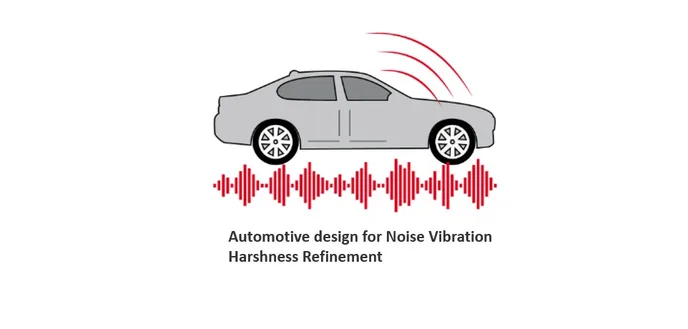
A Complete course on automotive design for Noise Vibration Harshness Refinement
A Complete course on automotive design for Noise Vibration Harshness Refinement
- 7-day money-back guarantee
- Lifetime access
- Certificate of completion
Why enroll
What enrolled engineers say
Came in to audit it for our L&D budget and ended up learning more than expected, especially mapping legacy NVH thinking to how teams actually work today. The Transfer Path Analysis chapter stuck: the example where they isolate a firewall mount using order tracking and a simple FFT waterfall made it click. It bridges old-school test rigs with modern obs and CI habits; not k8s-in-a-car, but the arch thinking translates. Mostly good, though I wasn't sold on the brief EV NVH bit and wished for more on active noise control—still, it's made a messy topic feel manageable.
Reads like field notes from someone who's shipped and debugged NVH issues in prod. The moment that stuck was Chapter 3 on transfer path analysis, where the 180 Hz cabin boom gets traced back to an exhaust hanger stiffness change; that example maps cleanly to how we reason about arch and PR reviews. From a team lead angle, it’s mostly efficient for onboarding juniors without burning budget, though I wasn't sold on the light tooling walkthroughs and wished for more EV-specific NVH. left with a refactoring plan sketched for our test repo and CI.
The NVH basics clicked via the powertrain mount tuning chapter's FFT walkthrough—mostly useful, though I wasn't sold on the MATLAB-heavy detour.
Is this course for you?
You should take this if
- You work in Automotive
- You're a Noise & Vibration Engineering / Automobile Engineering professional
- You prefer self-paced learning you can revisit
You should skip if
- You need a different specialisation outside Noise & Vibration Engineering
- You need live interaction with an instructor
Course details
Course suitable for
Key topics covered
Course content
The course is readily available, allowing learners to start and complete it at their own pace.
- 1. How Acoustics and Vibrations shape the Vehicle Design and Environment60 min
- 1.1 Fundamentals of Acoustics & Vibrations,60 min
- 1.2 Overview of Automotive NVH : Advanced TEST tools deployed during Vehicle Validation phases60 min
- 1.3 Industry practices of overall synthesis & control of vibrations & noise of vehicles - part A60 min
- 1.4 Industry practices of overall synthesis & control of vibrations & noise of vehicles - part B60 min
- 1.5 Industry practices of overall synthesis & control of vibrations & noise of vehicles - part C60 min
- 1.6 Industry practices of overall synthesis & control of vibrations & noise of vehicles - part D60 min
- 2 Optimal Design of Power-train mounting for the Best Vehicle NVH60 min
- 2.1 Part A --Modal Separation principle, transfer paths, Optimization,60 min
- 2.2 Part B --Transient Event Control, Rubber mount material property60 min
- 2.3 Part C --Electric motor-train mounting special considerations, Advanced Hydra-mounts60 min
- 3. Structural modal analysis Made Easy for Automotive Managers: A Strategic Approach60 min
- 3.1 Part A -, Operational Modal Analysis, ODS, Acoustic cavity modes60 min
- 4. Design of Vehicle-body for Best NVH refinements - Part A60 min
- 4. (continued) Design of Vehicle-body for Best NVH refinements- Part B60 min
- 5. Part A -- Electric Motors to be made really quieter –free from tonal sound60 min
- 5. (continued) Part B overall EV -NVH challenges for Buses, Fuel Cell Vehicles and mitigation plans -60 min
- 6. Part 1 Advanced CAE tools deployed during Vehicle Design - overview & FEA60 min
- 6. continued Part 2 - FEA in structural dynamics57 min
- 6. continued Part 3 - FEA with case-studies and BEM61 min
- 6. continued Part 4 -Advanced CAE tools deployed during Vehicle Design - CFD, MBD50 min
- 6. continued Part 5 -Advanced CAE tools deployed during Vehicle Design -SEA , Optimization and 7. Test vs digital simulation57 min
- 7. (continued from Lecture 22) The Art of Trade-offs: Physical Testing vs. digital Simulations in NVH Analysis and 8. Durability of vehicle components54 min
- 8.. (continued from Lecture 23 ) Durability of vehicle components and vibrations & acoustic pressures57 min
- 9. Part 1 Diesel & Gasoline Engine NVH synthesis and control Lecture No. 2559 min
- 9. continued Part 2 Diesel & Gasoline Engine NVH synthesis and control Lecture - 2661 min
- 10. Part 1 Gear-train Whine minimization Lecture - 2759 min
- 10. Part 2 Continued Gear-train Rattle minimization and 11. Wind noise control Lecture 2854 min
- 11. (continued from Lecture 28 ) Wind Noise Control: and 12. Tye noise -Lecture 2957 min
- 12. Tye/ road noise continued and Buzz Squeak Rattle (BSR) Part 1 --- Lecture 3059 min
- 12. BSR Part 2 13. Sound Quality analysis Part 1 --Lecture 3154 min
- 13 Sound Quality Analysis Part 2--Lecture 3262 min
- 13 Sound Quality -Part 3 and 14- A Vehicle Brake Noise Part 1 -- Lecture 3353 min
- 14-A Brake Squeal Part 2 14-B Vehicle Dynamics & NVH and 15 Vehicle Noise Regulations Part 1 - Lecture 3450 min
- 15 Vehicle Noise Regulations Part 2 and Acoustic Vehicle Alert System for EVs --Lecture 3562 min
- 16 Performance Targets Setting & Cascading for Best in class NVH of Vehicles -- Lecture 3660 min
- 17 Design for Six Sigma (DFSS) for Automotive NVH Part 1 --Lecture 3759 min
- 18 DFSS & NVH Part 2 and 18 Active Noise & vibrations control and AI/ML applications -- Lecture 3862 min
Opportunities that await you!
Career opportunities
Why people choose EveryEng
Industry-aligned courses, expert training, hands-on learning, recognized certifications, and job opportunities-all in a flexible and supportive environment.


 Aug 29, 2026