<link href="https://fonts.googleapis.com/css2?family=Caveat:wght@500;700&family=JetBrains+Mono:wght@400;500;600&display=swap" rel="stylesheet" /> Skip to main contentEngineering Courses, Mentoring & Jobs | EveryEng
Bevel Gear Design In SolidWorks banner

Bevel Gear Design In SolidWorks

Bevel Gear Design In SolidWorks banner
Self-paced Beginner

Bevel Gear Design In SolidWorks

170
6 enrolled
703 views
FREE
10 min
Anytime
English
Team EveryEng
Team EveryEngMechanical Engineering
  • Lifetime access
  • Certificate of completion
  • Foundational Learning
  • Access to Study Materials
Volume pricing for groups of 5+

Why enroll

This course is designed for mechanical engineers, design engineers, and professionals involved in gear design and manufacturing. Basic familiarity with SolidWorks and mechanical engineering principles is recommended. Upon completion of the course, participants will possess the skills and knowledge to confidently design, simulate, and document bevel gears using SolidWorks, ensuring optimal performance, reliability, and manufacturability in mechanical systems and applications.

Is this course for you?

You should take this if

  • You work in Aerospace or Automotive
  • You're a Mechanical Engineering professional
  • You prefer self-paced learning you can revisit

You should skip if

  • You need a different specialisation outside Mechanical Engineering
  • You need live interaction with an instructor

Course details

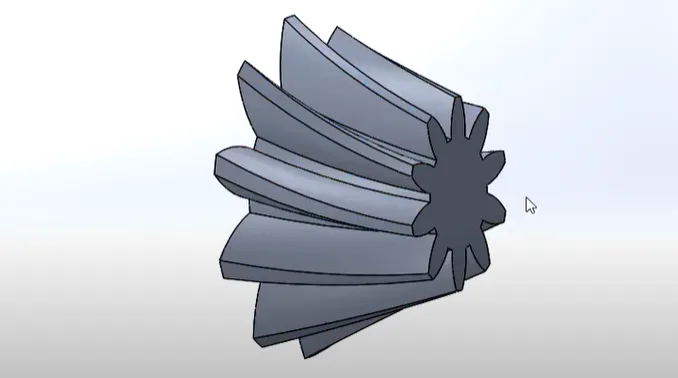
This specialized course focuses on the design of bevel gears using SolidWorks, a widely used CAD software in mechanical engineering and manufacturing. Participants will learn the fundamental principles of bevel gear design and how they are used in power transmission systems. The course explains important concepts such as gear geometry, tooth profiles, and gear ratios. Learners will develop practical skills in creating accurate 3D models of bevel gears in SolidWorks. It also introduces techniques for assembling and aligning gears within mechanical systems. Participants will explore simulation tools to analyze gear performance and efficiency. The course highlights best practices for improving durability and reducing mechanical stress. Real-world design examples help learners understand industrial applications. By the end of the course, participants will be able to design reliable and efficient bevel gears. This course is ideal for students and professionals interested in mechanical design and CAD modeling.

Course suitable for

Key topics covered

  • Fundamentals of Bevel Gear Geometry

  • Advanced Modeling Techniques

  • Simulation Analysis

Course content

The course is readily available, allowing learners to start and complete it at their own pace.

2 lectures10 min

Opportunities that await you!

Skills & tools you'll gain

SolidWorks

Career opportunities

FREE

Access anytime

Questions and Answers

A: A fits because chloride-driven pitting and fretting at the tooth root dominate here, and a deep carburized case buys fatigue margin even when corrosion initiates. B sounds reasonable since black oxide shows up on drawings, but it does almost nothing once salt water sits in the mesh. C tempts anyone thinking marine, yet bronze trades corrosion for tooth bending fatigue you can't afford at automotive torque density. D looks clean on paper, but nitrided stainless brings distortion risk and contact fatigue limits that don't match a splash-lubed bevel set.

A: B is outside the protection envelope. A shear pin breaks on torque, not pressure. A, C, and D all ride directly on torque transmission and see relief when the pin goes. Thermal expansion driving MAWP exceedance keeps happening even with zero torque, and the housing still pays the price.

A: C respects cause and effect. Backlash means nothing until bearings and bores are right. A feels classic shop practice, but pattern checks before preload can lie. B swaps the order; bolt torque affects alignment but doesn't replace bearing setup. D is how you create your own NCR on day one.

A: C ties all symptoms together. A wrong apex shifts contact to the tips and flips behavior between drive and coast. A alone gives noise, but not the consistent tip polish. B would show spalling or scuffing, not clean polish. D changes noise character but doesn't selectively polish tips.