<link href="https://fonts.googleapis.com/css2?family=Caveat:wght@500;700&family=JetBrains+Mono:wght@400;500;600&display=swap" rel="stylesheet" /> Skip to main contentEngineering Courses, Mentoring & Jobs | EveryEng
Design Water Bottle in SolidWorks banner

Design Water Bottle in SolidWorks

Design Water Bottle in SolidWorks banner
Self-paced Beginner

Design Water Bottle in SolidWorks

4(1579)
5 enrolled
1300 views
FREE
22 min
Anytime
English , Hindi
Team EveryEng
Team EveryEngMechanical Engineering
  • Lifetime access
  • Certificate of completion
  • Foundational Learning
  • Access to Study Materials
Volume pricing for groups of 5+

Why enroll

By the end of the course, students will have developed a comprehensive understanding of water bottle design principles and proficiency in using SolidWorks to bring their designs to life. They will be equipped with the knowledge and skills necessary to pursue careers in product design, engineering, and manufacturing, with a focus on sustainable and innovative solutions for the consumer goods industry.

Is this course for you?

You should take this if

  • You work in All Domains
  • You're a Mechanical Engineering professional
  • You prefer self-paced learning you can revisit

You should skip if

  • You need a different specialisation outside Mechanical Engineering
  • You need live interaction with an instructor

Course details

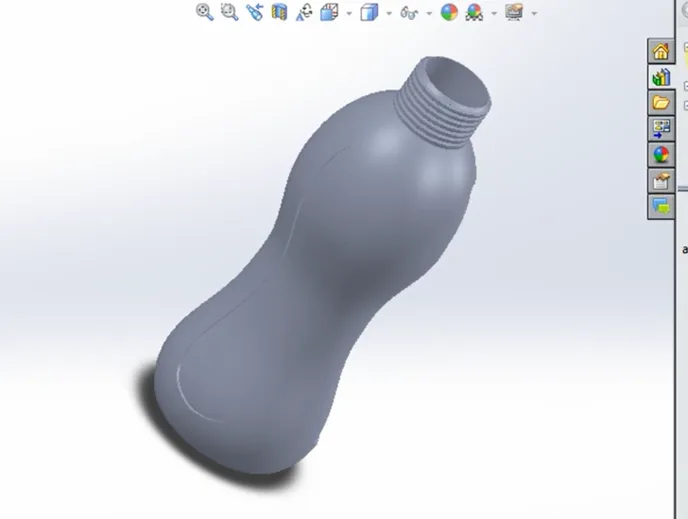
This course is designed to equip students with comprehensive knowledge and practical skills in water bottle design using SolidWorks, a leading computer-aided design (CAD) tool widely used in product development. Participants will begin with the fundamentals of CAD modeling, learning essential tools, sketching techniques, and feature creation. The course then focuses on designing water bottles by exploring concepts such as ergonomics, material selection, and aesthetic design. Students will gain hands-on experience in creating 3D models, assemblies, and detailed engineering drawings.In addition, the course covers advanced topics like surface modeling, rendering, and simulation to optimize product performance and appearance. Learners will understand manufacturing considerations, including injection molding and prototyping methods. Real-world projects and case studies will help participants apply their knowledge to practical scenarios. By the end of the course, students will be able to design efficient, functional, and visually appealing water bottles ready for production. This course is ideal for beginners and aspiring product designers looking to build a strong foundation in CAD-based product design.

Course suitable for

Key topics covered

  • Bottom part of the Bottle

  • Creating shell and outer design

  • Sketching And Smart Dimension

  • Neck Finishing and Material Selection

Course content

The course is readily available, allowing learners to start and complete it at their own pace.

4 lectures22 min

Opportunities that await you!

Skills & tools you'll gain

SolidWorks

Career opportunities

FREE

Access anytime

Questions and Answers

A: A looks boring, which is why it gets skipped. If the gauge is drifting low, your apparent pass is fiction, and the longer dwell times are a clue. B feels decisive, but changing acceptance pressure on the floor without an MOC breaks the test basis. C is how marginal designs escape into production; trends don't fix themselves. D confuses failure modes — leaks at the neck are about hoop stress and creep, not impact.

A: A sounds pedantic; mold finishes do live on part drawings in plastics. C might be true in some markets, but nothing here proves it. D is cosmetic. B is where the physics bite — draft on what should be a controlled sealing surface shifts contact stress and shows up later as marginal leak results.

A: A feels intuitive but drops section modulus where hoop stress is highest. C is tempting for schedules, but higher temperature moves you further into the creep regime and muddies comparison. D misses that functional failure comes long before burst. B addresses the local stress riser that FEA usually flags red in these bottles.

A: A comes straight from σ = p·r/t, and the geometry fits the assumption. B sneaks in material behavior to dodge arithmetic — redistribution doesn't halve basic membrane stress. C doubles radius by mistake. D applies a safety factor before you've even checked allowable, a classic spreadsheet habit.