

Article details
Introduction
Autoignition temperature is an important concept in fire safety, chemical engineering, fuel handling, and industrial operations. It helps engineers understand the temperature at which a substance can catch fire without an external ignition source, such as a flame, spark, or electrical discharge.
Different fuels and chemicals have different autoignition temperatures. Understanding these differences is essential for selecting suitable equipment, preventing accidental fires, designing industrial processes, and maintaining safe storage conditions.
This article explains the meaning of autoignition temperature, the factors that affect it, how it differs from other ignition properties, and why it matters in industrial applications.
What Is Autoignition Temperature?
Autoignition temperature is the lowest temperature at which a substance can ignite spontaneously under specified test conditions without an external ignition source.
When a combustible substance reaches this temperature in the presence of sufficient oxygen, chemical reactions can generate heat rapidly enough to initiate combustion. The process does not require a spark or open flame to start.
For example, a fuel exposed to a sufficiently hot surface may ignite if its temperature and surrounding conditions allow self-ignition. However, the exact temperature at which ignition occurs depends on the fuel's properties and the conditions in which it is tested.
Autoignition temperature is commonly expressed in degrees Celsius (°C), degrees Fahrenheit (°F), or kelvin (K).
How Does Autoignition Occur?
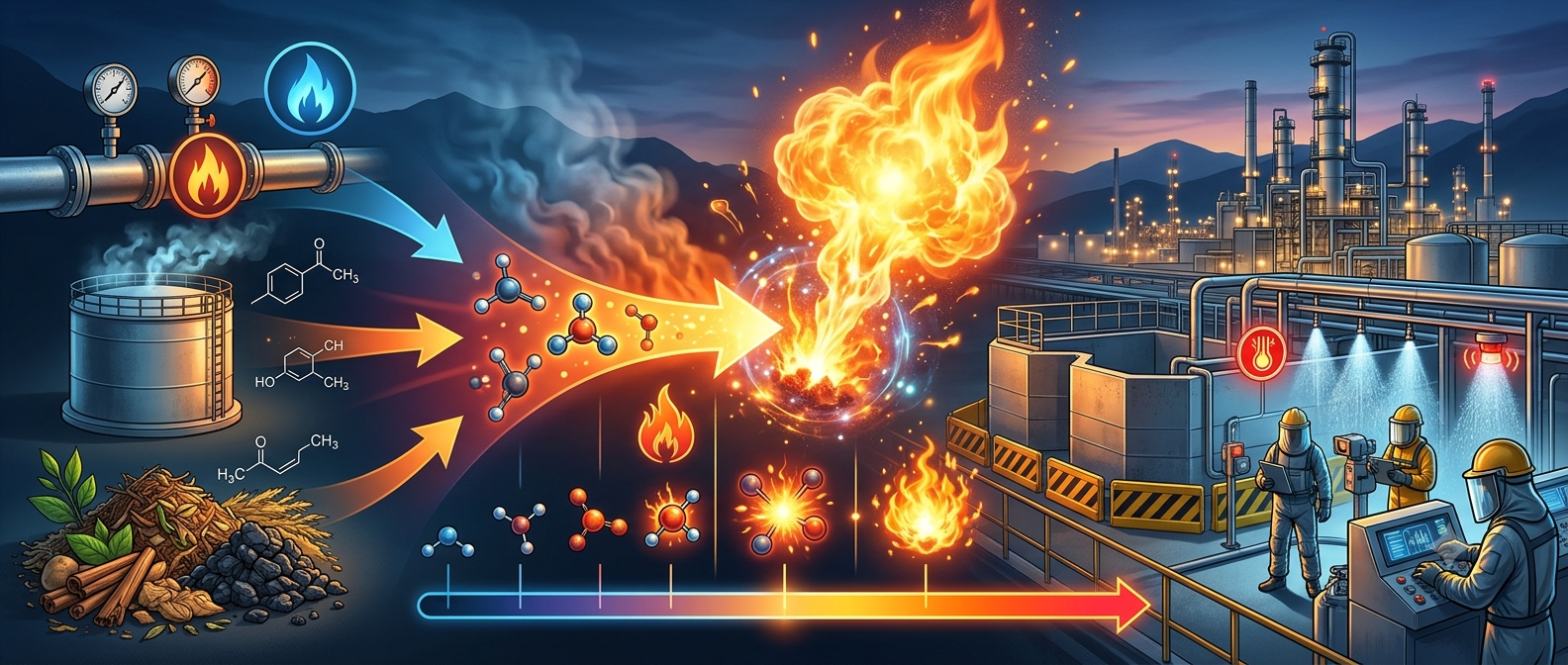
Autoignition occurs through a series of chemical reactions between a combustible substance and an oxidizing agent, usually oxygen in the air.
The process generally involves the following stages:
Heat exposure: The fuel or combustible vapour is exposed to elevated temperatures.
Chemical reaction: The heat accelerates chemical reactions between the fuel and oxygen.
Heat generation: These reactions release energy, increasing the temperature of the reacting mixture.
Self-ignition: If heat generation becomes sufficient to sustain combustion, the substance ignites without an external flame or spark.
The time required for ignition can vary. Some substances ignite quickly at a particular temperature, while others may require longer exposure. Therefore, autoignition temperature should not be treated as a universal guarantee that a substance will or will not ignite under every situation.
Autoignition Temperature of Common Fuels
Different fuels have different autoignition temperatures because their chemical structures and combustion characteristics vary. Knowing these values helps engineers assess potential fire hazards in fuel storage, processing, and combustion systems.
The following table provides approximate reference values for selected fuels and combustible gases.
Fuel or gas | Approximate autoignition temperature |
|---|---|
Methane | 537°C |
Hydrogen | 500–585°C |
Propane | 450–470°C |
Butane | 365–405°C |
Ethanol | 363°C |
Methanol | 464°C |
Gasoline | Approximately 250–300°C |
Diesel fuel | Approximately 210°C |
Note: These values are indicative, not universal. Published values can differ significantly depending on the test method, fuel composition, pressure, and other conditions. Actual safety decisions should use the relevant chemical's safety data sheet (SDS) and applicable standards.
Factors Affecting Autoignition Temperature
Autoignition temperature is influenced by several chemical and environmental factors. Engineers must consider these factors when evaluating combustion risks.
1. Chemical Composition
The molecular structure of a fuel affects how readily it reacts with oxygen. Different hydrocarbons and alcohols have different ignition characteristics because their chemical bonds and reaction pathways differ.
For example, methanol and ethanol have different autoignition temperatures despite both being alcohol-based fuels. Therefore, values for one chemical should not be assumed to apply to another.
2. Oxygen Concentration
Oxygen supports combustion, and its concentration can affect the rate of oxidation and the conditions required for ignition.
A fuel-air mixture may behave differently when the oxygen concentration changes. Industrial systems must therefore account for ventilation, air supply, and the possibility of oxygen-enriched environments.
3. Pressure and Temperature
Pressure can influence chemical reaction rates, fuel evaporation, and the formation of combustible mixtures. Changes in operating pressure may affect the temperature at which ignition occurs.
The surrounding temperature is also important because it determines how much additional heat the fuel or vapour requires to reach ignition conditions.
4. Fuel-to-Air Ratio
Combustion requires a suitable mixture of fuel and oxygen. If the mixture contains too little or too much fuel relative to the available air, ignition may not occur under the same conditions.
The fuel-to-air ratio can therefore affect measured autoignition temperatures. Engineers should evaluate the expected operating conditions rather than relying on a single isolated value.
5. Exposure Time and Heat Transfer
A combustible mixture exposed to a hot surface may ignite after a delay. The duration of exposure, the surface material, and the rate at which heat is transferred all influence ignition behaviour.
A laboratory measurement may not represent every real-world situation, particularly in large vessels, enclosed equipment, or systems with different airflow patterns.
Autoignition Temperature vs Flash Point vs Fire Point
These three terms describe different properties of combustible substances. Understanding the differences is important for fire prevention and fuel handling.
Property | Meaning |
|---|---|
Autoignition temperature | The temperature at which a substance ignites without an external flame or spark under specified conditions. |
Flash point | The lowest temperature at which a liquid produces enough vapour to ignite momentarily when an ignition source is applied. |
Fire point | The temperature at which a liquid produces enough vapour to sustain combustion after ignition. |
The flash point is particularly useful for assessing the handling and storage hazards of liquids. Autoignition temperature is important when evaluating hot surfaces, heating equipment, and processes that may expose combustible vapours to elevated temperatures.
These properties should be considered together because none of them alone provides a complete assessment of fire risk.
How Is Autoignition Temperature Measured?
Autoignition temperature is determined through controlled laboratory testing. A commonly used method is ASTM E659, which specifies a procedure for measuring the autoignition temperature of chemicals.
During testing, a measured quantity of a substance is introduced into a heated test vessel under specified conditions. The temperature and test conditions are controlled while the sample is observed for signs of ignition.
The test is repeated at different temperatures to establish the ignition behaviour of the substance. Factors such as vessel size, material, pressure, oxygen concentration, and exposure time can influence the results.
Standardized testing makes it easier to compare substances, but the resulting value must still be interpreted within the context of the intended application.
Industrial Applications of Autoignition Temperature
Autoignition temperature plays an important role across several engineering industries.
Chemical and Petrochemical Plants
Chemical plants handle solvents, fuels, hydrocarbons, and other combustible materials. Engineers use ignition data when evaluating process hazards, selecting equipment, and establishing safe operating conditions.
Oil and Gas Industry
Oil refineries, gas processing facilities, and pipeline systems may contain flammable gases and vapours. Understanding ignition temperatures helps engineers assess the risks associated with heated equipment, compressors, pumps, and process vessels.
Power Generation and Boilers
Combustion systems depend on controlled fuel ignition. Knowledge of fuel ignition properties supports burner design, combustion management, and the assessment of abnormal heating conditions.
Electrical and Mechanical Engineering
Motors, electrical enclosures, bearings, and other equipment can develop hot surfaces during normal operation or equipment failure. Engineers must consider whether these surfaces could ignite nearby combustible substances.
Equipment selection should follow the applicable hazardous-area classification and temperature requirements, not autoignition temperature alone.
Safety Measures for Preventing Accidental Ignition
Proper handling of combustible materials reduces the likelihood of fire and equipment damage.
Control hot surfaces: Keep equipment temperatures within approved operating limits and inspect components that may overheat.
Provide suitable ventilation: Prevent the accumulation of flammable gases and vapours.
Store fuels correctly: Follow the chemical's SDS, compatibility requirements, and applicable storage regulations.
Monitor operating conditions: Use appropriate temperature sensors, alarms, and protective shutdown systems.
Maintain equipment: Inspect burners, pumps, motors, electrical installations, and process systems regularly.
Conduct risk assessments: Consider the fuel's properties, possible leaks, ignition sources, and abnormal operating conditions.
Train personnel: Ensure workers understand fuel hazards, emergency procedures, and safe handling practices.
An important precaution is to avoid treating the listed autoignition temperature as a guaranteed safe operating limit. Ignition may occur under conditions different from those used in laboratory testing.
Conclusion
Autoignition temperature is a key parameter in understanding fuel combustion and preventing industrial fires. It describes the temperature at which a combustible substance can ignite without an external ignition source under specified conditions.
Its value depends on chemical composition, oxygen concentration, pressure, fuel-to-air ratio, exposure time, and testing conditions. Engineers use this information in chemical processing, oil and gas operations, power generation, and equipment design.
For effective fire prevention, autoignition temperature should be considered alongside flash point, fire point, flammability limits, equipment temperature ratings, and relevant safety standards. Combining these factors helps industries develop safer operating procedures, reduce fire hazards, and improve overall process safety.
