

Article details
Introduction
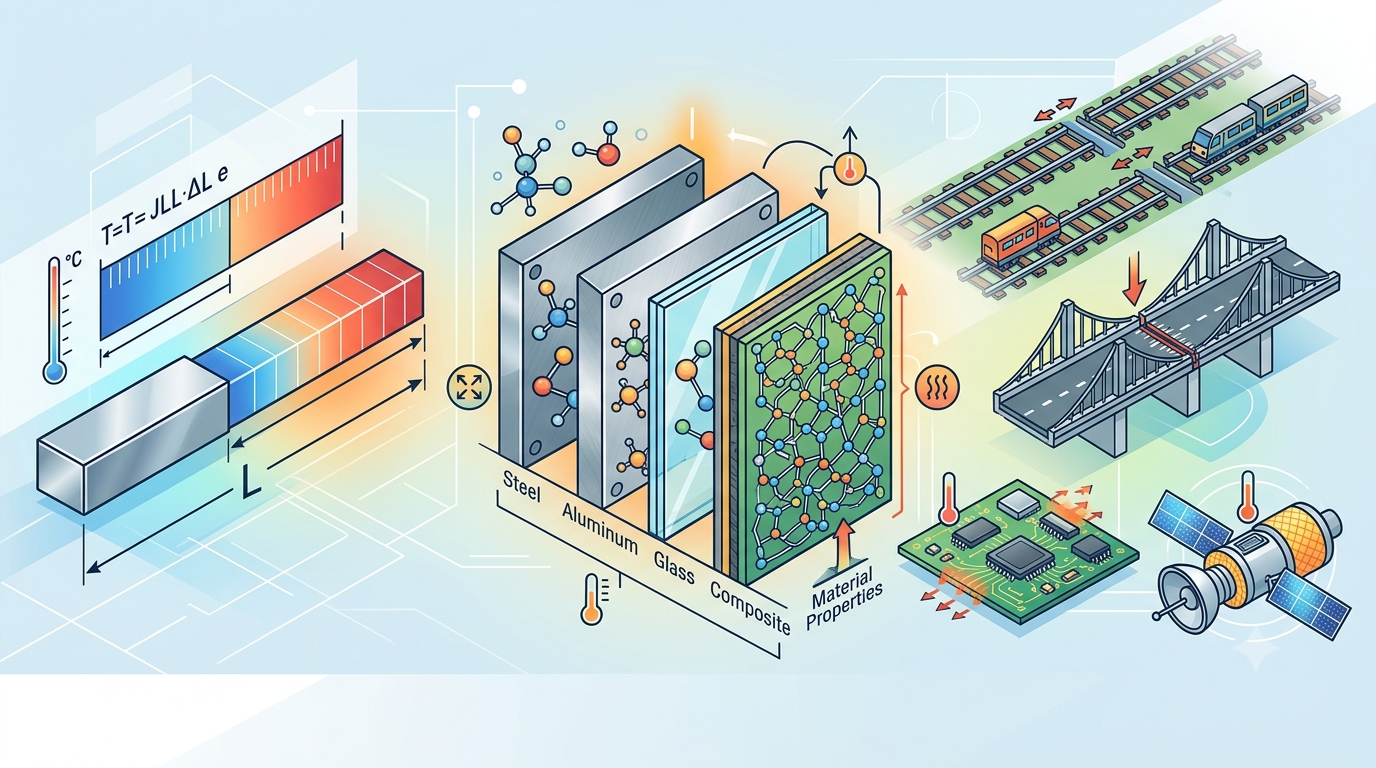
Temperature changes can affect the dimensions of almost every engineering material. When a material is heated, it generally expands, and when it cools, it generally contracts. Although these dimensional changes may appear small, they can significantly affect the performance, accuracy, and safety of engineering components.
The coefficient of linear thermal expansion (CLTE) is an important material property that describes how much a material's length changes with temperature. Engineers use this property when designing piping systems, machine components, structural elements, plastic products, and precision assemblies.
Understanding thermal expansion helps engineers select suitable materials, maintain dimensional accuracy, prevent excessive thermal stress, and improve the reliability of industrial equipment.
1. What Is the Coefficient of Linear Thermal Expansion?
The coefficient of linear thermal expansion measures the change in a material's length per unit of its original length for every degree of temperature change. It is represented by the Greek letter alpha (α).
Materials with a high coefficient expand or contract more significantly when exposed to temperature variations. Materials with a low coefficient generally maintain better dimensional stability under similar conditions.
For example, aluminum expands more than carbon steel for the same original length and temperature increase. This difference is important when designing assemblies that combine multiple materials.
The coefficient is commonly expressed in reciprocal degrees Celsius (°C⁻¹), reciprocal kelvin (K⁻¹), or as a value multiplied by 10⁻⁶ per degree Celsius.
2. Formula for Linear Thermal Expansion
The change in length of a material can be calculated using the following equation:
ΔL = α × L₀ × ΔT
Where:
ΔL = Change in length
α = Coefficient of linear thermal expansion
L₀ = Original length of the material
ΔT = Change in temperature (final temperature − initial temperature)
The final length can be calculated using:
L₁ = L₀ + ΔL
This formula assumes that the coefficient remains approximately constant over the temperature range considered. For materials exposed to large temperature changes, temperature-dependent properties may be required.
3. How Does Thermal Expansion Work?
When a solid material is heated, its atoms or molecules gain energy and vibrate more strongly. In most solids, this increased atomic motion leads to a greater average separation between atoms, causing the material to expand.
When the material cools, atomic motion decreases and the material generally contracts.
The amount of expansion depends on several factors, including the material type, original dimensions, temperature change, and the direction in which expansion occurs. If a component is prevented from expanding freely, thermal stresses may develop.
Image 1: Linear Thermal Expansion of a Metal Rod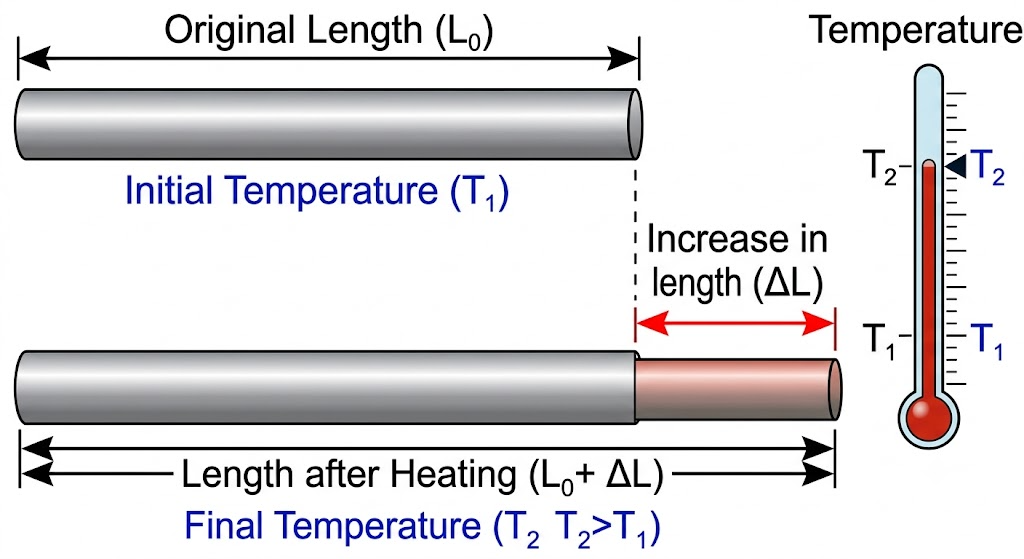
4. Coefficients of Linear Thermal Expansion for Common Materials
Different materials respond differently to temperature changes. The following table provides representative approximate values for selected engineering materials near room temperature.
Material | Approximate coefficient α (×10⁻⁶/°C) |
|---|---|
Aluminum | 23 |
Carbon steel | 12 |
Stainless steel 304 | 17.3 |
Copper | 17 |
Brass | 19–21 |
Titanium | 8.5–9 |
Gray cast iron | 10.8 |
Ordinary glass | 9 |
Borosilicate glass | 3.3 |
Concrete | 10–12 |
ABS plastic | 65–100 |
Polyethylene (PE) | 120–140 |
Nylon | 70–80 |
PTFE (Teflon) | 70–100 |
Note: Values are approximate and vary with material grade, composition, temperature, manufacturing process, and testing conditions. Always consult the relevant material datasheet for engineering calculations.
Metals
Metals such as carbon steel, aluminum, copper, and stainless steel are widely used in industrial equipment and structures. Aluminum typically has a higher coefficient of thermal expansion than carbon steel, which means it undergoes greater dimensional changes for the same length and temperature difference.
Engineers must consider this behavior when designing metal frameworks, heat exchangers, pipelines, and mechanical assemblies.
Plastics and Polymers
Many plastics expand more than metals when heated. Materials such as polyethylene, ABS, nylon, and PTFE can experience considerable dimensional changes even over moderate temperature ranges.
Reinforced engineering plastics may offer lower thermal expansion than their unreinforced counterparts. Glass fibers and carbon fibers can improve dimensional stability, depending on the material formulation and fiber orientation.
Glass and Ceramics
Certain glasses and ceramics have relatively low thermal expansion coefficients. Borosilicate glass, for example, is valued for its comparatively low expansion and resistance to thermal shock. However, thermal shock resistance also depends on strength, geometry, thermal conductivity, and temperature gradients.
5. Example: Calculating Thermal Expansion
Consider a carbon steel pipe with an original length of 10 metres. Its temperature increases from 20°C to 120°C. Assume the coefficient of linear thermal expansion is 12 × 10⁻⁶/°C.
Given:
Original length = 10 m
Coefficient = 12 × 10⁻⁶/°C
Temperature change = 120 − 20 = 100°C
Calculation:
ΔL = α × L₀ × ΔT
ΔL = 12 × 10⁻⁶ × 10 × 100
ΔL = 0.012 m = 12 mm
Therefore, the pipe expands by approximately 12 mm, resulting in a final length of 10.012 metres.
This example demonstrates why even a relatively small coefficient can produce noticeable movement in long industrial components.
6. Factors Affecting Linear Thermal Expansion
Several factors influence the dimensional changes observed in engineering materials.
Material Composition
The atomic structure, alloying elements, polymer composition, and reinforcement materials affect the coefficient. Two grades within the same material family may have different expansion characteristics.
Temperature Range
The coefficient is not always constant at every temperature. Some materials exhibit significant changes in thermal expansion near phase transitions, glass transition temperatures, or other structural changes.
Original Length
For a given material and temperature change, a longer component generally experiences a greater absolute change in length. This is particularly important for long pipelines, rails, and structural members.
Material Orientation and Manufacturing
Certain composites and plastics behave differently in different directions because of fiber orientation, molecular alignment, or manufacturing processes. Engineers should consider directional properties where applicable.
Mechanical Restraint
A component that can move freely may expand without developing substantial thermal stress from restraint. If its movement is restricted, internal forces and stresses can develop, potentially causing deformation or damage.
7. Engineering Applications of Thermal Expansion
The coefficient of linear thermal expansion is used in several engineering disciplines.
Piping and Process Engineering
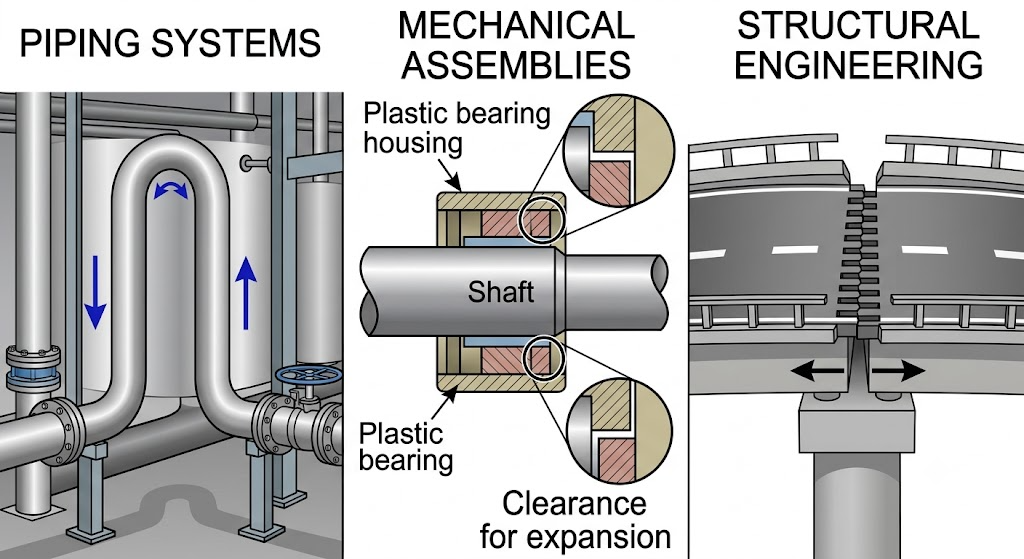
Pipelines carrying hot fluids expand during operation. Engineers account for thermal movement through piping flexibility analysis, suitable supports, expansion loops, and engineered expansion joints where required.
Mechanical Engineering
Machine components, shafts, bearings, and precision assemblies must maintain appropriate clearances across their operating temperature ranges. Thermal expansion is also used intentionally in shrink-fitting and interference-fit assemblies.
Civil and Structural Engineering
Bridges, buildings, railways, and other structures experience seasonal and operational temperature changes. Expansion joints and suitable connection details accommodate movement and reduce the risk of excessive stress.
Plastic Product Design
Plastic housings, molded components, and precision parts must be designed with thermal expansion in mind. Incorrect material selection or insufficient clearance can cause warping, dimensional inaccuracies, and assembly problems.
Electronics and Electrical Engineering
Electronic assemblies may combine metals, ceramics, glass, and polymers with different expansion coefficients. These differences can stress solder joints, circuit boards, seals, and bonded interfaces during temperature cycling.
8. How to Reduce Thermal Expansion Problems
Engineers can minimize thermal expansion-related issues through careful material selection and design.
Select materials with suitable thermal expansion coefficients for the intended operating temperature.
Provide adequate clearances and movement allowances in assemblies.
Include expansion joints or flexible arrangements where required by the design.
Evaluate thermal stresses when components are restrained.
Consider differences in expansion between connected materials.
Use material properties appropriate to the expected temperature range.
Validate critical designs through engineering calculations, simulation, and applicable codes or standards.
Image 2: Thermal Expansion in Engineering Applications
Suggested placement: After this section or before the conclusion. Show industrial piping with an expansion loop, a metal-and-plastic assembly, and a structural expansion joint to illustrate practical engineering solutions.
9. Difference Between Linear and Volumetric Thermal Expansion
Linear thermal expansion describes a change in length, whereas volumetric thermal expansion describes a change in volume.
For a homogeneous, isotropic solid undergoing a small temperature change, the volumetric expansion coefficient (β) is approximately three times the linear expansion coefficient:
β ≈ 3α
This approximation assumes similar expansion behavior in all three dimensions. It may not apply directly to anisotropic materials or materials undergoing complex structural changes.
Linear expansion is particularly useful for pipes, beams, shafts, and rods. Volumetric expansion is more relevant when evaluating changes in the volume of solids, liquids, and other systems.
Conclusion
The coefficient of linear thermal expansion is an essential property in engineering design because temperature variations can change the dimensions of materials and affect the performance of components. By understanding the expansion behavior of metals, plastics, glass, and other engineering materials, engineers can make better material selections and design safer, more reliable systems.
Applying the linear thermal expansion formula helps estimate dimensional changes, plan movement allowances, and identify potential thermal stress problems. In practical engineering, accurate material data, suitable temperature ranges, and proper design standards are essential for achieving reliable results.
