

Article details
Understanding Counter-Flow Heat Exchangers
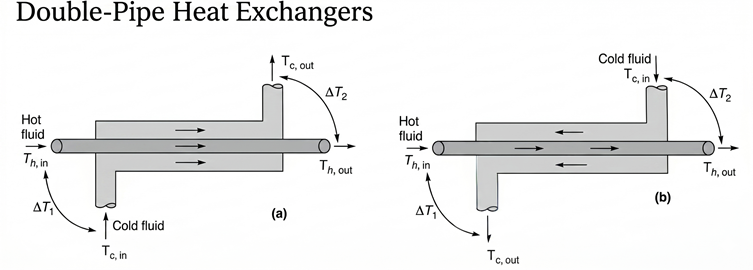
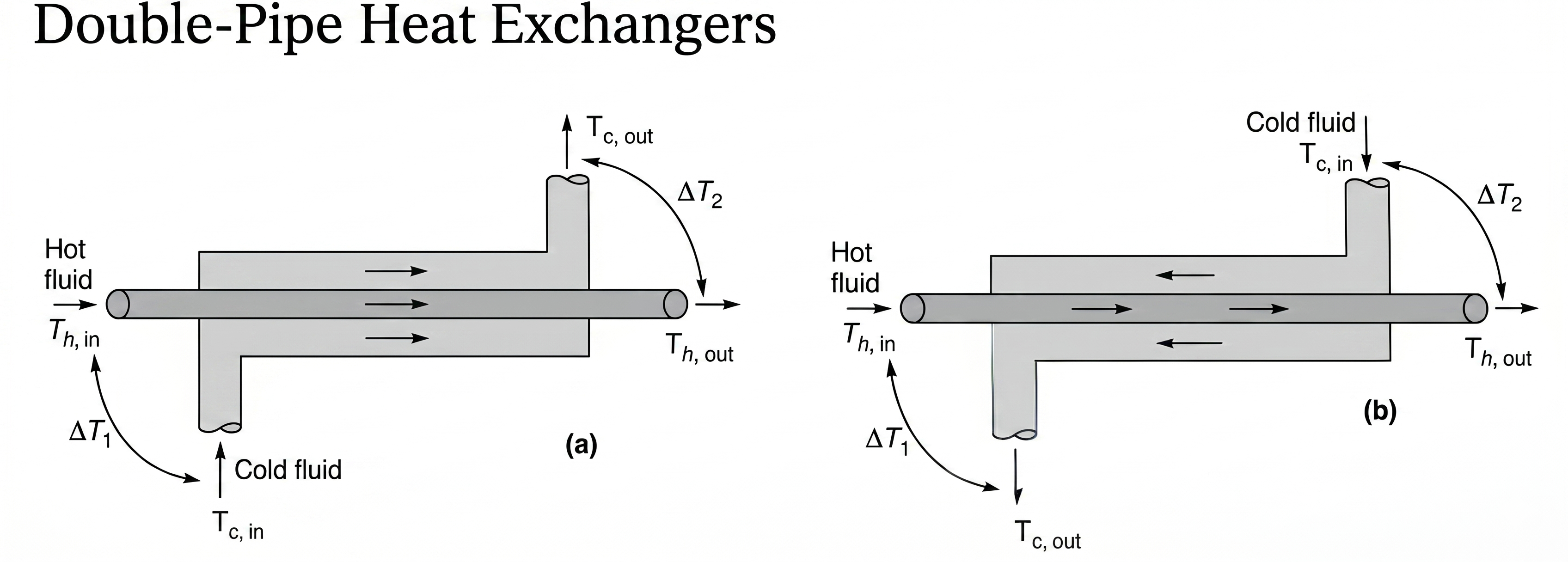
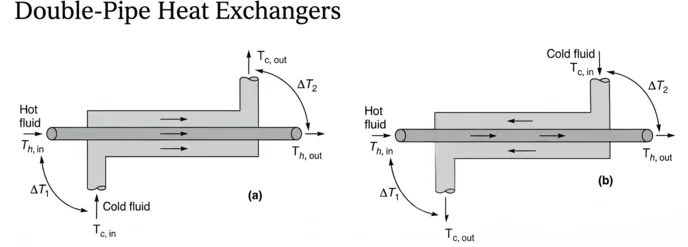
a) Parallel flow b) counter flow
A heat exchanger is a device used to transfer heat between two or more fluids at different temperatures. The efficiency of this heat transfer is significantly influenced by the flow arrangement of the fluids. The two primary types of arrangements are parallel-flow and counter-flow.
Parallel-Flow Arrangement
In a parallel-flow heat exchanger, the hot and cold fluids enter the exchanger at the same end and flow in the same direction. The temperature difference between the two fluids is highest at the inlet and decreases along the length of the exchanger.
Counter-Flow Arrangement
In a counter-flow heat exchanger, the hot and cold fluids enter at opposite ends and flow in opposite directions. As shown in the provided diagram, the hot fluid (Th) flows from left to right, while the cold fluid (Tc) flows from right to left.
The temperature profile for a counter-flow arrangement is distinct and advantageous. As the hot fluid cools, it encounters progressively colder sections of the exchanger, allowing for continuous heat transfer. This arrangement can achieve a final cold fluid outlet temperature (Tc,out) that is higher than the hot fluid outlet temperature (Th,out).
The Advantage of Counter-Flow
The key to the superior performance of a counter-flow heat exchanger lies in the Log Mean Temperature Difference (LMTD), denoted as ΔTlm. The LMTD represents the average temperature difference driving the heat transfer.
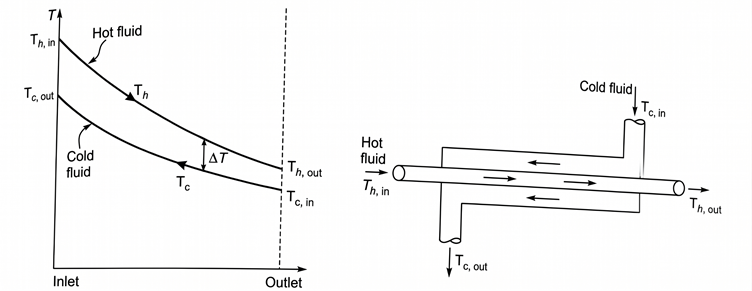
For a given set of inlet and outlet fluid temperatures, the LMTD for a counter-flow arrangement (ΔTlm,CF) is always greater than the LMTD for a parallel-flow arrangement (ΔTlm,PP).
ΔTlm,CF>ΔTlm,PP
This greater average temperature difference has a direct and significant implication:
Increased Efficiency: A higher LMTD means a more effective transfer of heat.
Reduced Size: For a specified heat transfer rate, a counter-flow heat exchanger requires a smaller heat transfer surface area. This results in a more compact, cost-effective, and efficient design.
