

Article details
Introduction to Dehumidification
Dehumidification is the process of removing excess moisture from the air to maintain a suitable humidity level in indoor and industrial environments. It is an important part of heating, ventilation, and air conditioning (HVAC) systems because humidity directly affects indoor comfort, air quality, equipment performance, and building maintenance.
High humidity can cause condensation, mold growth, corrosion, and damage to materials. In industrial environments, uncontrolled moisture can also affect product quality, manufacturing processes, and storage conditions.
Dehumidification helps control these problems by reducing the amount of water vapor present in the air. It is widely used in residential buildings, commercial spaces, warehouses, pharmaceutical facilities, food processing plants, and other moisture-sensitive environments.
What Is Dehumidification?
Dehumidification is the process of reducing the moisture content of air without necessarily lowering its temperature. The objective is to maintain relative humidity within a suitable range for a particular application.
Relative humidity represents the amount of water vapor present in the air compared with the maximum amount the air can hold at the same temperature. Warm air can generally hold more water vapor than cold air.
When humidity becomes too high, moisture may collect on cold surfaces, walls, ceilings, pipes, and equipment. Dehumidification removes this excess moisture and helps maintain stable environmental conditions.
For example, a warehouse storing electrical components may require controlled humidity to prevent corrosion and moisture-related damage. Similarly, a pharmaceutical facility may need precise humidity control to protect materials and maintain product quality.
Why Is Dehumidification Important?
Maintaining proper humidity is essential for comfort, safety, and operational efficiency. The main benefits include the following.
1. Prevents Mold and Mildew Growth
Excess moisture creates favorable conditions for mold and mildew. These can develop on walls, ceilings, furniture, insulation, and other surfaces.
Dehumidification helps reduce the moisture that supports their growth, particularly in poorly ventilated rooms, basements, and humid climates.
2. Improves Indoor Comfort
High humidity makes the air feel warmer and can reduce the body's ability to cool itself through evaporation of sweat.
Removing excess moisture helps create a more comfortable indoor environment and can improve the effectiveness of air conditioning systems.
3. Protects Equipment and Materials
Moisture can cause rust, corrosion, electrical faults, and deterioration of sensitive materials. Dehumidification helps protect machinery, electronic components, metal products, and stored goods.
4. Supports Industrial Quality Control
Many manufacturing processes require stable humidity conditions. Excess moisture can affect product dimensions, surface finishes, chemical reactions, packaging, and material properties.
Proper humidity management helps maintain consistent production quality and reduce material waste.
5. Reduces Condensation Problems
Condensation occurs when moist air comes into contact with a surface that is colder than the air's dew point. Removing moisture lowers the dew point, reducing the risk of water forming on cold surfaces.
This is especially important in cold-storage facilities, industrial pipelines, air conditioning systems, and buildings with temperature differences between indoor and outdoor environments.
Types of Dehumidification Systems
Different dehumidification systems are designed to meet specific humidity requirements. The most common methods are refrigerant-based dehumidification and desiccant dehumidification.
1. Refrigerant-Based Dehumidification

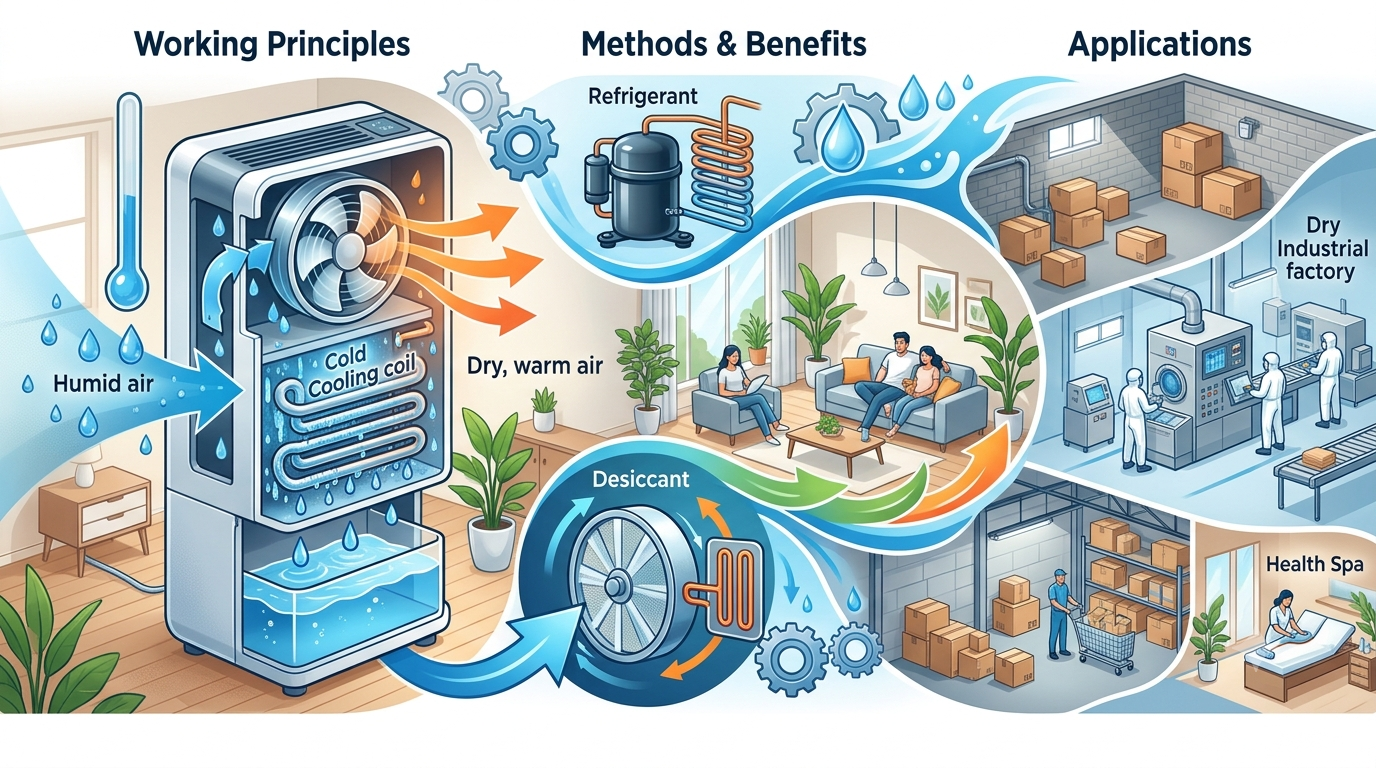
Refrigerant-based dehumidification removes moisture by cooling humid air below its dew point. It is commonly used in residential, commercial, and industrial HVAC systems.
The system draws moist air over a cold evaporator coil. As the air cools, water vapor condenses into liquid water, which is collected in a drain pan and discharged through a drainage line.
The dried air then passes through the condenser or another heating section before returning to the space. This process reduces humidity while allowing the system to manage the air temperature.
Advantages:
Suitable for many everyday humidity-control applications.
Effective in warm and humid environments.
Can provide both moisture removal and air conditioning.
Generally energy-efficient under suitable operating conditions.
2. Desiccant Dehumidification

Desiccant dehumidification uses moisture-absorbing materials to remove water vapor from the air. Common desiccants include silica gel and other specially designed moisture-attracting materials.
Humid air passes through the desiccant material, which captures moisture. The material is then regenerated using heated air to release the absorbed moisture, allowing it to be used again.
Unlike refrigerant-based systems, desiccant dehumidifiers can achieve very low humidity levels and are suitable for applications where precise moisture control is necessary.
Advantages:
Effective at low temperatures and low humidity targets.
Suitable for moisture-sensitive industrial processes.
Provides precise humidity control.
Can use recovered heat or other suitable thermal energy for regeneration.
3. Hybrid Dehumidification Systems
Hybrid systems combine refrigerant-based cooling with desiccant technology. Each method performs the task for which it is best suited.
For example, a desiccant unit may remove a large amount of moisture before the air enters a cooling coil. The cooling system then adjusts the air temperature to the required level.
This arrangement can improve overall system performance in facilities with demanding humidity requirements.
Major Applications of Dehumidification
Dehumidification is used in several sectors where moisture control is important.
HVAC systems: Maintains comfortable indoor conditions in offices, hotels, hospitals, and commercial buildings.
Pharmaceutical manufacturing: Helps protect moisture-sensitive ingredients and products.
Food processing: Supports drying, storage, packaging, and quality control.
Electronics manufacturing: Reduces moisture-related risks during the production and storage of sensitive components.
Warehouses and cold storage: Limits condensation, corrosion, and unwanted ice formation.
Chemical industries: Maintains suitable environmental conditions for moisture-sensitive materials and processes.
Museums and archives: Helps preserve documents, artwork, historical objects, and other valuable materials.
Factors to Consider When Selecting a Dehumidification System
Choosing the correct system requires evaluating the operating environment and the amount of moisture that must be removed.
Humidity requirements: Determine the target relative humidity and dew point based on the application.
Temperature conditions: Refrigerant-based systems generally work well in warm, humid environments, while desiccant systems are often preferred for low-temperature or very-low-humidity applications.
Moisture load: Consider moisture entering through ventilation, doors, air leakage, people, equipment, and manufacturing processes.
Energy consumption: Evaluate electricity requirements, heating energy, operating hours, and opportunities for heat recovery.
Maintenance requirements: Check filters, coils, drainage systems, humidity sensors, and desiccant regeneration components as applicable.
System capacity: Select equipment according to the space volume, airflow rate, moisture generation rate, and required humidity-control performance.
Conclusion
Dehumidification is an essential process for controlling moisture in residential, commercial, and industrial environments. It helps prevent condensation, mold growth, corrosion, and product damage while supporting indoor comfort and reliable manufacturing operations.
Refrigerant-based systems are widely used for general humidity control, while desiccant systems are suitable for applications requiring lower humidity levels and more precise moisture management. Hybrid systems can combine the advantages of both methods.
Selecting the right dehumidification technology depends on temperature, humidity targets, moisture load, energy efficiency, and operating requirements. With proper system design and maintenance, dehumidification can improve product quality, protect equipment, and support efficient HVAC operation.
