

Article details
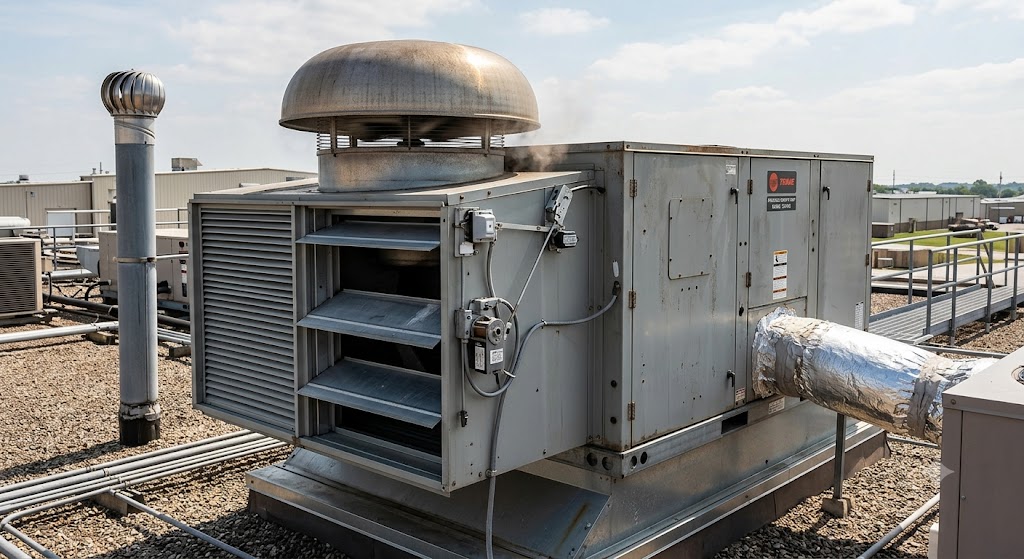
Demand control ventilation and economizers both work through the same piece of hardware, the outdoor air damper, and they want opposite things from it. Demand control ventilation tries to bring in no more outdoor air than the people in the building actually need. An economizer tries to bring in as much outdoor air as helps with cooling. Two strategies, one damper. How the control system referees between them determines whether the building gets both energy savings and good air quality, or quietly gets neither.
Two Different Goals for the Same Damper
Demand control ventilation, usually shortened to DCV, adjusts the outdoor air supplied to a space based on how many people are actually there. Since occupancy is hard to measure directly, controllers commonly use a carbon dioxide sensor as a proxy, because people exhale it and its level in a space rises as occupancy rises. When the room is lightly occupied, outdoor air is reduced, saving the energy it would have taken to heat, cool, or dehumidify that air. When the room fills, outdoor air increases.
In practice, DCV works within a band. One controller description commonly sets a floor of roughly five to ten percent outdoor air and a DCV ceiling of roughly twenty to forty percent, and a manufacturer example sets a minimum of 396 cfm with an occupancy driven maximum of 627 cfm for the same unit. The point is that DCV adjusts the minimum position within a range, not between fully closed and fully open.
An economizer works on a different premise. When outdoor air is cool enough to help, the economizer opens the damper beyond any ventilation minimum to deliver free cooling, as covered in the earlier articles in this series.
Why They Are Complementary, Not Competitors
The two strategies cover different weather. In mild conditions, the economizer is bringing in plenty of outdoor air for free, so reducing outdoor air through DCV would save nothing and would waste the free cooling opportunity. In hot, humid, or cold conditions, the economizer is locked out and outdoor air is expensive to condition, which is exactly when DCV saves the most.
In other words, the economizer earns its savings in the shoulder seasons and DCV earns its savings at the extremes. The control sequence just needs a clear rule for who is in charge at any moment.
The Priority Logic: The Highest Request Wins
A common way to referee is to let the outdoor air damper follow the highest of several requests: the fixed minimum position, the request from the CO2 control loop, and the request from the economizer loop. One published university sequence describes four states that follow from this idea.
Neither economizer nor high CO2. The damper holds the minimum position, with the mixed air control keeping things within limits.
Economizer active, CO2 normal. The damper follows the economizer's mixed air control, but never drops below the minimum.
High CO2, economizer not active. The damper follows the larger of the CO2 loop's request and the minimum.
Economizer active and high CO2. The damper follows the largest of the economizer request, the CO2 request, and the minimum.
The logic ensures that an economizer opening for cooling can never reduce ventilation below what occupants require, and that a crowd driving CO2 up can force the damper open even when the economizer would not have asked for it.
The Conflict Case: When Ventilation Fights Cooling
The interesting case is the one where the two strategies disagree. Imagine a hot, humid afternoon with a packed conference room. The economizer is locked out because outdoor air is unfavorable, yet DCV is demanding more outdoor air because CO2 is rising. Every additional cubic foot of outdoor air adds sensible and latent load that the mechanical cooling has to handle, as discussed in the articles on latent heat and indoor air quality.
The correct resolution is that ventilation wins. Some controller designs go as far as comparing the DCV demand against the cooling demand and flagging the conflict to operators, but the fundamental priority is to keep occupants supplied with adequate fresh air and accept the higher cooling energy. The right response to the cost is to design for it, with adequate latent capacity, not to suppress ventilation.
The Cold Weather Conflict: Mixed Air Low Limit
A less obvious priority shows up in winter. In one published sequence, a mixed air low limit of about forty five degrees Fahrenheit overrides the economizer, the minimum outdoor air, and the CO2 control, so the damper closes down if the mixed air gets cold enough to threaten the coil. That makes sense for equipment protection, but it means ventilation can be sacrificed to freeze protection unless the design provides another way to keep mixed air warm enough, such as preheat or better mixing. A building where the low limit regularly overrides ventilation on cold days has a hidden air quality problem that no CO2 sensor in the return duct will necessarily reveal.
Avoiding Hunting Between Modes
Because the damper position is the output of several competing loops, stability matters. One university standard enables economizer mode when outdoor enthalpy falls to twenty eight Btu per pound and does not disable it until enthalpy rises to twenty nine, a deliberate deadband that keeps the damper from flipping back and forth when conditions hover near the limit. CO2 loops are also generally tuned slowly, since a space's CO2 level changes gradually and aggressive control would only cause the damper to chase noise.
Sensing Pitfalls
A CO2 based approach is only as good as its measurements. A sensor in the return duct reads an average across zones, so one crowded zone can be masked by quieter ones. CO2 sensors can drift and need calibration, as with the humidity sensors discussed in the sensor failure article. And CO2 mainly reflects people, not the building itself, so ventilation standards generally keep a baseline tied to floor area that DCV cannot reduce away. Sources differ in how they describe the limits of using CO2 to cut ventilation below the design minimum, which is a good reason to confirm the requirement in whichever edition of the ventilation standard and energy code applies.
Testing the Interaction
Commissioning should exercise each state deliberately. Force the economizer to be enabled with CO2 normal, then force CO2 high with the economizer locked out, then both together, and confirm in each case that the damper ends up where the sequence says it should and that ventilation never drops below the minimum. Test the cold weather low limit too, and see what happens to ventilation when it trips.
The Practical Takeaway
Demand control ventilation and economizers are complementary, one saving energy at the weather extremes and the other in the mild seasons, but they share one damper, so the sequence has to be explicit about who wins. The highest request generally wins, ventilation takes priority over cooling energy, and equipment protection can override both unless the design plans around it. A sequence that states these priorities, tests them, and watches its sensors produces a building that saves energy without letting air quality slip.
EveryEng. For everyone in Engineering.
