


Article details
Viscosity is an important property of fluids that describes their resistance to flow. It plays a major role in engineering applications such as lubrication, pipeline transportation, hydraulic systems, cooling systems, and fluid machinery. Dynamic viscosity and kinematic viscosity are two closely related properties used to evaluate how liquids and gases behave during motion.
Although both properties describe fluid flow, they measure different characteristics. Understanding their meaning, formulas, units, and applications helps engineers select suitable fluids and design efficient systems.
What Is Dynamic Viscosity?
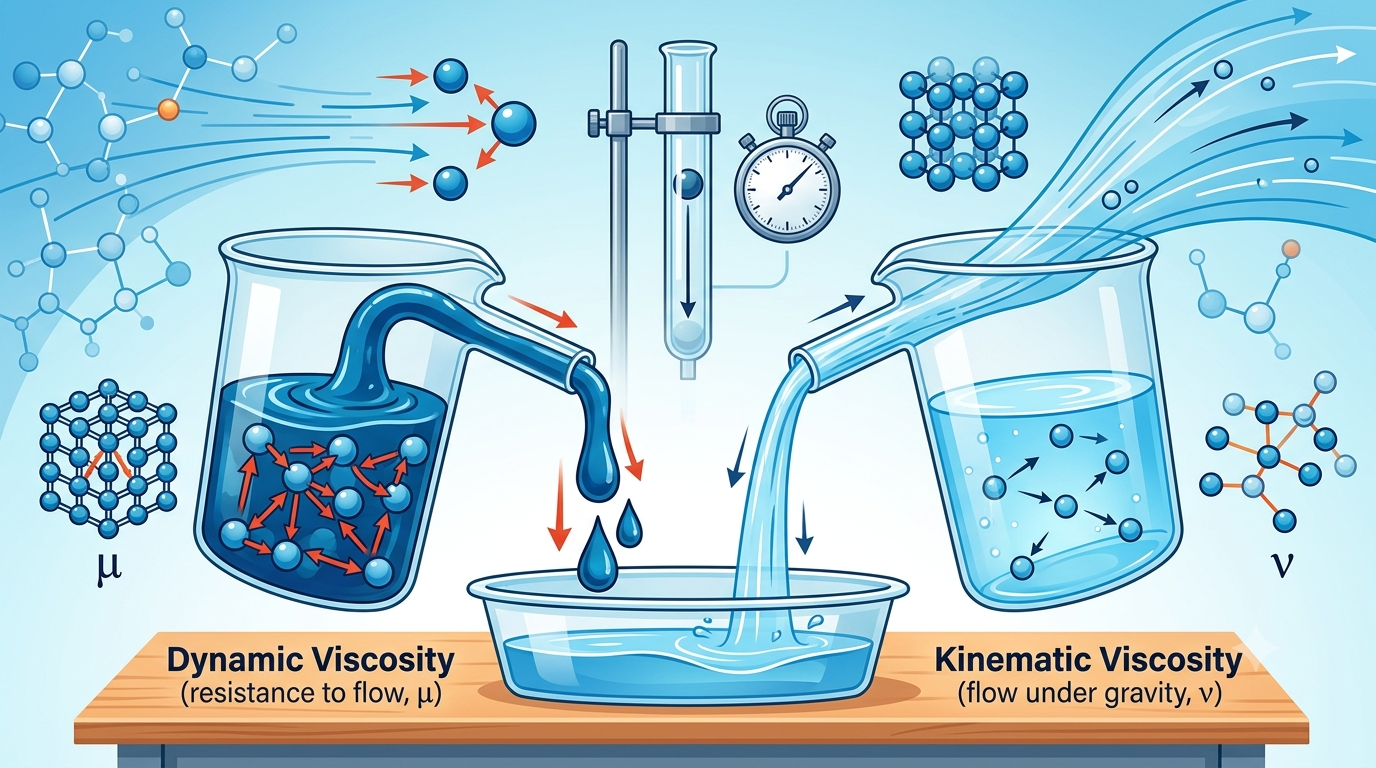
Dynamic viscosity, also called absolute viscosity, measures a fluid’s resistance to flow when an external force is applied. It describes the internal friction between adjacent layers of a moving fluid.
A fluid with high dynamic viscosity flows more slowly under the same applied force than a fluid with low dynamic viscosity. For example, honey has a higher dynamic viscosity than water at room temperature, making it more resistant to movement.
Dynamic viscosity is represented by the Greek letter μ (mu).
Dynamic Viscosity Formula
Dynamic viscosity can be expressed as:
μ = τ / (du/dy)
Where:
μ = Dynamic viscosity
τ = Shear stress acting on the fluid
du/dy = Velocity gradient perpendicular to the direction of flow
The SI unit of dynamic viscosity is the pascal-second (Pa·s). It can also be expressed in newton-seconds per square metre (N·s/m²). Another commonly used unit is the centipoise (cP).
Dynamic viscosity is particularly important when calculating the force required to move fluids through pipes, operate hydraulic equipment, or maintain effective lubrication between moving components.
What Is Kinematic Viscosity?
Kinematic viscosity describes a fluid’s resistance to flow in relation to its density. It considers both the fluid’s internal friction and its mass density, making it useful for analysing fluid movement under gravitational and inertial forces.
Kinematic viscosity is represented by the Greek letter ν (nu). It is calculated by dividing dynamic viscosity by fluid density.
Kinematic Viscosity Formula
ν = μ / ρ
Where:
ν = Kinematic viscosity
μ = Dynamic viscosity
ρ = Fluid density
The SI unit of kinematic viscosity is the square metre per second (m²/s). In practical applications, it is often expressed in centistokes (cSt).
Kinematic viscosity is widely used in lubricant selection, fluid flow calculations, and the analysis of liquids moving through pipelines and channels. It also helps engineers evaluate Reynolds number, which indicates whether fluid flow is likely to be laminar or turbulent.
Difference Between Dynamic and Kinematic Viscosity
The main difference is that dynamic viscosity measures a fluid’s resistance to shear, whereas kinematic viscosity relates that resistance to the fluid’s density.
Dynamic viscosity is useful when determining the force required to move a fluid or maintain a lubricating film. Kinematic viscosity is useful when analysing fluid motion and comparing flow characteristics across fluids with different densities.
For the same fluid at a given temperature and pressure, kinematic viscosity can be calculated directly from dynamic viscosity and density. Both properties vary with temperature, so accurate operating conditions are essential when using viscosity values in engineering calculations.
Applications in Engineering
Dynamic and kinematic viscosity are important in several industries. In mechanical engineering, they help engineers select lubricants for bearings, gears, and rotating machinery. In chemical and oil and gas industries, viscosity affects pumping requirements, pipeline pressure losses, and fluid transportation.
In automotive engineering, viscosity is used to evaluate engine oils and transmission fluids. In thermal and process engineering, it influences the performance of cooling systems, heat exchangers, and fluid-handling equipment.
Conclusion
Dynamic and kinematic viscosity are essential properties for understanding fluid behaviour. Dynamic viscosity measures resistance to shear, while kinematic viscosity relates dynamic viscosity to density. Knowing their formulas, units, and applications helps engineers make informed decisions about lubrication, pumping, pipeline design, and fluid system performance.
