

Article details
Introduction
Electrical heating is a widely used method of converting electrical energy into heat to increase the temperature of a material. It is used in industrial heating systems, electric furnaces, water heaters, laboratory equipment, and many other applications where controlled heating is required.
The amount of electrical energy needed to heat a material depends on several factors, including its mass, specific heat capacity, initial temperature, and final temperature. Understanding the relationship between these properties helps engineers calculate heating requirements, select suitable electrical heating equipment, and improve energy efficiency.
This article explains the principle of electrical heating, the formula used to calculate the heat required to raise the temperature of a mass, the role of heat capacity, and its practical engineering applications.
What Is Electrical Heating?
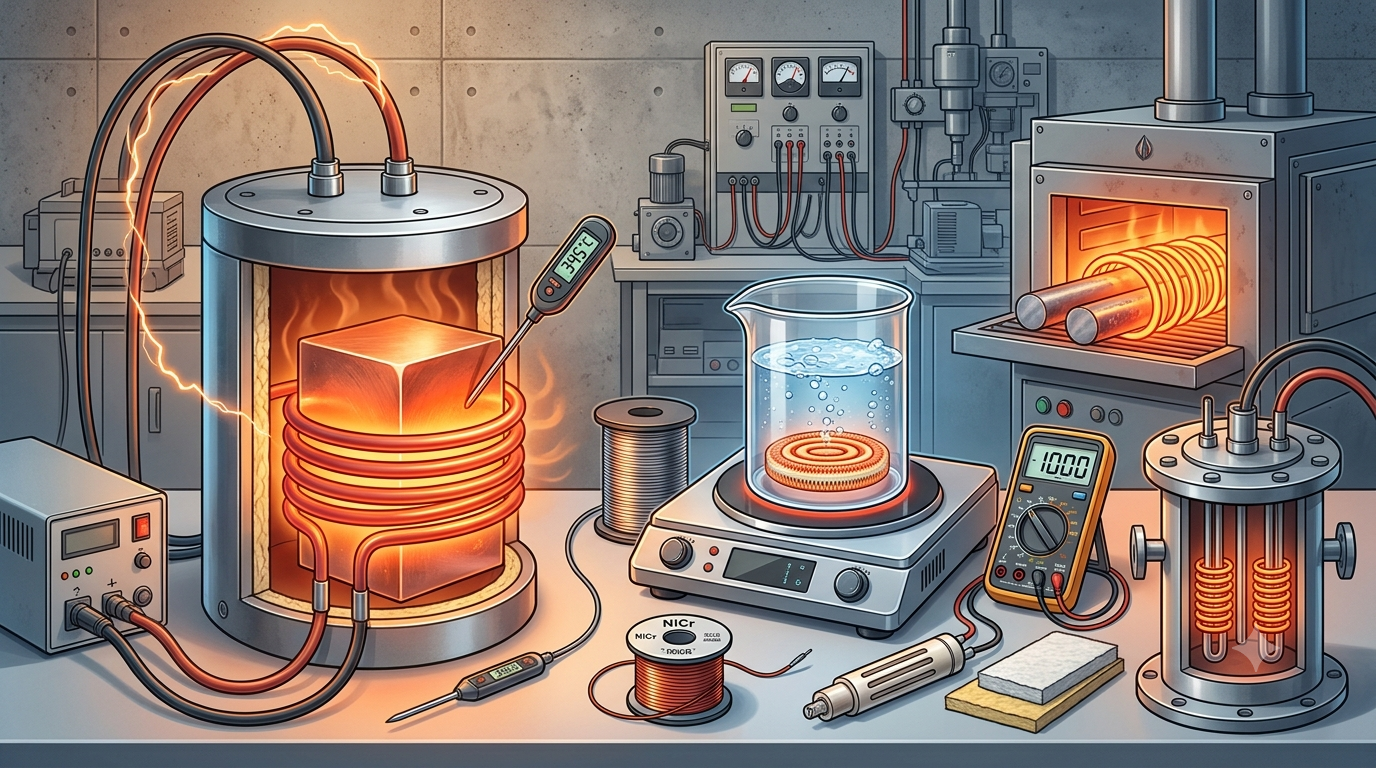
Electrical heating is the process of converting electrical energy into thermal energy. This conversion commonly occurs when an electric current passes through a resistive element, producing heat due to electrical resistance. This phenomenon is known as Joule heating.
The heat generated can be transferred to a solid, liquid, or gas, depending on the design of the heating system. For example, a resistance heating element transfers heat to water in an electric water heater, while an industrial furnace uses electrical energy to heat metal components or other materials.
Electrical heating is useful because it provides controllable heat, can offer uniform temperature distribution when properly designed, and does not require direct combustion at the point of use.
Electrical Heating of a Mass Formula
The energy required to heat a material can be calculated using its mass, specific heat capacity, and temperature change.
The fundamental formula is:
\[ Q = mc\Delta T \]
Where:
\(Q\) = heat energy required, measured in joules (J)
\(m\) = mass of the material, measured in kilograms (kg)
\(c\) = specific heat capacity, measured in J/(kg·K)
\(\Delta T\) = temperature change, measured in kelvins (K) or degrees Celsius (°C)
The temperature change is calculated as:
\[ \Delta T = T_f-T_i \]
Where \(T_f\) is the final temperature and \(T_i\) is the initial temperature.
This formula assumes that the specific heat capacity remains approximately constant over the temperature range and that the material does not undergo a phase change.
Factors Affecting Heat Energy Requirements
1. Mass of the material
A greater mass requires more heat energy to achieve the same temperature increase, provided the material properties remain unchanged.
2. Specific heat capacity
Specific heat capacity indicates how much energy is needed to raise the temperature of one kilogram of a substance by one degree Celsius. Materials with higher specific heat capacities require more energy for the same temperature increase.
3. Temperature change
The greater the required temperature increase, the more energy is needed. Heating a component from 20°C to 100°C requires more energy than heating the same component from 20°C to 50°C.
4. Heating efficiency
In a practical system, some electrical energy is lost to the surroundings, heating equipment, insulation, and other components. Therefore, the actual electrical energy consumed is generally greater than the theoretical heat required by the material.
Electrical Energy and Heating Time
The heat supplied by an electrical heater depends on its power and operating time. Electrical energy can be calculated using:
\[ Q_{\text{electrical}}=Pt \]
Where:
\(P\) = electrical power in watts (W)
\(t\) = heating time in seconds (s)
\(Q_{\text{electrical}}\) = electrical energy supplied in joules (J)
For a heater operating at a constant voltage and current, power can also be calculated as:
\[ P=VI \]
Where \(V\) is voltage in volts and \(I\) is current in amperes.
Considering the heating efficiency, the relationship becomes:
\[ \eta Pt=mc\Delta T \]
Therefore, the time required to heat a material can be estimated using:
\[ t=\frac{mc\Delta T}{\eta P} \]
Here, \(\eta\) represents heating efficiency as a decimal. For example, 90% efficiency is represented as 0.90.
This equation assumes constant heater power, approximately constant specific heat capacity, and negligible phase changes. It also assumes that the efficiency represents the proportion of electrical energy transferred usefully to the material.
Worked Example: Calculating Electrical Heating Energy
Consider an electric heater used to heat 2 kg of water from 25°C to 75°C. The specific heat capacity of water is approximately 4,186 J/(kg·K).
Given:
Mass = 2 kg
Specific heat capacity = 4,186 J/(kg·K)
Initial temperature = 25°C
Final temperature = 75°C
Step 1: Calculate the temperature change.
\[ \Delta T=75-25=50^\circ C \]
Step 2: Apply the heat energy formula.
\[ Q=mc\Delta T \]
\[ Q=2\times4186\times50 \]
\[ Q=418,600\text{ J} \]
The theoretical heat energy required is 418.6 kJ.
Step 3: Estimate the heating time.
Suppose the heater has a power rating of 1,500 W and an effective heating efficiency of 90%.
\[ t=\frac{418600}{0.90\times1500} \]
\[ t\approx310.1\text{ seconds} \]
The estimated heating time is approximately 5.2 minutes.
In a real installation, the heating time may be longer because of heat losses, the thermal capacity of the container, changes in heater performance, and other operating conditions.
What Is Heat Capacity?
Heat capacity describes the amount of heat energy required to raise the temperature of an entire object by one degree Celsius or one kelvin.
It differs from specific heat capacity, which measures the energy needed per unit mass.
The relationship between heat capacity and specific heat capacity is:
\[ C=mc \]
Where:
\(C\) = heat capacity in J/K
\(m\) = mass in kg
\(c\) = specific heat capacity in J/(kg·K)
The heat required to produce a temperature change can therefore also be written as:
\[ Q=C\Delta T \]
A large object made from a material with high specific heat capacity has a greater heat capacity and generally requires more energy to achieve the same temperature rise.
Heat capacity is an important consideration when designing thermal systems because it influences warm-up time, temperature stability, and energy consumption.
Electrical Heating and Different Materials
Different materials respond differently to electrical heating because their specific heat capacities vary.
For example, water requires a relatively large amount of energy to increase its temperature. Many metals require less energy per kilogram for the same temperature rise, although their exact requirements depend on their material properties.
Material | Approximate specific heat capacity |
|---|---|
Water | 4,186 J/(kg·K) |
Aluminium | 900 J/(kg·K) |
Iron | 450 J/(kg·K) |
Copper | 385 J/(kg·K) |
Values are approximate and can vary with temperature, composition, and material condition.
These differences are useful when selecting materials for heating equipment. Materials with high heat capacity can store substantial thermal energy, while materials with lower heat capacity may heat up more quickly under comparable conditions.
However, the actual heating rate also depends on electrical power, heat transfer, material dimensions, thermal conductivity, and losses to the surroundings.
Applications of Electrical Heating of Mass
Electrical heating calculations are used across several engineering industries.
1. Industrial Furnaces
Electric furnaces heat metals, ceramics, and other materials during manufacturing, heat treatment, and processing. Engineers calculate the required energy to estimate cycle times and select suitable heating power.
2. Water Heating Systems
Electric water heaters use heating elements to raise the temperature of water for domestic, commercial, and industrial purposes. Mass, specific heat capacity, heater rating, and heat losses help determine the required heating time.
3. Manufacturing and Process Engineering
Electrical heating is used to warm components, maintain process temperatures, and prepare materials for forming, bonding, or other production operations. Accurate heat calculations support consistent processing and improved product quality.
4. HVAC and Building Systems
Electric heaters are used in space heating, air handling, and temperature-control equipment. Heat capacity and heating power influence how quickly a room, component, or thermal storage material reaches the desired temperature.
5. Laboratory Testing
Electrical heating can help determine the specific heat capacity of a material. By supplying a known quantity of electrical energy and measuring the resulting temperature change, engineers can estimate its thermal properties.
Electrical Heating Efficiency and Energy Losses
The theoretical energy calculated using \(Q=mc\Delta T\) represents the heat absorbed by the material, not necessarily the total electrical energy consumed by the system.
Energy may be lost through convection, radiation, conduction into supporting structures, and heating of surrounding components. Poor insulation and unsuitable heater placement can increase these losses.
Engineers can improve heating performance by selecting appropriately rated heating elements, insulating equipment, reducing unnecessary heat transfer, and using temperature controllers.
It is also important to distinguish between the efficiency of a resistance heater and the performance of a heat pump. A resistance heater converts electrical energy into heat at the heating element, while a heat pump transfers heat from another source and can deliver more thermal energy than the electrical energy it consumes.
Common Mistakes in Electrical Heating Calculations
Several errors can affect heating calculations:
Using the wrong units: Mass should be in kilograms when specific heat capacity is expressed in J/(kg·K).
Confusing temperature and temperature change: Use the difference between final and initial temperatures.
Ignoring heating efficiency: Actual electricity consumption is usually higher than the theoretical energy absorbed by the material.
Overlooking equipment mass: Containers, pipes, and fixtures may also absorb heat.
Ignoring phase changes: Melting, boiling, and other changes of state require additional energy calculations involving latent heat.
Assuming constant material properties: Specific heat capacity may change significantly across a wide temperature range.
Correctly identifying these factors improves the reliability of engineering estimates and equipment selection.
