

Article details
Introduction
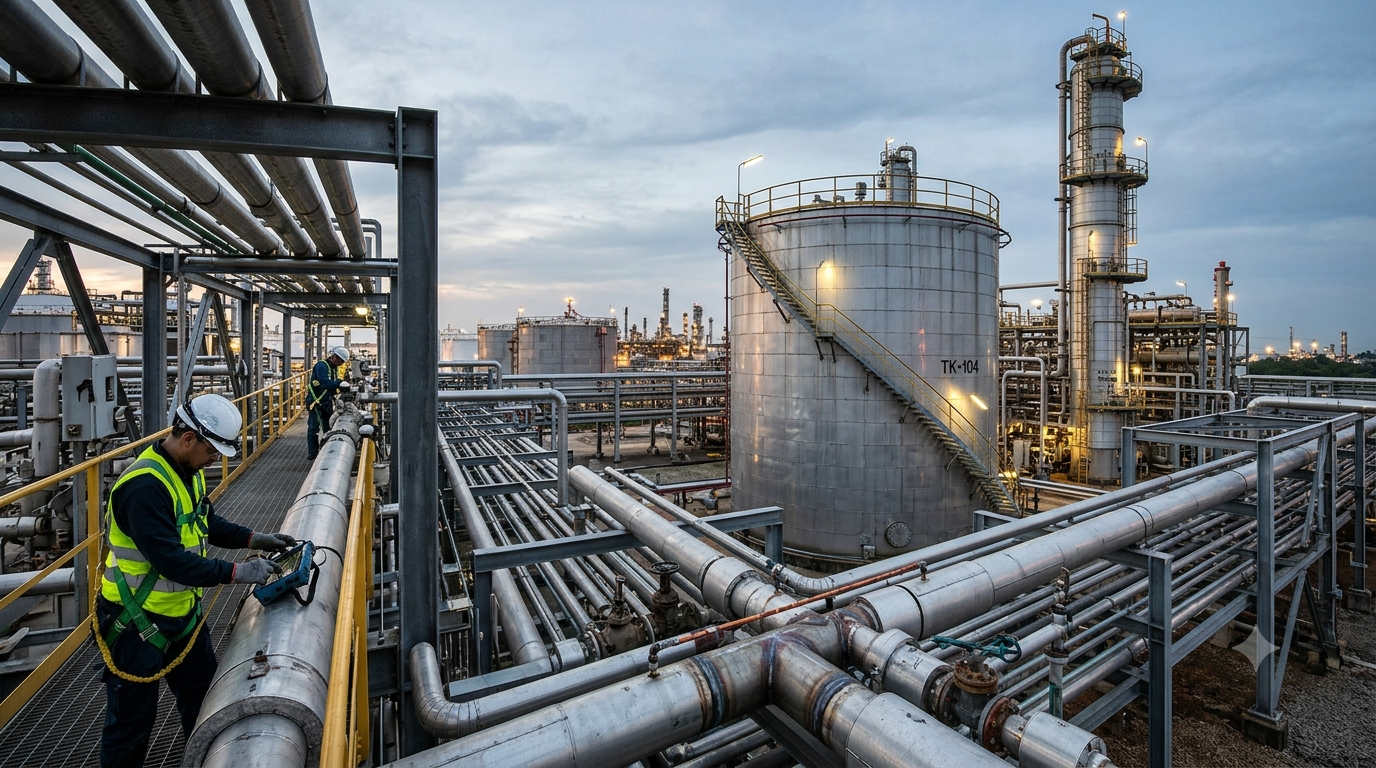
Piping systems, pressure vessels, storage tanks, and boilers are essential components of industries such as oil and gas, petrochemicals, power generation, chemical processing, and manufacturing. These systems transport fluids, store materials, and operate under different pressure and temperature conditions.
Over time, equipment can experience corrosion, erosion, cracking, vibration, fatigue, and other forms of damage. If these problems are not identified and managed properly, they can lead to leaks, unexpected shutdowns, equipment failure, environmental hazards, and serious safety incidents.
Failure prevention and fitness-for-service assessment help engineers determine whether equipment can continue operating safely, requires repair, or should be replaced. These methods also help companies manage maintenance costs and extend equipment life without compromising safety.
By applying appropriate engineering standards, inspection methods, and repair practices, industries can improve reliability and maintain the mechanical integrity of their facilities.
What Is Failure Prevention in Industrial Equipment?
Failure prevention is the process of identifying potential problems before they cause equipment breakdown or unsafe operating conditions. It involves proper design, material selection, inspection, operation, maintenance, and risk assessment.
Engineers must consider the operating pressure, temperature, fluid properties, corrosion risks, mechanical loads, and environmental conditions that affect equipment performance.
For example, a pipeline carrying corrosive chemicals may gradually lose wall thickness. Regular inspections can identify this damage before the remaining material becomes insufficient to withstand the operating pressure.
An effective failure prevention program includes:
Selecting materials suitable for the operating environment.
Following applicable engineering codes and standards.
Monitoring operating conditions and equipment performance.
Performing regular inspections and non-destructive testing.
Identifying damage mechanisms and their root causes.
Planning preventive and predictive maintenance.
Evaluating risks and implementing corrective actions.
These activities help reduce unexpected failures, improve plant availability, and protect personnel and equipment.
Common Causes of Piping and Pressure Vessel Failures
Industrial equipment can fail because of design errors, unsuitable materials, poor maintenance, incorrect operation, or progressive material degradation.
1. Corrosion and Erosion
Corrosion occurs when metal reacts with its surrounding environment, gradually reducing its thickness or damaging its surface. It may appear as uniform wall thinning, localized corrosion, or pitting.
Erosion occurs when flowing fluids, solid particles, or droplets gradually wear away the material. High flow velocities and changes in flow direction can increase erosion in piping systems.
Both mechanisms can weaken pressure boundaries and increase the risk of leakage or rupture.
2. Fatigue and Cracking
Fatigue develops when equipment experiences repeated loading or pressure and temperature cycles. Small cracks may grow over time until the component can no longer withstand the applied loads.
Cracking can also result from stress corrosion, welding defects, thermal stresses, or unsuitable material conditions.
Early detection is important because cracks may grow without causing obvious external damage.
3. Creep and Thermal Damage
Creep is the gradual deformation of materials subjected to sustained stress at elevated temperatures. It can affect boilers, process heaters, high-temperature piping, and other equipment operating under demanding conditions.
Repeated heating and cooling can also produce thermal fatigue. Engineers must evaluate operating temperatures, stress levels, material properties, and service duration to identify these risks.
4. Vibration and Pressure Transients
Mechanical vibration and flow-induced vibration can place repeated stresses on piping, supports, joints, and connected equipment. If the vibration approaches a system's natural frequency, resonance may increase the risk of damage.
Pressure transients, including water hammer, can create sudden pressure changes that exceed normal operating conditions. Proper hydraulic analysis, support design, operating procedures, and monitoring help reduce these risks.
What Is Fitness-for-Service (FFS) Assessment?
Fitness-for-service (FFS) is an engineering evaluation used to determine whether damaged or deteriorated equipment remains suitable for continued operation under specified conditions.
Instead of replacing every component that shows damage, engineers assess the type, size, location, and severity of the defect. They also consider material properties, operating conditions, inspection results, and applicable acceptance criteria.
The assessment helps answer three important questions:
Can the equipment continue operating safely?
Is repair or modification necessary before further operation?
Should the equipment be replaced because the risk is unacceptable?
API 579-1/ASME FFS-1 provides established methods for evaluating different types of damage in pressure vessels, piping, and storage tanks.
Levels of Fitness-for-Service Assessment
FFS assessments generally use different levels of analysis depending on the complexity of the damage and the information available.
Level 1 assessment: This is a relatively straightforward screening method that uses predefined criteria and conservative assumptions. It is useful for evaluating suitable damage cases when the available inspection data meet the required conditions.
Level 2 assessment: This involves more detailed calculations and engineering analysis. It may require additional information about material properties, operating conditions, stress distribution, and defect dimensions.
Level 3 assessment: This is an advanced evaluation used for complex damage cases that cannot be adequately assessed using simpler methods. It may involve detailed stress analysis, numerical modelling, and specialized engineering expertise.
The appropriate assessment level depends on the damage mechanism, available data, applicable standards, and the consequences of failure.
Risk-Based Inspection for Industrial Equipment
Risk-based inspection (RBI) is a systematic approach used to prioritize inspection activities according to the likelihood and consequences of equipment failure.
Rather than inspecting every component at the same frequency, engineers identify equipment that presents greater risk and allocate inspection resources accordingly.
The process generally includes identifying equipment, reviewing operating history, evaluating possible damage mechanisms, estimating failure likelihood, assessing consequences, and developing inspection plans.
Importance of Risk-Based Inspection
RBI provides several benefits:
Helps prioritize critical equipment.
Supports better inspection planning and resource allocation.
Identifies areas requiring more frequent monitoring.
Reduces unnecessary inspections where justified by the assessment.
Improves plant safety and equipment reliability.
For example, a pipeline carrying corrosive fluid may require more frequent thickness measurements than a similar pipeline operating in a less aggressive environment.
RBI does not eliminate the need for inspection or override mandatory inspection requirements. It helps establish a technically justified inspection strategy within applicable regulations and company procedures.
Inspection Methods for Detecting Equipment Damage
Accurate inspection data are essential for assessing equipment condition and making reliable maintenance decisions.
Visual Inspection
Visual inspection identifies visible signs of corrosion, leakage, deformation, coating damage, damaged supports, and other surface conditions. It is often an initial step in equipment assessment.
Ultrasonic Testing (UT)
Ultrasonic testing measures material thickness and can help detect internal defects. It is commonly used to evaluate wall thinning in piping, pressure vessels, and storage tanks.
Radiographic Testing (RT)
Radiographic testing uses radiation to examine internal features and identify certain defects, particularly in welds and components, depending on the technique and application.
Magnetic Particle and Liquid Penetrant Testing
Magnetic particle testing detects surface and near-surface discontinuities in suitable ferromagnetic materials. Liquid penetrant testing identifies surface-breaking defects in non-porous materials.
Selecting the correct inspection method depends on the material, defect type, component geometry, accessibility, and required detection capability.
Repair and Life Extension of Piping, Vessels and Tanks
When an assessment identifies damage, engineers must determine whether repair, continued monitoring, operating changes, or replacement is the most appropriate action.
The decision should consider technical feasibility, safety, equipment condition, remaining service life, downtime, and overall cost.
Welded Repairs
Welded repairs may be suitable for certain damaged components when the material condition, defect characteristics, and repair procedure allow safe restoration.
These repairs require appropriate engineering assessment, qualified welding procedures, suitable personnel, and the necessary examination and testing.
Mechanical Repairs
Mechanical repair methods can restore or maintain the integrity of selected components without relying exclusively on welding. Their suitability depends on the type of damage, pressure and temperature conditions, fluid service, and applicable requirements.
Composite Wrap Repairs
Engineered composite systems may be used for certain piping defects, including selected wall-thinning conditions. Their use requires careful evaluation of the damage, operating environment, design limitations, and installation requirements.
ASME PCC-2 provides recognized guidance for repair methods used on pressure equipment and piping. The repair technique must be selected according to the specific application and applicable engineering requirements.
Remaining Life Assessment
Remaining life assessment estimates how long equipment may continue operating before a defined damage condition or acceptance limit is reached.For example, corrosion rate calculations can help estimate future wall thickness when sufficient historical inspection data are available and the assumptions are appropriate.However, remaining life is not simply a fixed number of years. Changes in operating conditions, damage progression, inspection uncertainty, and other degradation mechanisms can affect the result.Engineers should establish suitable inspection intervals and operating limits based on the assessment findings.
Important Engineering Codes and Standards
Engineering codes and standards provide structured requirements and methods for designing, inspecting, evaluating, and repairing industrial equipment.
Key standards and documents include:
ASME B31 series: Covers requirements for different types of piping systems, including power and process piping.
ASME Boiler and Pressure Vessel Code, Section VIII: Addresses the construction of pressure vessels.
API 579-1/ASME FFS-1: Provides methodologies for fitness-for-service assessments of equipment containing flaws or damage.
ASME PCC-2: Covers repair methods for pressure equipment and piping.
National Board Inspection Code (NBIC): Provides guidance related to inspection, repairs, and alterations of pressure-retaining items within its scope.
API 571: Addresses damage mechanisms affecting fixed equipment in the refining and related process industries.
API 580: Provides a framework for risk-based inspection programs.
Engineers must verify the applicable editions, jurisdictional requirements, and equipment-specific standards before making technical decisions.
Benefits of Failure Prevention and Equipment Life Extension
A structured equipment integrity program offers significant operational and financial benefits.
Improved safety: Early detection and evaluation of damage help reduce the likelihood of leaks, ruptures, and hazardous releases.
Lower maintenance costs: Appropriate repair and monitoring decisions can prevent unnecessary equipment replacement and reduce emergency maintenance expenses.
Reduced downtime: Planned inspections and repairs help avoid unexpected shutdowns and production interruptions.
Better asset utilization: Reliable assessments allow companies to use existing equipment effectively while respecting safety limits.
Improved decision-making: Combining inspection results, engineering calculations, operating history, and risk assessments provides a stronger basis for maintenance planning.
Conclusion
Failure prevention, fitness-for-service assessment, repair, and life extension are essential parts of industrial asset integrity management. They help engineers identify damage, evaluate equipment condition, determine acceptable operating limits, and select appropriate corrective actions.By combining suitable inspection techniques, risk-based inspection planning, engineering calculations, and recognized standards, organizations can make informed decisions about whether to continue operating, repair, or replace damaged equipment.For mechanical, piping, inspection, maintenance, and reliability engineers, these skills are particularly valuable in oil and gas, petrochemical, power generation, and other process industries. A systematic approach to equipment integrity supports safer operations, improved reliability, and more effective use of industrial assets.
