

Article details
A standard VAV box can only do one thing with air: throttle the supply air it receives from the central system. A fan powered terminal adds a second source, the warm air sitting in the ceiling plenum, and a small fan to pull it in. There are two ways to arrange that fan, in series with the primary air or in parallel with it, and the choice changes how the box behaves, how much energy it uses, how it sounds, and where it fits.
What a Fan Powered Terminal Adds
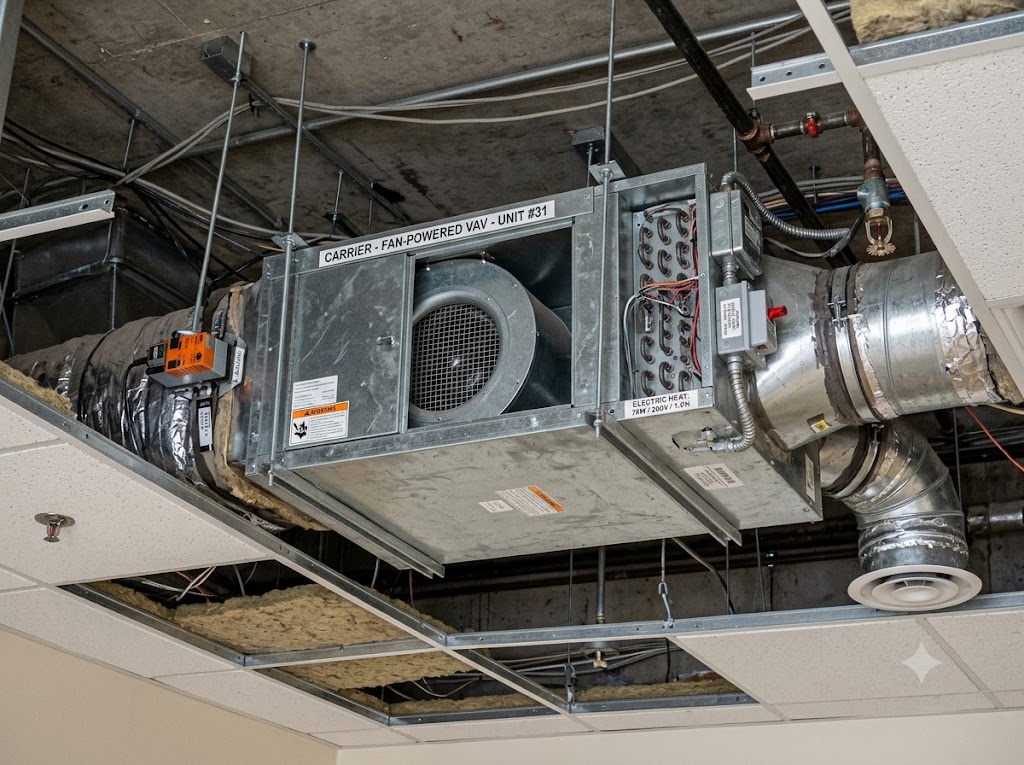
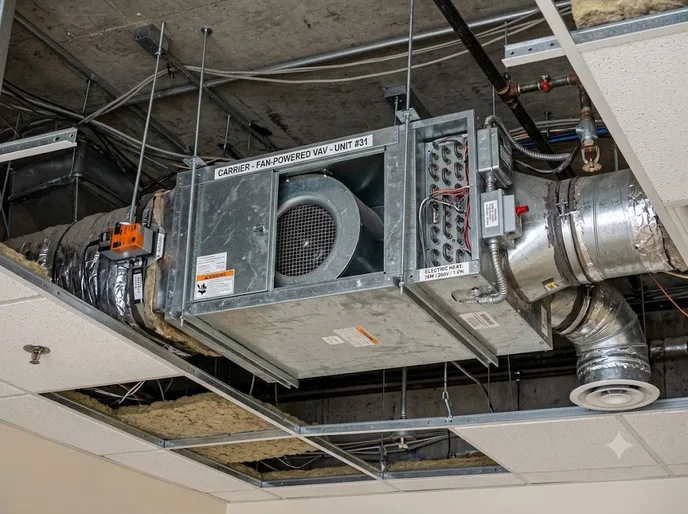
A fan powered terminal is a VAV box with an integral fan, a connection to the ceiling plenum, and usually a heating coil. The plenum air is the reason for the fan. Lights, equipment, and heat flowing in from the occupied space warm the plenum, so air drawn from it is a source of heat that would otherwise be wasted. Mixing that air with cool primary air lets the box warm a zone before it ever needs to switch on a coil, which is how the terminal recovers heat that a standard single duct box simply throws away.
Parallel Terminals: The Fan Joins Only for Heating
In a parallel unit, the fan sits in a path parallel to the primary air. During cooling, the unit behaves like an ordinary single duct VAV box, with the fan off. A backdraft damper on the fan inlet stays closed so primary air cannot flow backward through the idle fan and escape into the plenum.
When the zone needs heat, the primary damper reduces toward its minimum, the fan is energized in sequence, and it draws warm plenum air in and mixes it with the primary air. If that is not enough, the heating coil adds more. Because the fan only runs for heating, it moves the heating airflow, which is typically smaller than the cooling airflow, so the fan can be smaller than the fan in a series unit. The tradeoff is that the primary air must supply enough pressure to open the backdraft damper.
Since the fan runs intermittently, parallel units are often called variable volume units.
Series Terminals: The Fan Never Stops
In a series unit, the fan is in line with the primary air damper, and everything leaving the box passes through it. The fan runs continuously during occupied hours, so the zone receives a constant volume of air regardless of cooling or heating demand. What changes is the mix. As the primary air is throttled back, the fan draws in more plenum air to make up the difference, so the volume stays steady while the temperature varies.
A series box does not need a backdraft damper, because the fan always runs. It also boosts the pressure of both the primary and the induced air, a useful property in retrofits where extra static pressure is needed at the zone. The cost is a larger fan, since it must handle the full supply volume and not just the heating airflow.
Series units are sometimes called constant volume units, and their heating sequence mirrors a standard box: the primary damper goes to its minimum, the fan draws plenum air, and a coil adds heat if the plenum air is not warm enough.
A Side-by-Side Comparison
Aspect | Parallel | Series |
|---|---|---|
Fan operation | Intermittent, on for heating | Continuous in occupied hours |
Airflow to zone | Varies | Constant |
Fan size | Sized for heating airflow | Sized for full supply airflow |
Backdraft damper | Required | Not needed |
Noise | Intermittent | Constant |
Added static pressure | Primary air only | Boosts primary and induced air |
The Energy Question
It seems obvious that the parallel unit saves energy, since its fan runs only part of the time. In practice the answer is less clear. A manufacturer technical guide notes that the central issue in choosing between the two is the energy efficiency of the unit within the overall system, and that the savings from intermittent fan operation in parallel units can be offset in some circumstances. Motor type is a major variable. Fan assemblies using electronically commutated motors can operate as a pressure independent, constant volume assembly and draw considerably less power than older motor types, which narrows the gap between series and parallel operation. Critics of constantly running fans argue that a series fan sized for full volume wastes energy when its full capacity is rarely needed.
The honest summary is that parallel units start with a structural advantage, but the real comparison depends on fan sizing, motor technology, and the building's heating hours.
Noise and Comfort
Parallel units have an acoustic disadvantage: the fan switching on and off is audible and can be distracting. Series units run constantly, which produces a steady background sound that is less noticeable than intermittent noise. Constant airflow can also be a comfort advantage, because series units keep air moving and maintain consistent diffuser performance even at low cooling loads.
Where Each Fits
Parallel units are very common in perimeter zones and in buildings in cold climates, where frequent heating makes plenum air heat valuable. They are generally considered the ideal choice for perimeter control, where the fan runs rarely enough that intermittent operation pays off.
Series units suit applications that need constant air movement or blending, constant noise levels, or where retrofit applications need extra static pressure from the terminal. Public areas with tall ceilings are cited as good candidates, and so are spaces with stringent ventilation requirements.
Neither may be the right answer in mild climates. In those regions, perimeter heating is rarely needed, and a standard VAV box with a reheat coil often provides all the heat the zone needs at lower cost. Fan powered terminals can also be used in underfloor air distribution systems, where they mix and heat air near the perimeter.
The Practical Takeaway
A fan powered terminal adds plenum air and a fan to a VAV box. In a parallel unit, the fan comes on only for heating, which keeps the fan small and the energy low but introduces intermittent noise and a backdraft damper. In a series unit, the fan runs continuously and delivers constant volume, which gives steady air movement and extra static pressure at the cost of a larger fan and a steady energy draw. Choosing between them means weighing heating hours, acoustics, ventilation needs, and motor efficiency, not just the idea that a fan which is off must be saving energy.
EveryEng. For everyone in Engineering.
