



Article details
Introduction to Hot Air Balloon Lifting Force
Hot air balloons are a fascinating application of physics and thermodynamics. They rise into the atmosphere by using the buoyant force generated when air inside the balloon is heated. Understanding the lifting force of a hot air balloon is essential for estimating its payload capacity, determining the required air temperature, and evaluating the factors that influence its ability to rise.
The lifting force depends mainly on the balloon's volume, the temperature difference between the internal and surrounding air, and atmospheric conditions.
How Does a Hot Air Balloon Generate Lift?
A hot air balloon operates on the principle of buoyancy, also known as Archimedes' principle. When the burner heats the air inside the balloon's envelope, the air expands and its density decreases.
The surrounding cooler air is denser and exerts an upward buoyant force on the balloon. When this force exceeds the combined weight of the balloon structure, basket, burner, fuel, passengers, and other equipment, the balloon can ascend.
As the air inside cools, its density increases, reducing the lifting force. Pilots regulate the internal temperature to manage altitude while following the balloon's operating procedures.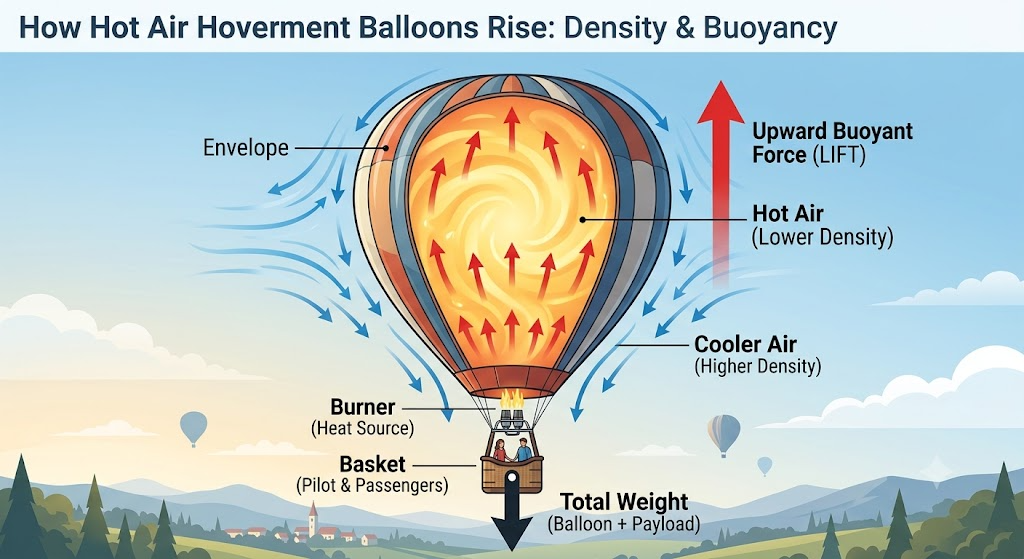
Factors Affecting Hot Air Balloon Lifting Force
Several factors determine the lifting capacity of a hot air balloon.
1. Balloon Volume
The envelope volume determines how much surrounding air the balloon displaces. A larger balloon generally produces greater buoyant force when other conditions remain constant.
2. Internal Air Temperature
Heating the air inside the envelope reduces its density. A greater temperature difference between the internal and external air generally increases the available lift. However, the envelope's maximum permitted operating temperature must never be exceeded.
3. Ambient Air Temperature
The temperature of the surrounding atmosphere influences air density. Colder ambient air is generally denser, which can increase the lifting capacity compared with warmer conditions, assuming other variables remain constant.
4. Atmospheric Pressure and Altitude
Atmospheric pressure decreases with altitude, affecting air density and the balloon's lifting performance. Therefore, launch elevation and changing atmospheric conditions should be considered when estimating lift.
5. Balloon Weight and Payload
The envelope, basket, burner, fuel cylinders, passengers, and additional equipment all contribute to the total mass. The lift available for carrying passengers and equipment must account for these weights.
Hot Air Balloon Lifting Force Formula
The lifting force can be calculated using the difference between the density of the surrounding air and the heated air inside the envelope.
Formula:
[
F_b=(\rho_o-\rho_i)\times V\times g
]
Where:
(F_b) = net buoyant force before subtracting balloon structure weight (N)
(\rho_o) = density of outside air (kg/m³)
(\rho_i) = density of heated air inside the envelope (kg/m³)
(V) = balloon envelope volume (m³)
(g) = gravitational acceleration, approximately 9.81 m/s²
The density of air can be estimated using the ideal gas relationship:
[
\rho=\frac{P}{R T}
]
Here, (P) represents absolute pressure, (R) is the specific gas constant for dry air, and (T) is absolute temperature in kelvin.
These equations help engineers estimate the buoyant force under specified atmospheric and temperature conditions.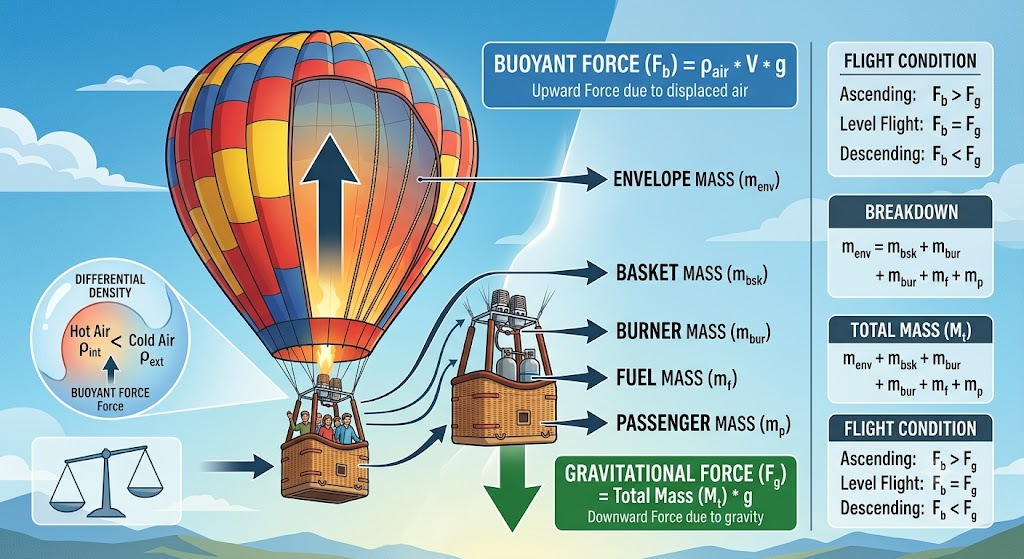
How to Calculate Balloon Payload Capacity
To estimate the available payload, first calculate the buoyant force and convert it into an equivalent lifting mass by dividing by gravitational acceleration.
Then subtract the mass of the envelope, basket, burner, fuel, and other essential equipment.
The remaining capacity represents the estimated mass available for passengers and additional loads. Actual operating limits, safety margins, fuel consumption, and the balloon manufacturer's flight manual must also be considered.
Applications of Hot Air Balloon Lift Calculations
Lifting force calculations are useful in aerostatics education, balloon design studies, thermodynamics experiments, and preliminary performance estimation. They also demonstrate how gas density, temperature, and pressure influence buoyancy.
Engineers and students can use these calculations to compare different envelope volumes, evaluate temperature requirements, and understand the relationship between payload and available lift.
Conclusion
The lifting force of a hot air balloon results from the density difference between heated air inside the envelope and cooler surrounding air. Balloon volume, air temperature, atmospheric pressure, and total mass all influence its lifting capacity.
Understanding these principles provides a foundation for calculating buoyancy and estimating payload requirements. However, theoretical calculations are not a substitute for approved flight procedures, manufacturer specifications, or professional assessment of actual flying conditions.
