


Article details
Introduction
Noise control is an important part of Heating, Ventilation, and Air Conditioning (HVAC) system design. HVAC systems provide indoor comfort by controlling temperature, humidity, and air quality. However, components such as fans, compressors, motors, ducts, and air terminals can generate unwanted noise and vibrations.
HVAC noise attenuation is the process of reducing sound as it travels through equipment, ductwork, and building spaces. Effective noise control improves occupant comfort, supports productivity, and helps create a quieter indoor environment in residential, commercial, and industrial buildings.
What Is HVAC Noise Attenuation?
HVAC noise attenuation refers to the reduction of sound intensity as it travels from its source to a receiving area. It can be achieved by absorbing sound energy, blocking sound transmission, reducing vibrations, or interrupting the path through which noise travels.
For example, a ventilation fan may produce noise that travels through an air duct and reaches an occupied office. Installing a suitable sound attenuator or acoustic lining can reduce the noise transmitted through the duct.
Noise attenuation is not the same as completely eliminating sound. Instead, it aims to reduce noise to an acceptable level while maintaining the required airflow and system performance.
Common Sources of HVAC Noise
Understanding the source of noise is the first step toward selecting an effective control method.
Fans and Blowers
Fans and blowers generate noise due to rotating blades, airflow turbulence, motor operation, and mechanical imbalance. High rotational speeds and poorly selected fan sizes can increase sound levels.
Compressors and Motors
Compressors in air conditioning and refrigeration systems can produce mechanical noise, vibration, and low-frequency sound. Motors may also generate humming and tonal noise during operation.
Ductwork and Airflow
Air moving through ducts can create turbulence, especially at bends, dampers, grilles, and sudden changes in duct dimensions. Excessive air velocity can increase noise, while poorly designed transitions may create additional turbulence.
Vibration and Structural Transmission
Equipment vibrations can travel through mounting frames, floors, walls, and connected pipes. These vibrations may cause building surfaces to radiate sound into occupied spaces.
Air Terminals and Dampers
Diffusers, grilles, and control dampers can generate noise when air passes through them at high velocities or under excessive pressure differences.
How Sound Attenuation Works
Sound attenuation depends on several physical mechanisms. The most suitable method depends on the frequency of the noise, its source, the transmission path, and the acoustic requirements of the building.
Sound Absorption
Sound-absorbing materials convert some sound energy into small amounts of heat through friction and internal material movement. Acoustic insulation, mineral wool, and specially designed foam materials may be used in suitable HVAC applications.
Absorption is particularly useful for reducing sound reflections and controlling noise inside ductwork or equipment enclosures. Its effectiveness varies with material thickness, density, installation, and sound frequency.
Sound Blocking
Sound blocking reduces the transmission of sound from one space to another. Dense barriers, insulated equipment enclosures, and properly sealed partitions can help limit the passage of airborne noise.
Unlike absorption, which reduces reflected sound energy, sound blocking relies mainly on the barrier's ability to resist sound transmission.
Vibration Isolation
Vibration isolation reduces the transfer of mechanical vibration from equipment to the building structure. Rubber mounts, spring isolators, flexible connectors, and resilient supports can help prevent fans, pumps, and compressors from transmitting vibration into floors and walls.
Correct selection and installation are essential because an unsuitable isolator may provide limited noise reduction.
Sound Attenuation Through Ducts
Duct silencers, acoustic liners, and specially designed duct sections reduce sound travelling through ventilation systems. Their performance depends on the silencer design, length, cross-sectional area, airflow conditions, and frequency range.
Common HVAC Noise Attenuation Methods
1. Duct Silencers
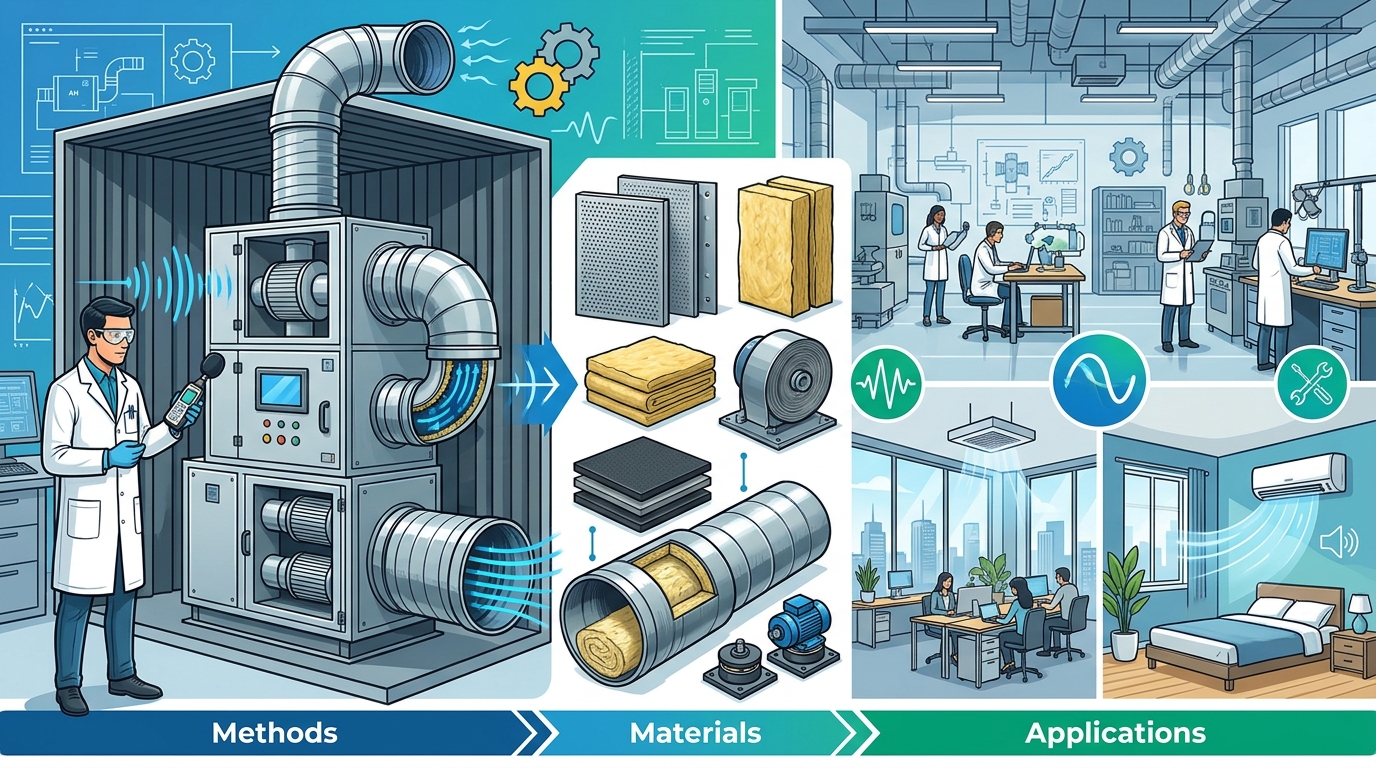
Duct silencers, also called sound attenuators, are installed in ventilation ducts to reduce transmitted noise. They commonly use sound-absorbing elements or engineered internal passages to attenuate sound while allowing air to flow.
They are useful near air handling units, fans, and other noise-producing equipment. Engineers must consider pressure drop, available space, airflow requirements, and the required attenuation when selecting a silencer.
2. Acoustic Duct Lining
Acoustic lining consists of sound-absorbing material installed inside suitable duct sections. It helps reduce sound energy as noise travels along the duct.
The lining must be compatible with the operating environment, airflow velocity, hygiene requirements, and applicable fire-safety standards. Poorly selected or installed lining may create maintenance and indoor air-quality concerns.
3. Equipment Enclosures
Acoustic enclosures surround noisy equipment with materials designed to absorb sound and limit its transmission. They are often used around compressors, generators, fans, and mechanical plant equipment.
Enclosures must provide sufficient ventilation and access for inspection and maintenance. Overheating, restricted cooling airflow, and difficult servicing should be avoided.
4. Flexible Connectors and Isolators
Flexible duct connectors and vibration isolators help prevent mechanical vibration from travelling through the building structure or connected ductwork.
These components are particularly important for rotating equipment. Proper alignment, mounting, and maintenance also help reduce vibration-related noise.
5. Improved Duct Design
Good duct design can reduce noise before additional acoustic treatment becomes necessary. Smooth transitions, appropriately sized ducts, gradual bends, and well-selected dampers help reduce turbulence and excessive pressure losses.
Maintaining suitable air velocities is also important. Undersized ducts may cause high airflow noise, while poorly positioned components can create unnecessary turbulence.
Measuring Noise Attenuation
Noise attenuation is commonly expressed in decibels (dB). Sound pressure levels can be measured using appropriate sound-level meters, while frequency analysis helps identify the characteristics of the noise.
The difference between sound levels before and after a treatment can provide an initial indication of attenuation when measurements are made under comparable conditions.
For example, if the measured sound level decreases from 80 dB to 70 dB, the reduction is 10 dB. This represents a substantial decrease in sound pressure level, although perceived loudness does not change in a simple linear relationship with decibels.
Engineers may also use frequency-specific attenuation data to determine whether a silencer or acoustic material performs effectively across the frequencies produced by the HVAC equipment.
Factors Affecting Attenuation Performance
Several factors influence how effectively an HVAC system controls noise.
Sound frequency: Low-frequency noise is generally more difficult to control than many high-frequency sounds and may require different treatment methods.
Material properties: Density, thickness, absorption characteristics, and construction affect acoustic performance.
Airflow velocity: High air velocities can generate additional noise and reduce the practical benefits of acoustic treatment.
Installation quality: Gaps, poor seals, rigid connections, and incorrect mounting can create sound transmission paths.
Pressure drop: Acoustic components must reduce noise without imposing excessive resistance to airflow.
System maintenance: Worn bearings, loose components, dirty filters, and unbalanced fans can increase noise over time.
Applications of HVAC Noise Attenuation
HVAC noise attenuation is important across many building types.
In residential buildings, it helps reduce disturbance from air conditioners, ventilation fans, and indoor air distribution systems. In offices and commercial buildings, it supports concentration, communication, and occupant comfort.
Hospitals and healthcare facilities require careful noise management to support rest and suitable indoor environments. Hotels, schools, libraries, and auditoriums also benefit from quieter ventilation systems.
Industrial facilities may require acoustic enclosures, silencers, and vibration isolation to manage noise from large fans, compressors, and mechanical equipment.
Best Practices for HVAC Noise Control
Effective noise management should begin during the design stage rather than after installation. Engineers should identify likely noise sources, assess transmission paths, and select equipment based on both performance and acoustic requirements.
Fan selection, duct sizing, equipment placement, and vibration isolation should be considered together. Acoustic silencers and lining should be selected according to the required frequency range and available pressure budget.
After installation, commissioning measurements can help verify performance. Regular maintenance, including fan balancing, bearing inspection, and checking flexible connections, helps maintain noise control throughout the system's service life.
Conclusion
HVAC noise attenuation is essential for creating comfortable, efficient, and acoustically suitable indoor environments. It combines sound absorption, sound blocking, vibration isolation, duct silencers, and improved system design to reduce unwanted noise.
By identifying noise sources early, choosing appropriate acoustic materials, maintaining suitable airflow, and inspecting equipment regularly, engineers can achieve effective noise control without compromising HVAC performance. A well-designed attenuation strategy improves the overall quality of residential, commercial, healthcare, and industrial spaces.
