

Article details
Introduction
Electric motors are essential components in industrial machinery, manufacturing plants, HVAC systems, pumps, compressors, and automation equipment. To ensure reliable performance, motors are designed and manufactured according to established standards. Two widely used standards are IEC (International Electrotechnical Commission) and NEMA (National Electrical Manufacturers Association).
Both standards define important motor characteristics, including dimensions, performance, torque, efficiency, and operating requirements. However, they differ in their design approach, classification methods, frame sizes, and regional applications.
Understanding IEC vs NEMA motor standards helps engineers, maintenance professionals, and equipment buyers select suitable motors, plan replacements, and ensure compatibility with existing machinery.
What Are IEC Motor Standards?
IEC motor standards are developed by the International Electrotechnical Commission. They are widely used across Europe, Asia, Africa, and many other international markets.
IEC standards establish common technical requirements for electrical motors, helping manufacturers and equipment users work with consistent specifications. IEC 60034 is a major series of standards covering rotating electrical machines.
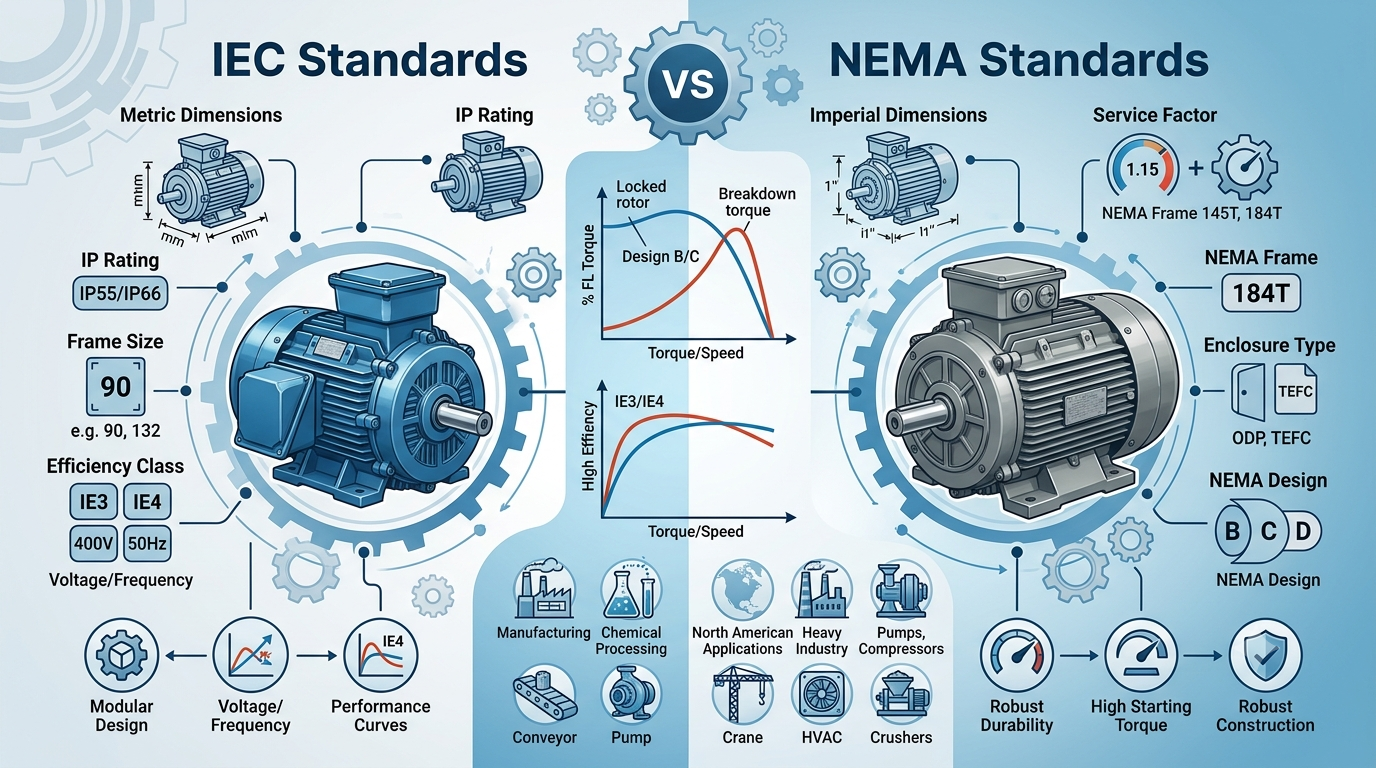
IEC motors generally use metric measurements, such as millimetres, for mounting dimensions and frame specifications. Their standardized frame sizes help simplify equipment design and motor selection across different manufacturers.
IEC motor specifications commonly cover:
Rated power, voltage, frequency, and current
Frame dimensions and mounting arrangements
Starting performance and torque characteristics
Temperature rise and insulation requirements
Efficiency and operating performance
Protection ratings and cooling methods
These standards are particularly useful in international projects where equipment may be sourced from multiple countries.
What Are NEMA Motor Standards?
NEMA motor standards are established by the National Electrical Manufacturers Association, an organization based in the United States. NEMA standards are widely used in North America and in industrial facilities that follow American electrical engineering practices.
NEMA MG 1 is a key standard covering the design, performance, construction, and testing of motors and generators.
NEMA motors commonly use imperial measurements, including inches, for frame dimensions and mounting arrangements. Their specifications also provide established performance requirements for applications involving different starting loads and operating conditions.
Important NEMA motor characteristics include:
Rated horsepower, voltage, and speed
Standardized frame and shaft dimensions
Starting torque and breakdown torque
Locked-rotor current and operating characteristics
Insulation and temperature-rise limits
Efficiency, service factor, and enclosure requirements
NEMA standards are widely applied in manufacturing plants, industrial machinery, commercial buildings, and process facilities throughout North America.
Key Differences Between IEC and NEMA Motors
Although IEC and NEMA motors perform similar functions, their standards differ in several important areas. These differences influence motor selection, installation, maintenance, and replacement.
Feature | IEC Motors | NEMA Motors |
|---|---|---|
Standard | IEC 60034 series | NEMA MG 1 |
Common regions | Europe, Asia, Africa, and international markets | USA and North America |
Measurement system | Metric | Primarily imperial |
Power rating | Kilowatts (kW) | Horsepower (HP) |
Frame designation | Usually based on shaft height in millimetres | Uses standardized frame codes |
Mounting arrangements | B3, B5, B14, and other configurations | Standardized foot, C-face, and D-flange arrangements |
Efficiency classification | IE efficiency classes | NEMA nominal and Premium efficiency classifications |
Torque classification | Defined through IEC performance requirements | Defined through NEMA design classifications |
Interchangeability | Compatible with matching IEC specifications | Compatible with matching NEMA specifications |
The exact motor specifications depend on the applicable standard, motor type, power rating, and operating conditions.
Differences in Motor Frame Sizes and Dimensions
Motor frame size is one of the most important differences between IEC and NEMA motors. It determines the motor's physical dimensions and affects how the motor fits into a machine or mounting structure.
IEC Frame Sizes
IEC motors generally use a frame designation related to the shaft centre height, measured in millimetres from the mounting surface to the shaft centreline.
Common frame sizes include 80, 90, 100, 112, 132, 160, and 180. The frame designation helps engineers identify the motor's general mechanical size.
IEC motors also use mounting codes to indicate their installation arrangement. For example, B3 commonly refers to foot mounting, B5 to flange mounting, and B14 to face mounting.
NEMA Frame Sizes
NEMA motors use frame designations such as 56, 143T, 184T, 213T, and 256T. These codes belong to the NEMA dimensional system and help identify the applicable motor frame configuration.
The frame designation is associated with standardized mounting and shaft dimensions, with the applicable requirements depending on the motor design.
Why Dimensions Matter
An IEC motor and a NEMA motor with similar power ratings may have different shaft diameters, shaft extension lengths, mounting-hole spacing, and flange dimensions.
Therefore, engineers should not assume that a motor can be replaced solely because its power rating and speed are similar. The complete dimensional drawing must be checked before installation.
IEC vs NEMA Motor Torque Standards
Torque is the rotational force produced by a motor to drive a connected load. It is essential for applications such as conveyors, pumps, compressors, mixers, and industrial machinery.
Both IEC and NEMA standards specify motor performance characteristics, including starting torque and other torque-related requirements. However, their classifications and test requirements are not identical.
Starting Torque
Starting torque is the torque produced when a motor begins rotating from rest. Applications involving heavy loads may require high starting torque to overcome inertia and initial resistance.
For example, a loaded conveyor may require a motor capable of producing sufficient starting torque to move the belt and its material.
Breakdown Torque
Breakdown torque is the maximum torque a motor can develop under specified operating conditions without losing stable operation. It indicates the motor's ability to withstand increased load before stalling or experiencing a significant speed reduction.
A suitable breakdown torque rating is important in machinery exposed to changing loads.
Pull-Up Torque
Pull-up torque refers to the minimum torque developed during acceleration from starting to the point where maximum torque occurs, within the applicable performance definitions.
It is particularly relevant when a motor must accelerate a load smoothly through its starting range.
Comparing IEC and NEMA Torque Ratings
NEMA induction motors are commonly classified using Design A, Design B, Design C, and other design categories, depending on their performance characteristics. IEC motors use corresponding performance classifications, including Design N and Design H for relevant squirrel-cage induction motors.
These categories can have broadly similar application purposes, but their requirements should not be assumed to be identical. Engineers should compare the actual motor data, including starting torque, breakdown torque, locked-rotor current, and acceleration requirements.
Differences in Efficiency and Electrical Performance
Motor efficiency indicates how effectively electrical input power is converted into mechanical output power. A more efficient motor generally reduces energy losses and operating costs.
IEC motors use international efficiency classes such as IE1, IE2, IE3, and IE4, with higher classes representing greater efficiency within the applicable classification system.
NEMA motors use efficiency classifications that include NEMA nominal efficiency and NEMA Premium efficiency.
Although some efficiency classes have broadly comparable performance levels, the classifications and test requirements are not always directly equivalent.
Electrical compatibility also requires attention. Supply voltage, frequency, phase, rated current, insulation, and starting method must match the application. For example, a motor designed for 50 Hz operation may behave differently when operated on a 60 Hz supply, depending on its design and ratings.
Engineers should always verify the motor nameplate and manufacturer specifications before connecting a motor to a power supply.
Can IEC and NEMA Motors Be Interchanged?
IEC and NEMA motors can sometimes be used in the same application, but they are not automatically interchangeable.
A replacement motor must meet both the electrical and mechanical requirements of the equipment. Even if two motors have similar power ratings and speeds, differences in shaft geometry, mounting dimensions, and performance may prevent direct replacement.
Before replacing an IEC motor with a NEMA motor, or vice versa, engineers should check:
Rated power, voltage, frequency, and speed
Starting torque and load requirements
Shaft diameter, extension length, and keyway dimensions
Foot-hole spacing and flange configuration
Enclosure, cooling, and protection requirements
Efficiency, duty rating, and operating environment
An adapter plate, a modified base, or a suitable coupling may sometimes be required. Any modification should preserve safe alignment and meet the equipment manufacturer's requirements.
How to Choose Between IEC and NEMA Motors
The right choice depends on the application, local requirements, equipment design, and availability of compatible replacement parts.
Choose an IEC Motor When:
The machine is designed around IEC specifications.
Metric frame dimensions and mounting arrangements are required.
The project follows international equipment standards.
The existing motor and spare-parts inventory use IEC specifications.
Choose a NEMA Motor When:
The machine follows North American design practices.
Existing mounting arrangements are based on NEMA dimensions.
The plant requires compatibility with NEMA-standard replacement motors.
The application follows relevant North American electrical and performance requirements.
For new equipment, selecting the applicable standard early in the design process simplifies motor procurement, installation, and maintenance.
