

Article details
Introduction
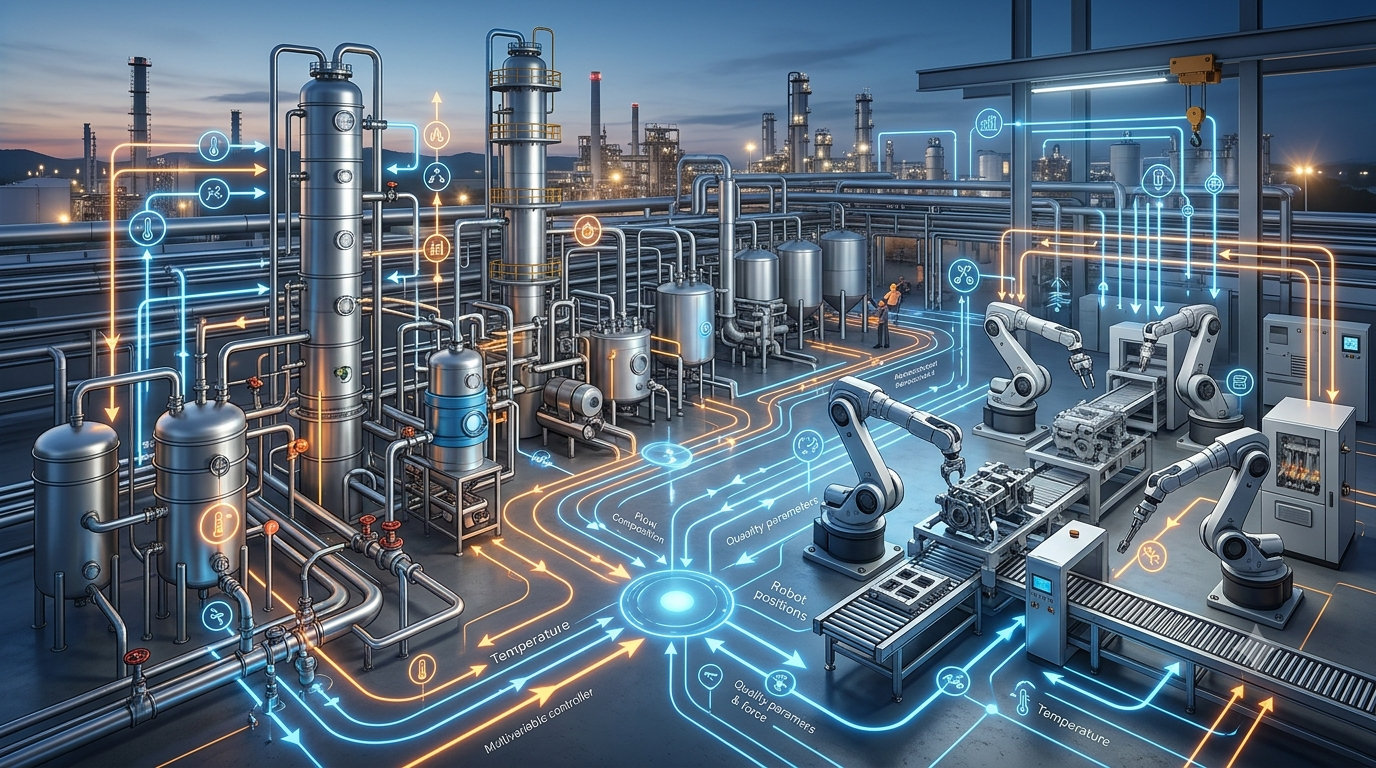
Modern industrial processes are becoming increasingly complex, with several operating variables influencing one another. In industries such as chemical processing, oil and gas, power generation, manufacturing, and aerospace, controlling one variable often affects multiple other variables. Traditional control methods may not always provide the required accuracy and stability in such situations.Multivariable control is an advanced control engineering approach designed to manage multiple input and output variables simultaneously. It considers the interactions between different process variables and helps maintain the desired operating conditions.This control strategy plays an important role in improving process efficiency, product quality, operational stability, and energy management. It is widely used in industries where several interconnected systems must operate together.
What Is Multivariable Control?
Multivariable control is a control system technique that manages multiple inputs and outputs within a single process. Unlike a conventional single-variable control system, which focuses on controlling one output using one input, multivariable control considers how different inputs influence several outputs.
For example, in a chemical processing plant, temperature, pressure, flow rate, and liquid level may all need to be controlled at the same time. Adjusting the flow rate may affect both temperature and pressure. A multivariable control system considers these relationships before making control adjustments.
The main objective is to achieve the desired performance of the entire process rather than controlling each variable independently.
Why Is Multivariable Control Important?
Industrial processes rarely operate with completely independent variables. Changes in one operating condition can influence several other conditions, making process control more challenging.
Multivariable control helps engineers address these challenges through coordinated control actions.
Some important reasons for using this approach include:
Better process stability: It reduces unwanted interactions between operating variables.
Improved accuracy: Multiple process outputs can be maintained closer to their desired values.
Higher productivity: Coordinated adjustments help maintain efficient operating conditions.
Reduced energy consumption: The system can optimize different operating parameters together.
Improved product quality: It maintains consistent process conditions during production.
Operational safety: It helps manage interconnected variables within defined operating limits.
These benefits make multivariable control an important part of modern industrial automation.
Basic Components of a Multivariable Control System
A multivariable control system consists of several interconnected elements that work together to monitor and regulate an industrial process.
1. Process Inputs
Inputs are the variables that engineers can adjust to influence the process. They are commonly called manipulated variables.
Examples include:
Control valve positions
Heating and cooling rates
Pump speeds
Feed flow rates
Motor operating speeds
2. Process Outputs
Outputs are the variables that need to be monitored and controlled. They are also known as controlled variables.
Common examples include temperature, pressure, flow rate, liquid level, and product composition.
3. Sensors and Transmitters
Sensors measure actual process conditions and provide information to the control system. Transmitters convert measured values into signals that can be processed by controllers.
Accurate measurement is essential for reliable control performance.
4. Controller
The controller receives process measurements, compares them with the desired setpoints, and calculates suitable control actions.
In multivariable systems, the controller considers the relationships between several inputs and outputs before determining adjustments.
5. Actuators and Final Control Elements
Actuators receive controller signals and make physical changes to the process. Examples include control valves, variable-speed drives, dampers, and motor-operated equipment.
Together, these components create a coordinated system that continuously monitors and regulates industrial operations.
How Does Multivariable Control Work?
Multivariable control works by continuously monitoring several process variables and coordinating adjustments to achieve the required operating conditions.
The process generally follows these steps:
Data collection: Sensors collect information about different process variables.
Signal processing: The control system receives and processes the measured values.
Setpoint comparison: Actual process values are compared with their desired setpoints.
Interaction analysis: The controller evaluates how changes in one input may affect other outputs.
Control calculation: Suitable control actions are calculated based on process requirements.
Process adjustment: Actuators and control valves make the required adjustments.
Continuous monitoring: The system checks the results and makes further corrections when necessary.
This continuous feedback process helps maintain stable operation even when disturbances or changing operating conditions affect the system.
Types of Multivariable Control Strategies
Different control strategies are used depending on process complexity, operating requirements, and the level of interaction between variables.
1. Decentralized Control
Decentralized control uses multiple individual controllers to manage different process variables. Each controller is assigned a specific input-output relationship.
For example, one controller may regulate temperature while another manages pressure.
This method is relatively simple to implement and is suitable for processes where interactions between control loops are limited.
2. Centralized Control
Centralized control uses a single coordinated control strategy to manage multiple inputs and outputs.
Instead of treating each variable independently, the controller considers the overall behaviour of the process.
This approach is useful in complex industrial systems where strong interactions exist between different operating parameters.
3. Decoupling Control
Decoupling control aims to reduce unwanted interactions between different control loops.
In a multivariable process, changing one manipulated variable may influence several controlled variables. Decoupling techniques compensate for these effects so that individual control objectives can be achieved with less interference.
Complete decoupling is not always practical, but reducing interactions can significantly improve system performance.
4. Model Predictive Control (MPC)
Model Predictive Control is an advanced control strategy widely used in multivariable industrial applications.
It uses a mathematical model of the process to predict future behaviour. Based on these predictions, the controller calculates suitable adjustments to manipulated variables.
MPC can consider multiple operating constraints, control objectives, and process interactions simultaneously.
It is particularly useful in industries where process conditions change continuously and several operating limits must be maintained.
5. Adaptive Multivariable Control
Adaptive control adjusts controller behaviour when process characteristics change.
Industrial equipment may experience changes due to operating conditions, equipment ageing, raw material variations, or environmental disturbances.
Adaptive control helps maintain suitable control performance by updating control parameters according to changing process behaviour.
Key Challenges in Multivariable Control
Although multivariable control provides several advantages, designing and implementing these systems requires careful engineering.
Some common challenges include:
1. Process Interaction
The biggest challenge is the interaction between inputs and outputs. A change in one variable can create unexpected effects in other parts of the process.
2. Mathematical Complexity
Multivariable systems require mathematical models that describe relationships between different process variables. Developing accurate models can require significant engineering effort.
3. Controller Tuning
Selecting suitable controller parameters is important for achieving stability and the required response speed. Poor tuning may cause oscillations, delays, or unstable operation.
4. Measurement Accuracy
Incorrect sensor readings can affect control calculations and lead to unsuitable adjustments.
5. Changing Operating Conditions
Industrial processes do not always operate under constant conditions. Changes in production rates, equipment performance, and external disturbances can affect the accuracy of process models.
6. Implementation Cost
Advanced controllers may require specialised software, instrumentation, skilled engineers, and additional computational resources.Engineers must consider these challenges during system design, testing, and commissioning.
Industrial Applications of Multivariable Control
Multivariable control is used across several engineering industries where multiple operating parameters must be managed together.
1. Chemical and Process Industries
Chemical plants involve interconnected variables such as temperature, pressure, flow rate, and chemical composition.
Multivariable control helps maintain reaction conditions, improve product consistency, and manage complex processing operations.
2. Oil and Gas Industry
Oil refineries and gas processing facilities use multivariable control to manage interconnected operations.
Applications include distillation columns, separation systems, heat exchangers, and gas processing units.
The control system helps maintain operating limits while improving production efficiency.
3. HVAC Systems
Heating, ventilation, and air conditioning systems involve multiple parameters, including temperature, humidity, airflow, and pressure.
Multivariable control helps coordinate heating, cooling, ventilation, and air distribution to maintain suitable indoor conditions.
4. Power Generation
Power plants require coordinated control of steam pressure, temperature, turbine speed, and other operating parameters.
Multivariable control helps maintain stable power generation and supports efficient equipment operation.
5. Manufacturing and Automation
Manufacturing processes often involve multiple machines, motors, production speeds, temperatures, and material flow rates.
Multivariable control helps coordinate these operations, improve production consistency, and reduce process disturbances.
Difference Between Single-Variable and Multivariable Control
Parameter | Single-Variable Control | Multivariable Control |
|---|---|---|
Control approach | Controls one output | Controls multiple outputs |
Inputs | Usually one manipulated input | Multiple manipulated inputs |
Process interaction | Generally limited | Considered during control |
System complexity | Relatively simple | More complex |
Controller design | Individual loop design | Coordinated controller design |
Applications | Simple process loops | Complex industrial processes |
Single-variable control is suitable for relatively independent processes, whereas multivariable control is more appropriate when several operating variables influence one another.
Benefits of Multivariable Control in Modern Engineering
Multivariable control contributes to better industrial performance by improving the coordination of interconnected process operations.
Its major benefits include:
Improved process efficiency: Coordinates multiple operating variables to achieve better performance.
Better production quality: Maintains consistent process conditions and reduces unwanted variations.
Reduced operating costs: Supports efficient resource and energy utilisation.
Improved equipment performance: Helps maintain operating parameters within acceptable limits.
Better disturbance management: Considers the combined effects of process changes.
Advanced automation: Supports integration with distributed control systems and industrial automation technologies.
These advantages make multivariable control valuable for industries looking to improve reliability, productivity, and operational efficiency.
Future Scope of Multivariable Control
The development of digital technologies is creating new opportunities for multivariable control systems.
Artificial intelligence, machine learning, digital twins, industrial IoT, and advanced process analytics are helping engineers improve process monitoring and control.Modern industrial systems are increasingly using real-time data to identify process changes, predict equipment behaviour, and improve control decisions.The integration of advanced algorithms with conventional control techniques is also creating opportunities for more flexible and responsive automation systems.As industrial operations become more interconnected, multivariable control will continue to play an important role in advanced process control and smart manufacturing.
Conclusion
Multivariable control is an important approach in modern control engineering because it manages multiple interconnected process variables through coordinated control actions.From chemical processing and oil refineries to HVAC systems, power generation, and manufacturing, it helps engineers maintain stable operating conditions and improve overall process performance.Understanding process interactions, controller design, decoupling techniques, and Model Predictive Control is essential for engineers working with complex industrial automation systems.As industries continue adopting advanced automation and digital technologies, multivariable control will remain an important part of efficient, reliable, and intelligent industrial operations.
